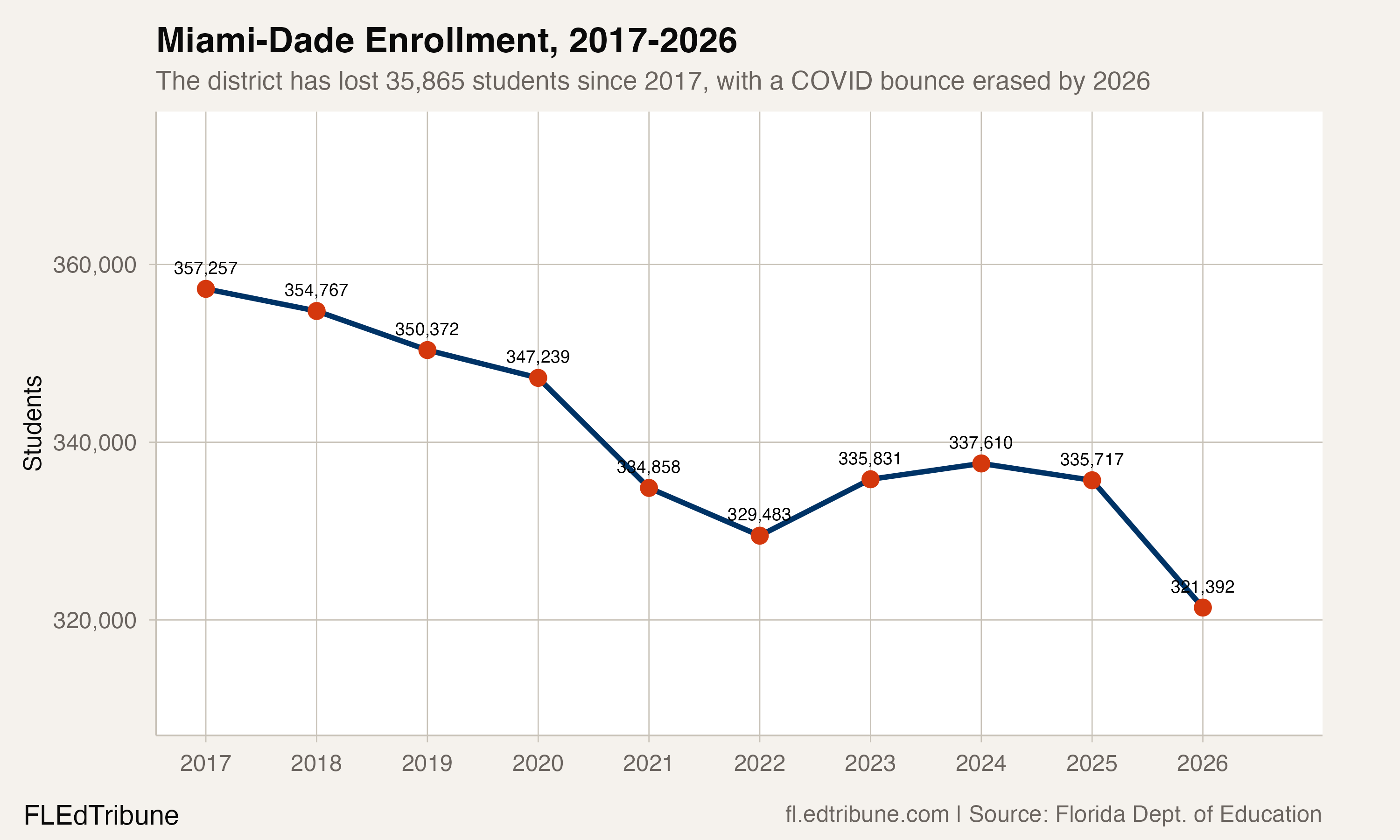
Miami-Dade↗ET enrolled 321,392 students in 2025-26. Nine years earlier, the figure was 357,257. The 35,865-student gap, a 10.0% decline, would fill every seat in a mid-sized Florida school district. What's new is the speed: 14,325 students disappeared from the rolls in a single year, a 4.3% drop that exceeds even the pandemic's toll.
Part of the Florida Enrollment 2026ET series.
RELATED: Florida Is 214,879 Students Below Where It Should BeET
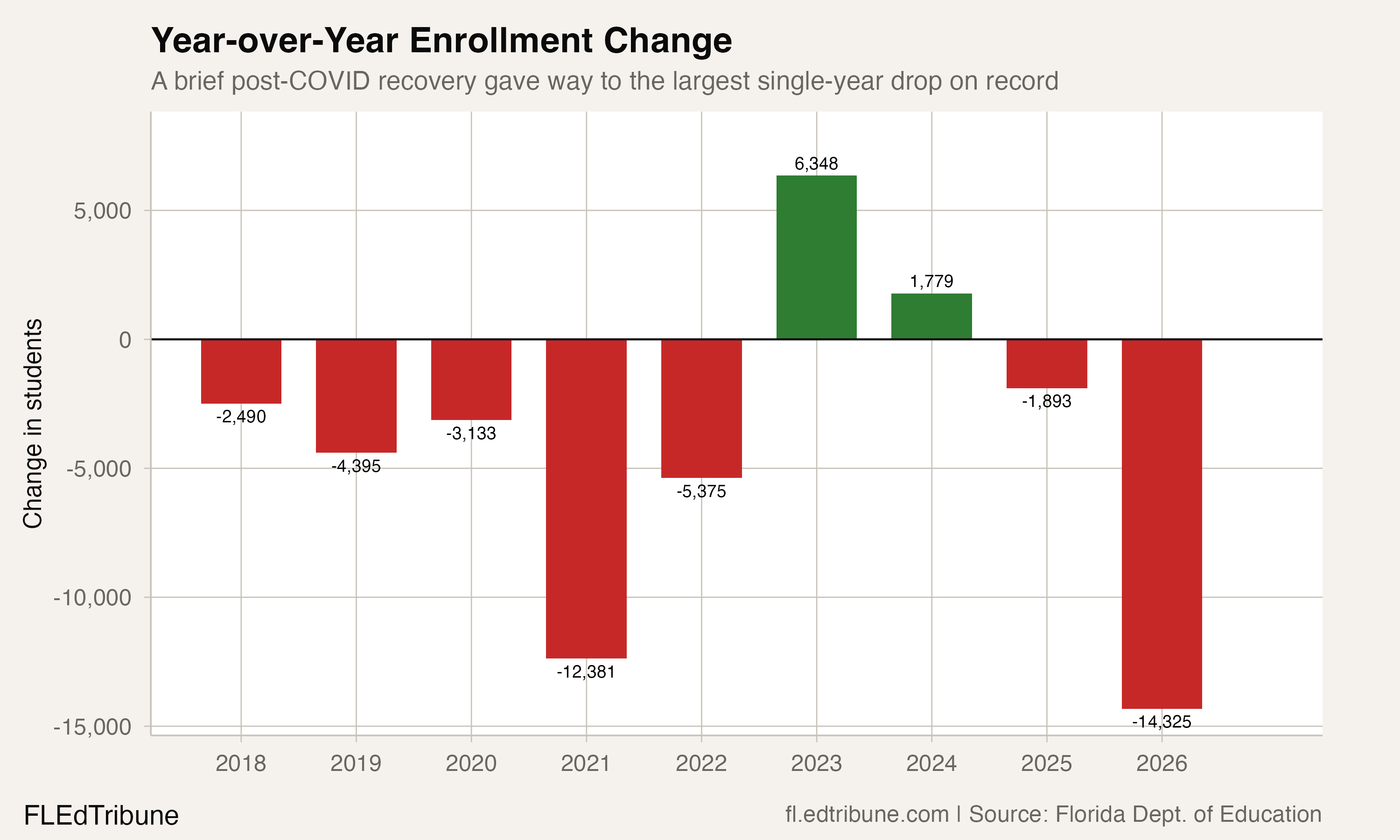
The nation's third-largest school district had been shrinking steadily since 2017, losing 2,000 to 5,000 students most years. A brief post-COVID bounce in 2022-23 and 2023-24, when the district added 6,348 and 1,779 students respectively, offered a false signal that the trend might be reversing. It was not. The 2025-26 plunge wiped out those gains and more, pushing enrollment 8,091 students below the pandemic-era trough of 329,483.
The newcomer pipeline dried up
The single-year drop has an identifiable source. New foreign-born student registrations, the pipeline that had sustained Miami-Dade's enrollment for decades, collapsed. Roughly 2,550 students from another country enrolled in 2025-26, down from nearly 14,000 the previous year and more than 20,000 the year before that. That is an 82% decline in two years.
Superintendent Jose Dotres has been direct about the primary cause.
"The greatest impact of our enrollment issue is not students leaving us. It's students that are not coming to us." — WLRN, Aug. 2025
Most of the newcomer students previously arrived from Cuba, Nicaragua, Venezuela, and Haiti through Biden-era parole programs. The sharp decline in foreign-born registrations followed the end of those programs and a broader contraction in the foreign-born population nationally, which the Pew Research Center documented as the first such decline since the 1960s. Dotres has said the district found no "pattern of fear" among surveyed parents regarding immigration enforcement, though the district acknowledged reserving budget capacity for anticipated enrollment losses from reduced foreign-born registrations.
Charter and private school competition, by contrast, accounted for a small fraction of the loss. In the opening week of the 2025-26 school year, only 379 additional charter students and 647 additional private school students enrolled compared to the prior year. That is roughly 1,000 students against a 14,325-student shortfall.
Housing costs are pushing families out
The immigration slowdown does not fully explain a nine-year trend that predates 2025. Miami-Dade was losing 2,490 to 4,395 students annually from 2017 to 2020, before the pandemic and before any change in immigration policy. The deeper structural force is South Florida's housing affordability crisis.
Between July 2023 and July 2024, 67,418 people left Miami-Dade for other parts of Florida or other states, the highest domestic outmigration of any Florida county. International arrivals, nearly 124,000 in the same period, partially offset the domestic exodus. But domestic outmigration disproportionately affects the population that drives school enrollment: families priced out of the housing market. International arrivals partially replace the headcount but do not necessarily produce school-age enrollment at the same rate.
The budget consequences are immediate. Florida funds schools on a per-pupil basis. The enrollment declines erased about $70 million from Miami-Dade's annual budget, forcing administrators to scramble to cover the shortfall. Dotres has pledged that no teachers would be laid off, but the district is exploring repurposing underused school buildings into early learning centers as a way to put empty space to use.
Who left, and when
The nine-year loss isn't spread evenly. Black enrollment took the hardest hit: from 75,398 in 2017 to 52,673 in 2026, down 22,725 students, or 30.1%. That's 63.4% of the district's total losses from a group that was 21.1% of enrollment in 2017.
White enrollment fell by 5,951 (23.6%) and Hispanic enrollment by 5,954 (2.4%) over the same period. But the Hispanic trajectory is the most volatile. Hispanic enrollment was essentially stable from 2017 through 2020, crashed during COVID, rebounded strongly through 2025, and then fell by 10,700 in a single year. That one-year Hispanic loss accounts for 74.7% of the 2025-26 total decline. It aligns closely with the collapse in foreign-born registrations, given that most newcomer students arrived from Latin American countries.
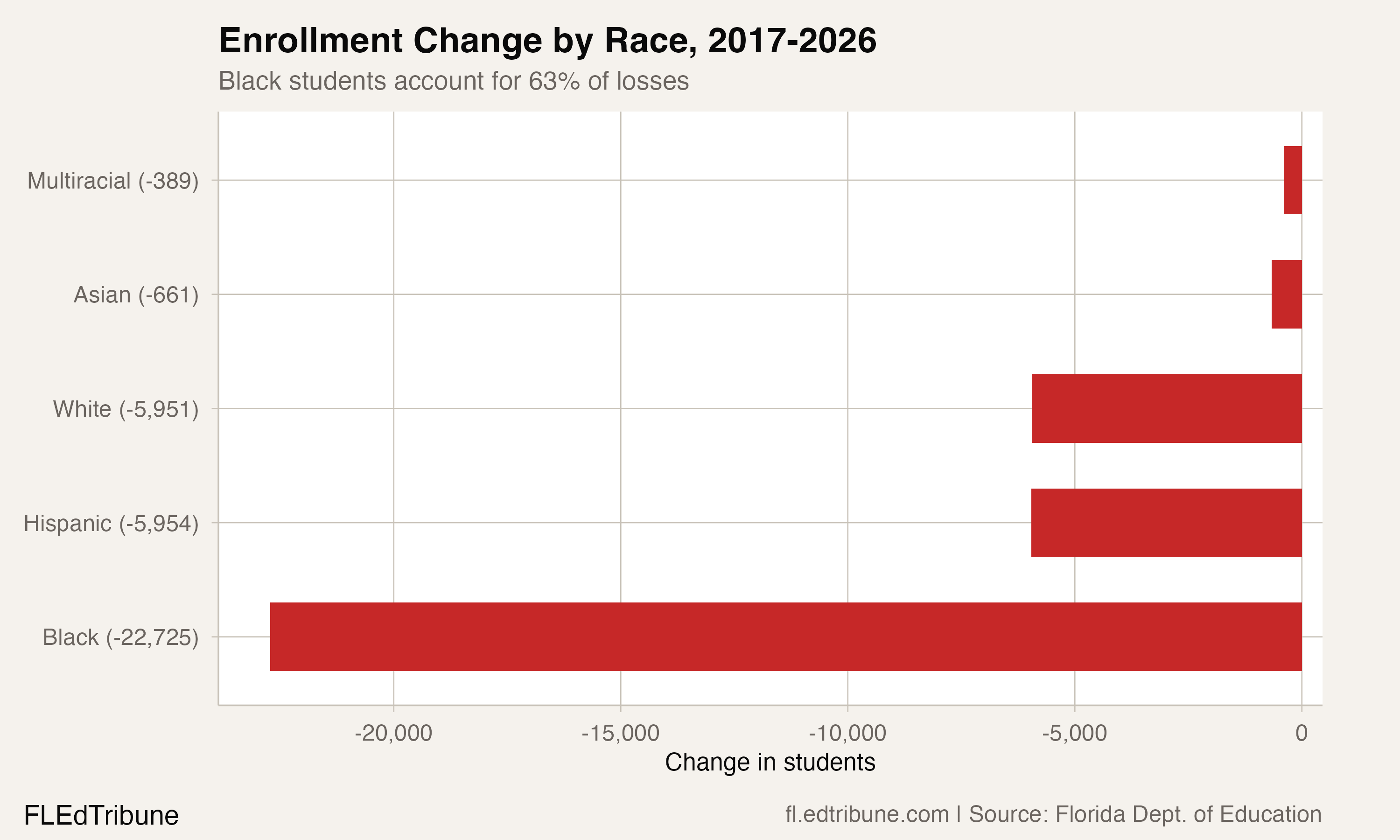
The Black enrollment decline is a different kind of loss. It has been steady, averaging 2,525 students per year across all nine years. It predates COVID, predates vouchers, and predates the immigration slowdown. The most likely driver is sustained domestic outmigration from Miami-Dade's high-cost housing market. An analysis of enrollment decline in South Florida's Black communities noted that neighborhoods historically dependent on public schools face heightened disadvantage as per-pupil funding follows departing students. The data cannot determine whether these families moved to cheaper Florida counties, left the state, or shifted to private schools, but the consistency of the decline across pre- and post-voucher years points toward outmigration rather than school choice.
A South Florida pattern
Miami-Dade is the largest piece of a regional phenomenon. Broward, its northern neighbor, has lost 35,564 students since 2017, a 13.1% decline that actually outpaces Miami-Dade's 10.0% in percentage terms. Palm Beach has been more resilient, losing 7,920 students (4.1%) over the same period.
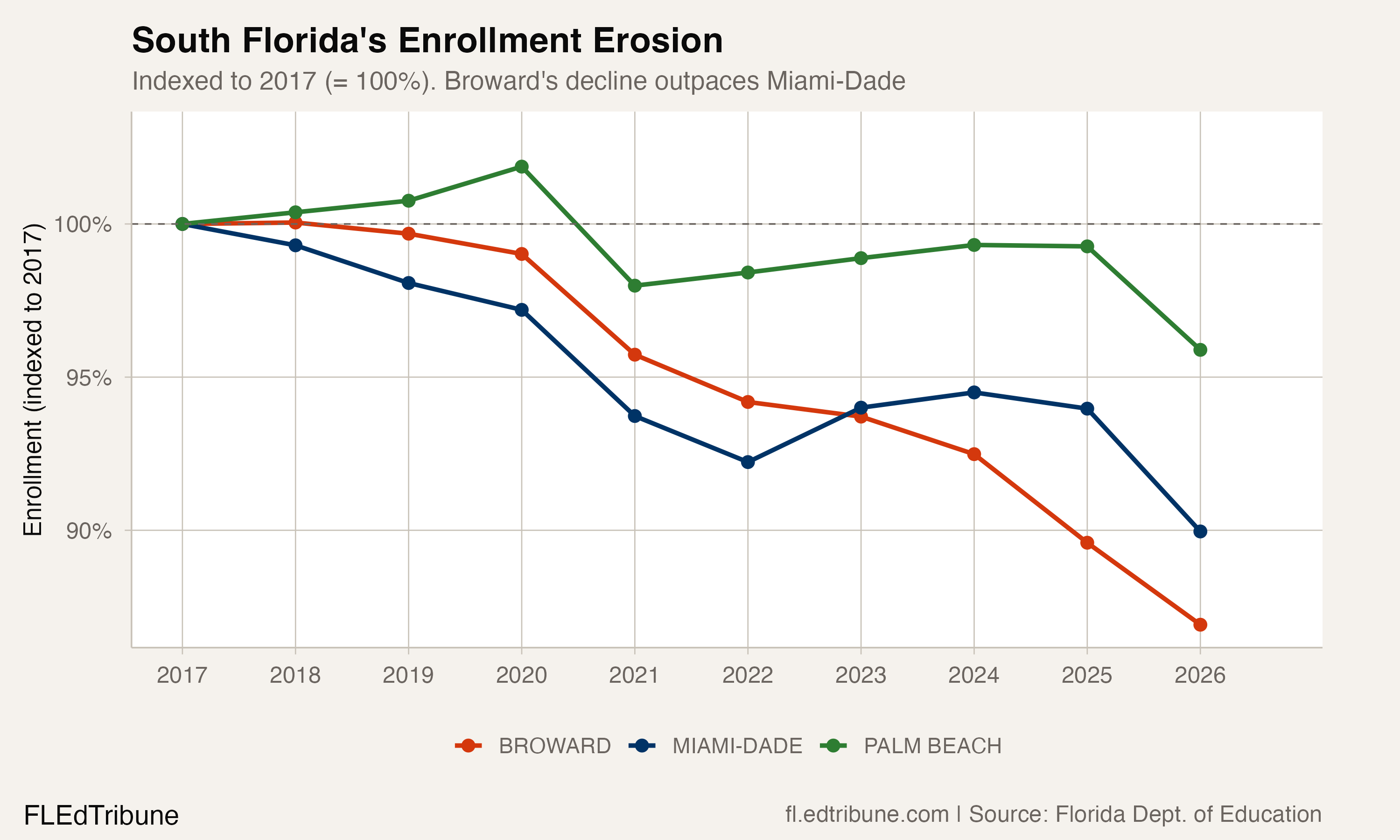
The three South Florida districts collectively lost 79,349 students since 2017. That is more than the entire enrollment of any Florida district outside the top five. Miami-Dade's share of statewide enrollment has slipped from 12.7% in 2017 to 11.5% in 2026.
Fewer kindergartners, same number of seniors
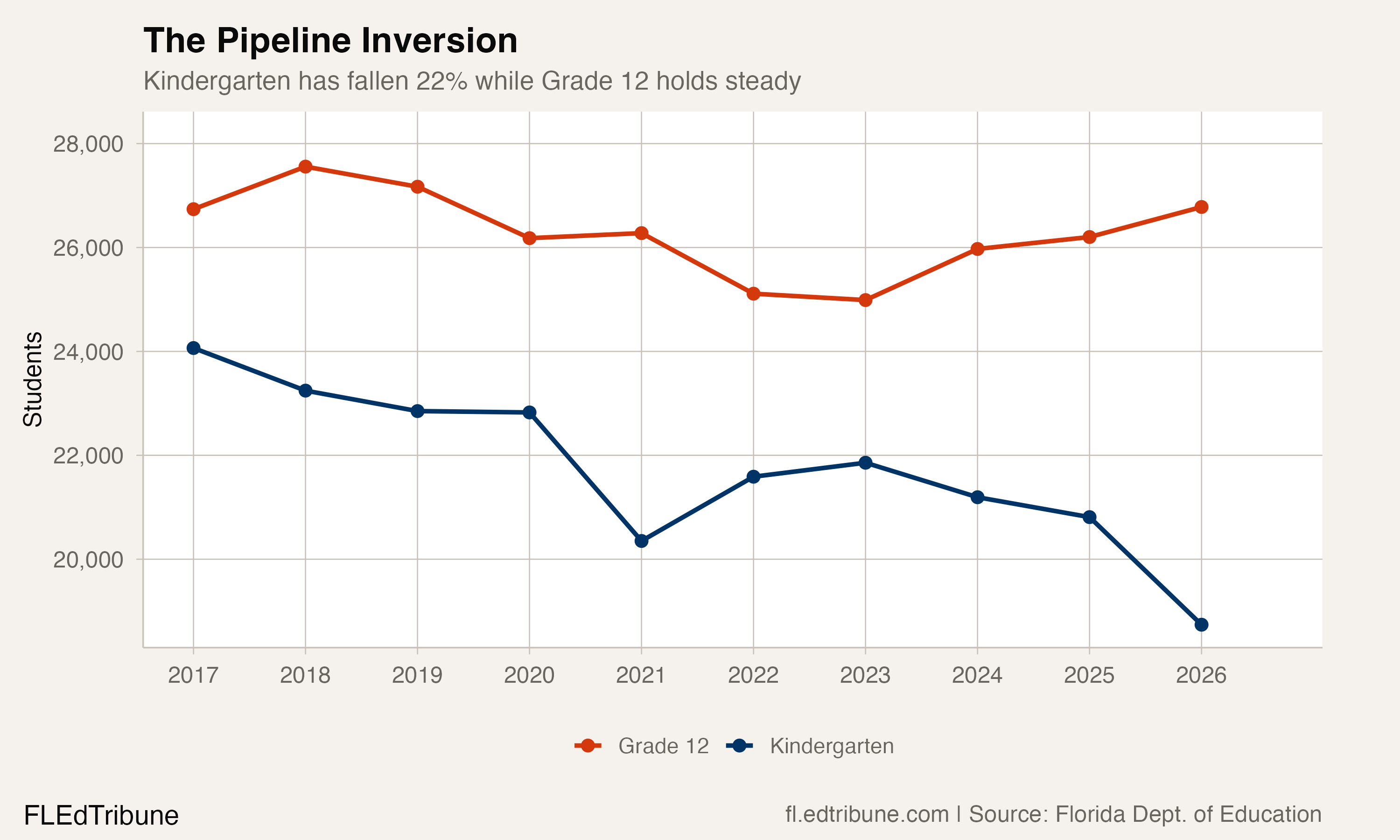
The pipeline that feeds Miami-Dade's schools is narrowing. Kindergarten enrollment fell from 24,065 in 2017 to 18,739 in 2026, a 22.1% decline. Grade 12 enrollment, by contrast, barely moved: 26,738 in 2017, 26,780 in 2026.
Miami-Dade's 12th-grade class is now 42.9% larger than its kindergarten class. In a stable district, those numbers run roughly even. Each large senior class that graduates gets replaced by a smaller kindergarten cohort, which means enrollment will keep falling even if no additional families leave. The decline is baked in for the next decade.
What the data cannot show
Enrollment data tracks headcounts, not destinations. The 35,865 students who left Miami-Dade's rolls could be in Broward, in Orlando, in Georgia, in a private school, or homeschooled. A family that moved to Pasco for cheaper housing looks identical in the data to one that accepted a voucher in Kendall or returned to Venezuela. The superintendent's account points to the newcomer pipeline as the primary 2025-26 driver, and the foreign-born registration data backs that up. But the longer-term trend, especially that steady Black enrollment decline, likely reflects domestic outmigration the district has less power to address.
Whether the 2025-26 drop represents a new floor or a new trajectory depends on what happens next. If foreign-born registrations recover, the district could stabilize in the low 320,000s. If they do not, and domestic outmigration continues, the kindergarten pipeline suggests Miami-Dade could fall below 300,000 students within five years. For a district that once served more than 357,000, that's a different school system entirely: fewer schools, fewer teachers, fewer resources, and a smaller footprint in a county that is still growing in population, just not in families who use public schools.
Detailed code that reproduces the analysis and figures in this article is available exclusively to EdTribune subscribers.
Discussion
Sign in to join the discussion.
Loading comments...