Before the pandemic, Florida's public schools added students like clockwork. From 2015 to 2019, the state gained an average of 22,480 students per year, a steady expansion powered by strong domestic migration and a growing school-age population. If that trajectory had held, Florida would have 3,001,154 public school students in 2025-26.
Part of the Florida Enrollment 2026ET series.
RELATED: Pasco's 10-Year Growth Streak EndsET
It has 2,786,275. The gap is 214,879 students, 7.2% of the projected total, and it grew by 70% in a single year.
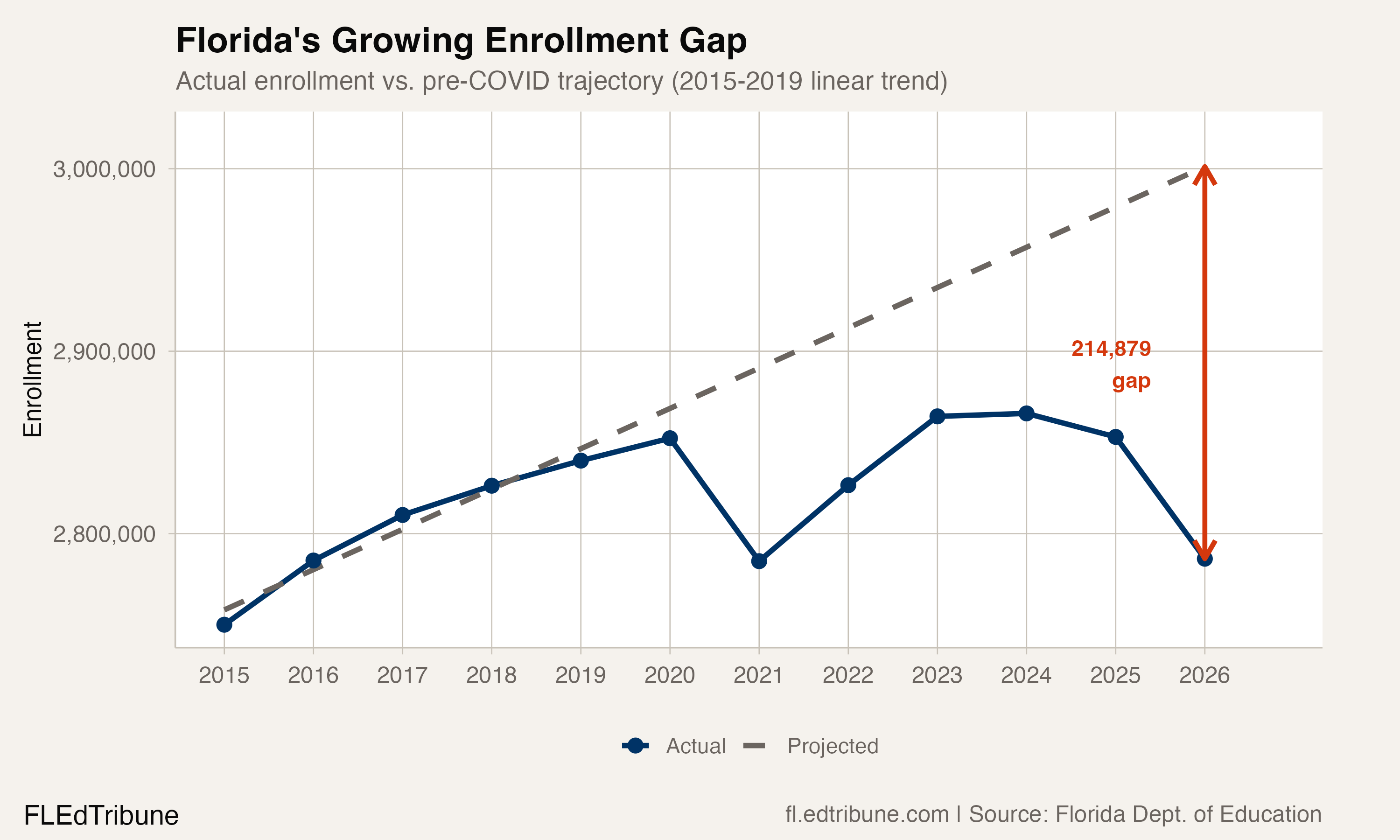
That gap is not a one-time COVID hangover. It opened at 16,343 in 2020, blew out to 105,800 during COVID, narrowed briefly during the 2022-2023 recovery, and then accelerated again to 214,879 as the recovery stalled. Florida didn't just lose students during the pandemic. The growth engine that ran for decades broke, and nothing has replaced it.
The growth engine stalled, then reversed
The 2025-2026 school year lost 66,756 students, a 2.3% single-year decline. Unlike the pandemic drop, which came with a clear cause and a partial rebound, the current losses have no external shock to explain them and no obvious recovery mechanism.
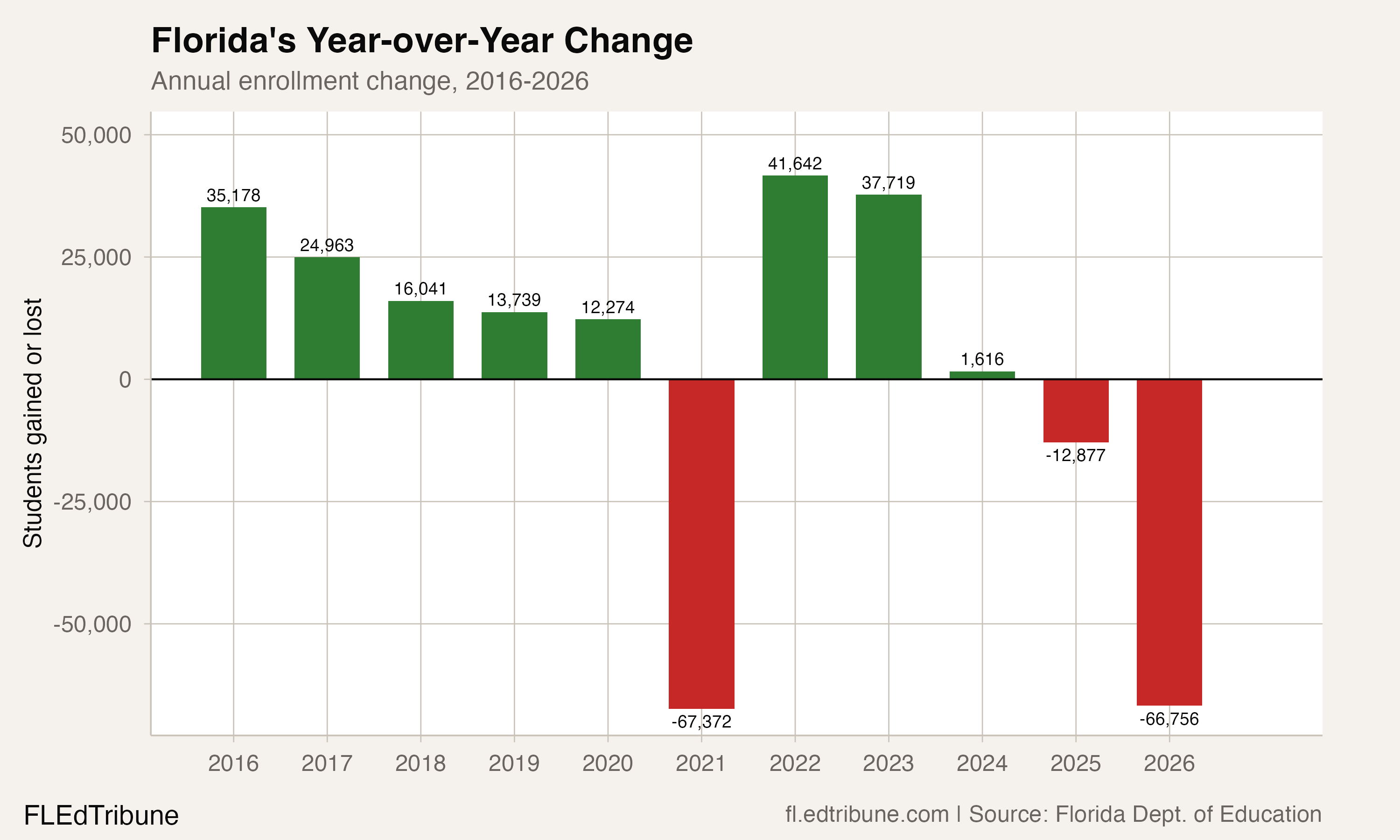
The year-over-year pattern tells the story clearly. Florida grew by 35,178 students in 2016. Growth slowed each year through 2020 but remained positive. The pandemic knocked enrollment down sharply, but the recovery years of 2022 and 2023 added back 79,361 students. Then the bottom dropped out: 1,616 in 2024, a loss of 12,877 in 2025, and a loss of 66,756 in 2026.
The two-year crash from the 2024 peak totals 79,633 students. That is larger than the entire enrollment of Osceola County, the state's eleventh-largest district at 74,365 students.
Where the students disappeared
The losses are concentrated but not isolated. Of Florida's 75 districts with data in both years, 58 lost students between 2024 and 2026. Only 17 gained. The losers shed a combined 91,999 students; the gainers added back just 10,929.
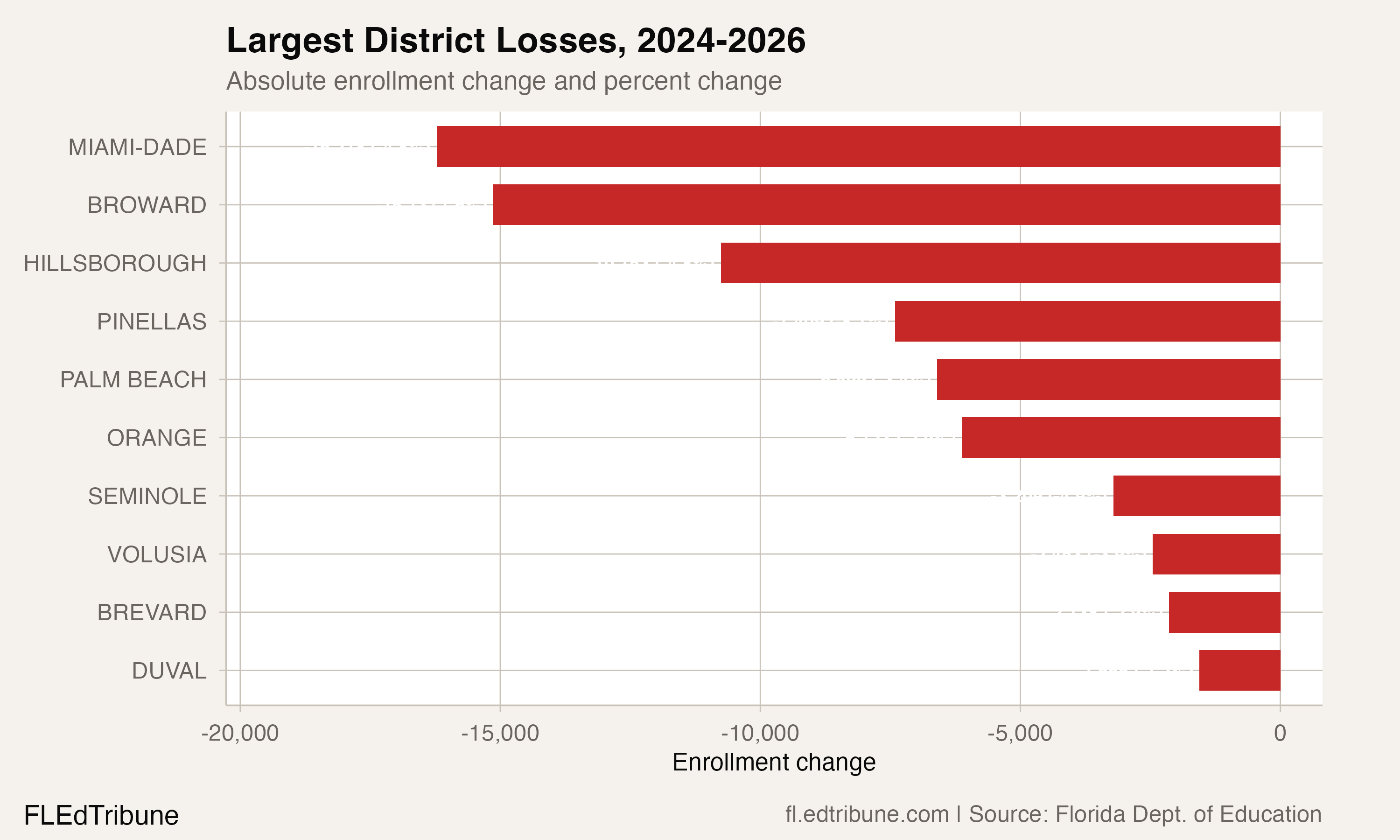
Three South Florida districts account for 47.7% of the two-year statewide loss. Miami-Dade lost 16,218 students (4.8%), Broward lost 15,137 (6.0%), and Palm Beach lost 6,599 (3.4%). Hillsborough, anchoring the Tampa Bay region, lost 10,753 (4.8%). Pinellas, smaller but declining faster, lost 7,409 (8.1%).
Broward's trajectory is especially stark. The district peaked at 271,824 students in 2017 and has declined every year since, losing 35,564 students over nine years. District data shows approximately 50,000 empty seats across Broward's public schools, and Superintendent Howard Hepburn recommended closing seven campuses in December 2025.
The small number of growing districts are mostly exurban or charter operators. St. Johns County, a fast-growing suburb south of Jacksonville, added 1,049 students. St. Lucie, on the Treasure Coast, gained 2,009. IDEA Public Schools, a charter network, grew by 1,614.
Three forces, one outcome
The enrollment gap has no single cause. Three forces are running at once, and they compound each other.
The most visible is Florida's universal voucher program, which eliminated income limits in 2023. Voucher participation has grown roughly fivefold since 2019, redirecting billions in state education funding to private schools. Most new voucher recipients were already in private school, so the program's direct enrollment effect is debated. But it has shifted the fiscal landscape for public districts and likely influences families on the margin.
The second force is demographic. Florida's domestic migration has slowed dramatically since its pandemic-era peak. Rising home insurance costs, averaging $5,700 per year and more than $3,350 above the national average, are pricing working families out of the state. The effect is most acute in South Florida, where the three largest districts have lost a combined 37,954 students in two years.
"It's so expensive to live in Pinellas County that families, or people who would have a family, don't want to live here." -- Lee Bryant, Pinellas Teachers Association, WUSF, Sept. 2025
The third force is the birth rate. The national fertility rate fell to a record low of 1.6 children per woman in 2024, well below the 2.1 replacement rate, and Florida has not been immune. The kindergarten pipeline shows the consequences: Florida enrolled 204,090 kindergartners in 2015 and 179,414 in 2026, a 12.1% decline. Those smaller cohorts will flow through the system for the next 12 years regardless of what happens with vouchers or migration.
Fewer children entering, more leaving
Here's the number that should worry planners most. In 2015, Florida enrolled 1.14 first-graders for every twelfth-grader — more students entering than leaving. That ratio crossed below 1.0 in 2021 and has fallen to 0.867 in 2026. Florida now has 29,539 more twelfth-graders (222,344) than first-graders (192,805).
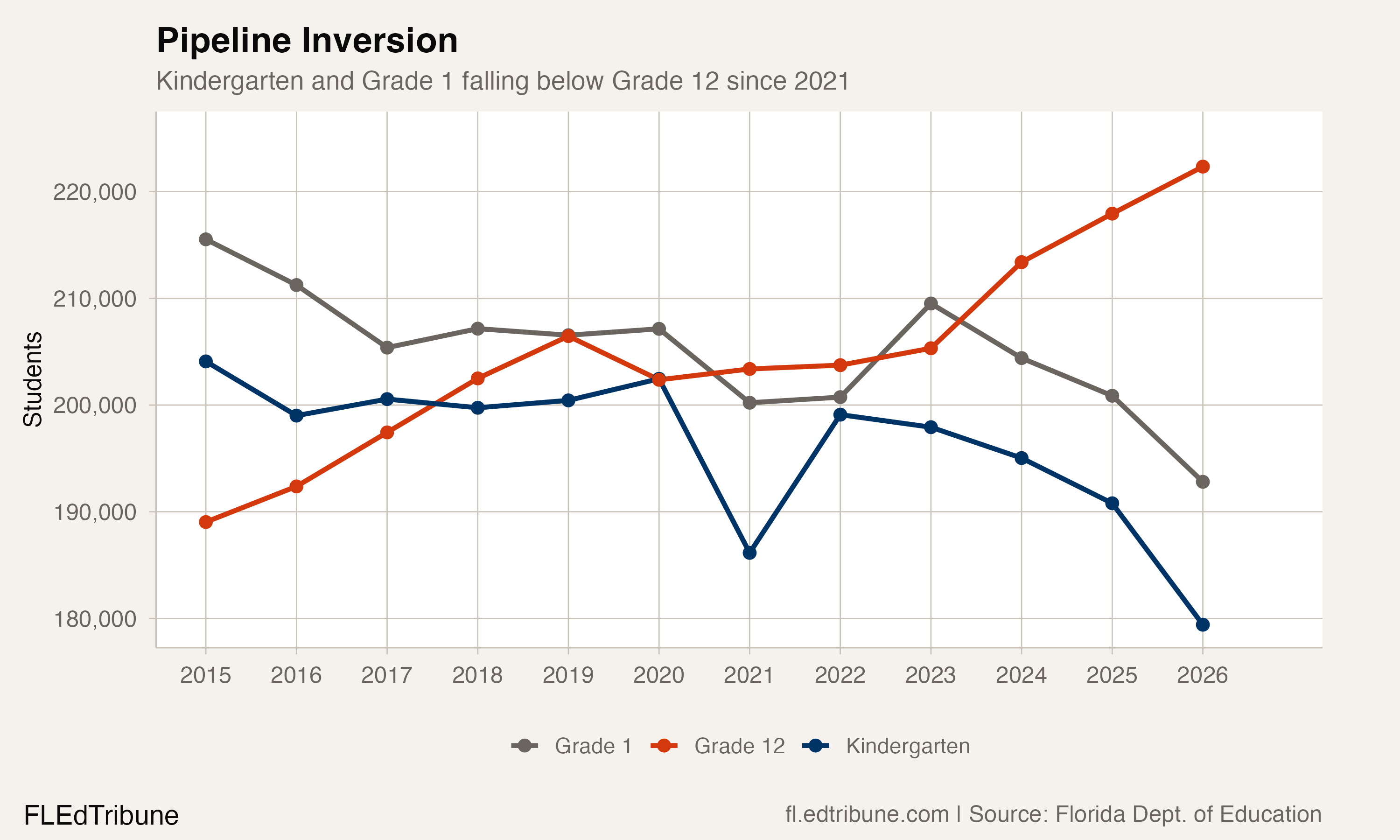
The system is top-heavy with students about to graduate and thin at the bottom. As large senior classes leave and smaller kindergarten cohorts advance, enrollment keeps falling even without further voucher expansion or outmigration. That decline is already locked in.
The gap that compounds
The projection model used here is deliberately simple: a linear fit to the five pre-pandemic years (2015-2019), which grew at an average of 22,085 students per year. Critics could argue that growth was already decelerating before 2020, with annual gains falling from 35,178 in 2016 to 12,274 in 2020. A more conservative projection using the 2018-2019 growth rate of 13,739 students per year would still show a gap of roughly 150,000.

The gap narrowed briefly in 2022 and 2023 as post-COVID recovery added students back. But recovery stalled in 2024, and the gap grew by 70% in a single year, from 126,038 in 2025 to 214,879 in 2026. The question is no longer whether Florida will close this gap. It will not. The question is how large the gap grows before enrollment stabilizes, and what that means for the infrastructure, staffing, and funding formulas built for 3 million students.
"Our public schools are struggling to make ends meet. That means fewer programs for kids, larger class size." -- Andrew Spar, Florida Education Association, WUFT/Fresh Take Florida, Dec. 2025
What comes next
Orange County Public Schools is considering closing seven schools. Broward is closing six campuses and evaluating 34 more for consolidation. Pinellas is cutting programs for English learners, mental health, and after-school enrichment to absorb a $9 million federal funding freeze on top of enrollment-driven revenue losses.
None of this is hypothetical. It is happening now, in the third-largest state's public school system. The 2026-2027 kindergarten cohort, born during a period of record-low national fertility, will enter a system with 214,879 fewer students than its trajectory predicted. Whether that trajectory was ever sustainable is a fair debate. That the system built to serve it is now too large is not.
Detailed code that reproduces the analysis and figures in this article is available exclusively to EdTribune subscribers.
Discussion
Sign in to join the discussion.
Loading comments...