The last time Florida public schools lost this many students, the country was in lockdown. In 2020-21, the pandemic emptied 67,372 seats across the state. In 2025-26, 66,756 seats emptied again, a difference of just 616 students. The rate of loss is nearly identical: 2.34% in 2025-26 versus 2.36% during COVID.
Part of the Florida Enrollment 2026ET series.
RELATED: 32 Florida Districts Hit Rock Bottom in 2026ET
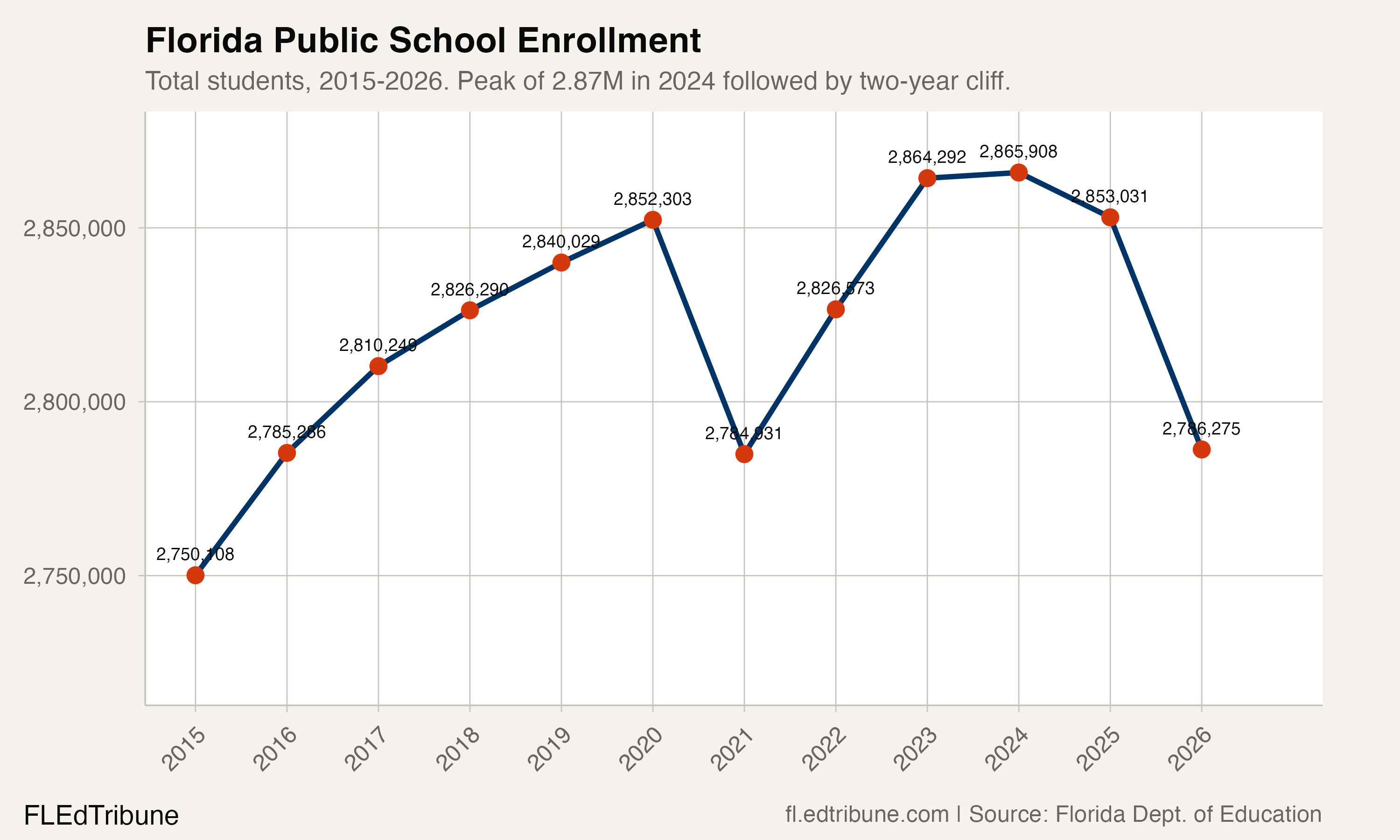
But there is no pandemic this time. Schools are open, the economy is functioning, and Florida simply has fewer public school students than it did a year ago. Far fewer than two years ago, when the state hit an all-time peak of 2,865,908. Since that 2024 high-water mark, 79,633 students have disappeared from the rolls.
Two years of freefall
What makes this different is the speed. Florida added students every year from 2015 through 2020, building steadily from 2,750,108 to 2,852,303. COVID knocked the system back to 2,784,931 in 2021, but recovery came fast: by 2023, enrollment had surpassed its pre-pandemic level and by 2024 it had set a new record.
Then it stopped. The 2024 gain was a barely perceptible 1,616 students, a 0.06% increase that looks, in hindsight, like the last exhale. In 2025, the state lost 12,877 students. In 2026, it lost 66,756 more.
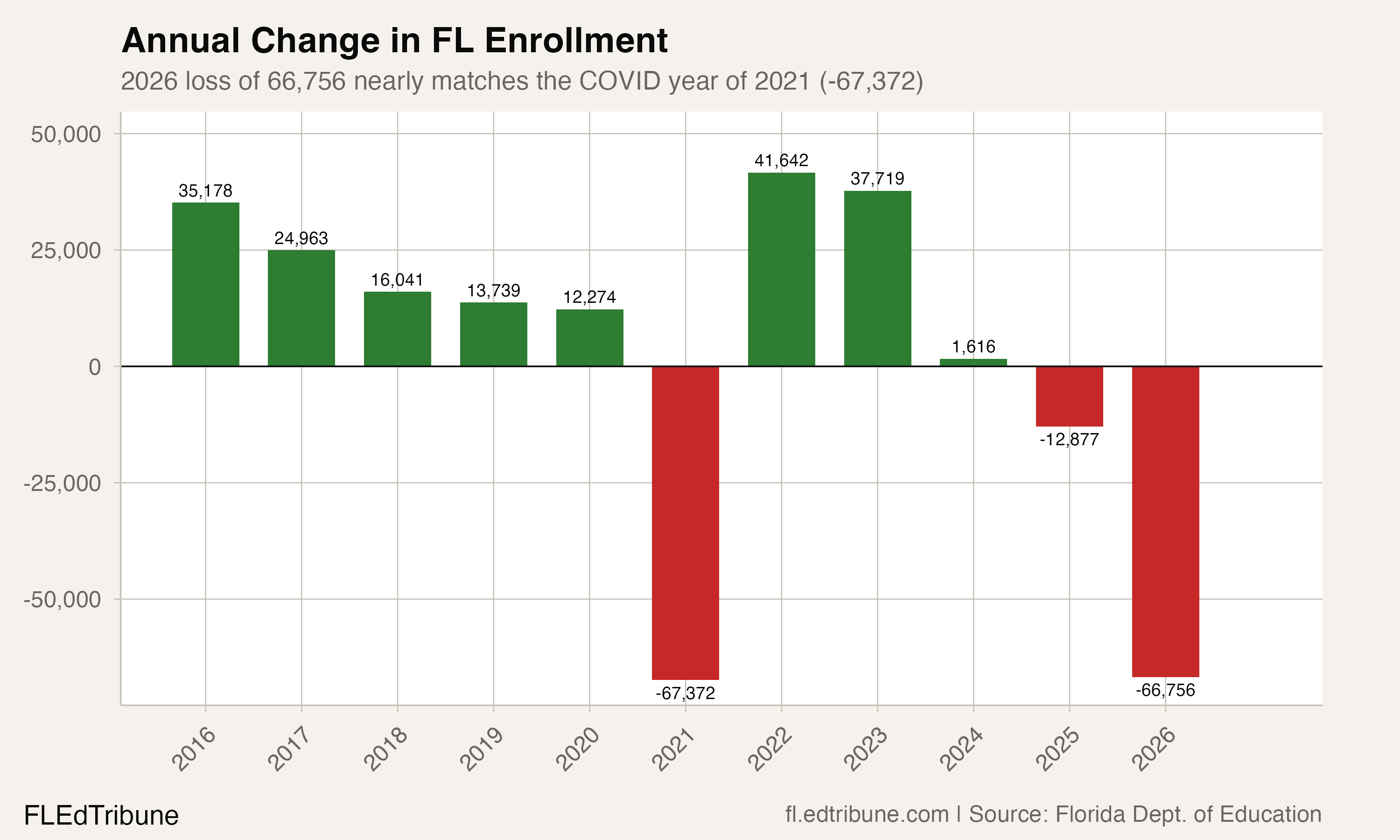
The COVID loss was a one-year shock followed by a two-year recovery. This time, the trajectory points in only one direction. Florida's current enrollment of 2,786,275 sits just 36,167 students above where it was in 2015. A decade of growth, effectively erased in two years.
Where 86% of the losses come from
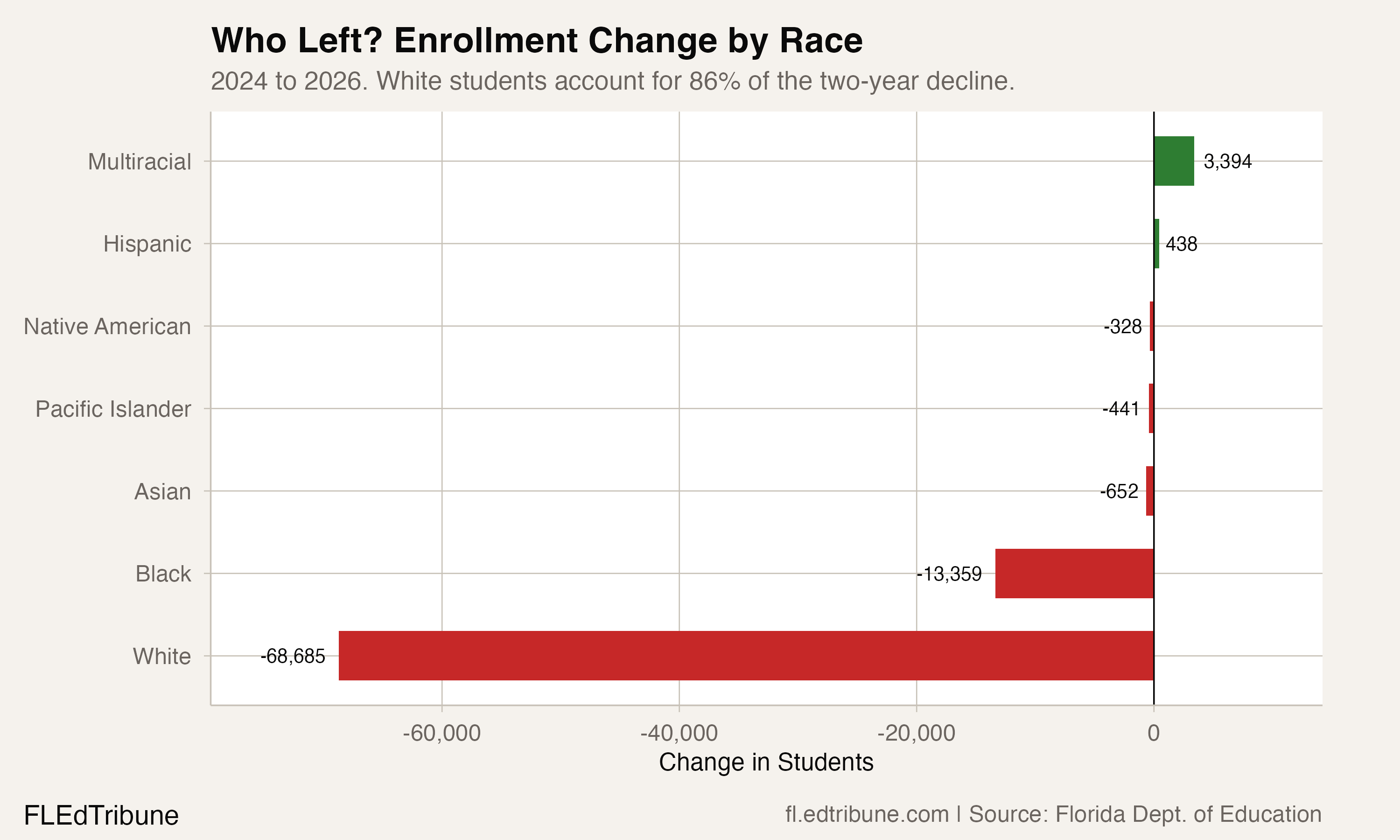
The decline is not evenly distributed across the student body. White enrollment, which has fallen every year except 2022, is accelerating downward. In 2024, white enrollment dropped by 25,243. In 2025, by 33,478. In 2026, by 35,207. Over the two years since the 2024 peak, white students account for 68,685 of the 79,633 total losses, or 86.3%.
White students now make up 33.0% of Florida's public school enrollment, down from 40.3% in 2015. The state has lost 188,090 white students over that period.
The losses are not confined to one racial group, though the scale differs sharply. Black enrollment fell by 13,359 from 2024 to 2026. Hispanic enrollment, which had grown every non-COVID year since 2015, dropped by 20,901 in 2026, its first non-pandemic decline in the dataset. Only multiracial students showed net growth over the two-year window, adding 3,394.
The Hispanic numbers are harder to explain. From 2016 through 2025, Hispanic enrollment grew by an average of 26,800 students per year (excluding the COVID dip). The 2026 loss of 20,901 does not yet have a clear explanation in the data. It coincides with reduced immigration nationally and with a sharp decline in net domestic migration to Florida, which fell from 310,892 new residents in 2022 to just 22,517 in 2025 according to Census Bureau estimates.
Five districts, 61% of the losses
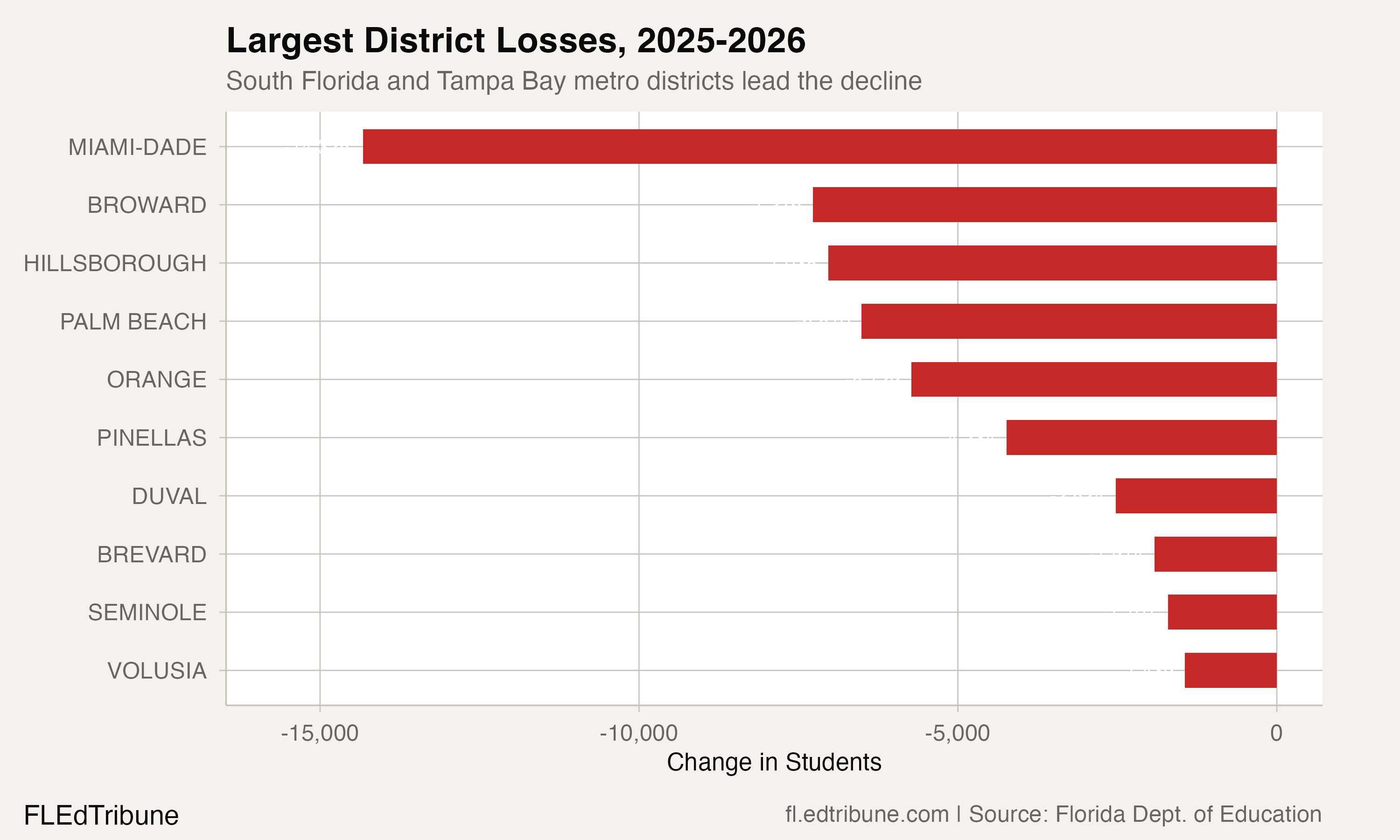
Miami-Dade alone lost 14,325 students in 2025-26, more than any other district by a factor of two. Broward lost 7,276. Hillsborough lost 7,035. Palm Beach lost 6,510. Orange lost 5,729. Together, these five districts shed 40,875 students, accounting for 61.2% of the statewide loss.
Sixty-one of Florida's 77 reporting districts lost students in 2025-26. Only 16 gained. Thirty-three of 73 districts with at least five years of data are now at all-time enrollment lows.
The hardest-hit districts are coastal, urban, and expensive. Miami-Dade has fallen from 357,257 students in 2017 to 321,392, a loss of 35,865 over nine years. Broward peaked at 271,951 in 2018 and now stands at 236,260, down 35,691. Pinellas has lost 20,194 students since 2015.
Miami-Dade Superintendent Jose Dotres told WLRN that the district's losses are driven less by competition from private or charter schools than by the absence of incoming families:
"The greatest impact of our enrollment issue is not students leaving us. [It is] students that are not coming to us."
Dotres pointed to reduced immigration and the cost of living in the Miami metro area. Charter and private schools together drew roughly 1,000 additional students from Miami-Dade in 2025-26; the remaining 12,000-plus loss came from families that simply never enrolled.
Broward is already acting. The district is moving to close or consolidate 34 schools across elementary, middle, and high school levels, with changes taking effect in 2026-27. Board Member Allen Zeman framed the consolidation as a financial necessity:
"We cannot continue to spend money on buildings that we could spend on the students we have or the students we want to win back."
Broward currently has approximately 50,000 empty seats across its schools. Its 10,000-student single-year loss translates to a $94 million budget hole.
The voucher question
Florida's universal voucher program, which removed income limits in 2023, is the most visible policy change coinciding with the enrollment decline. More than 500,000 students now use public funds for private schooling, and state funding directed to vouchers has doubled from 12% in 2021 to 24% in 2025, a shift from $1.4 billion to $3.8 billion annually.
The relationship between vouchers and public school enrollment loss is real but not as straightforward as the raw numbers suggest. Step Up for Students, the nonprofit administering the scholarships, reported that about 69% of students new to the voucher program were already enrolled in private schools. The vouchers subsidized existing private school attendance more often than they created new private school students. That said, the remaining 31% represents tens of thousands of families who did leave public schools, and the program's existence likely influences enrollment decisions at the margin for families weighing their options.
A state audit found a $398 million funding shortfall in the voucher program during 2024-25, along with $2.3 million in overpayments. The program's rapid expansion has strained both sides: public schools lose per-pupil funding for each departing student, while private schools have sued Step Up for Students over delayed and missing payments.
The voucher program is one factor among several, and the enrollment data alone cannot separate its effect from declining birth rates, outmigration, and homeschooling growth. In Orange County, 24% of state aid is redirected to vouchers while enrollment dropped 2.9%. In Miami-Dade, where voucher competition appears less central, the loss is 4.3%. The mechanism varies by district.
The pipeline is inverting
There is a less visible problem beneath the headline loss. Florida now graduates more seniors than it enrolls in kindergarten, and the gap is widening fast.
In 2015, Florida enrolled 204,090 kindergartners and graduated 189,034 seniors, a healthy surplus of 15,056 entering students. By 2018, the lines crossed: grade 12 enrollment exceeded kindergarten for the first time. The gap briefly closed in 2020, then blew open during COVID and has not recovered.
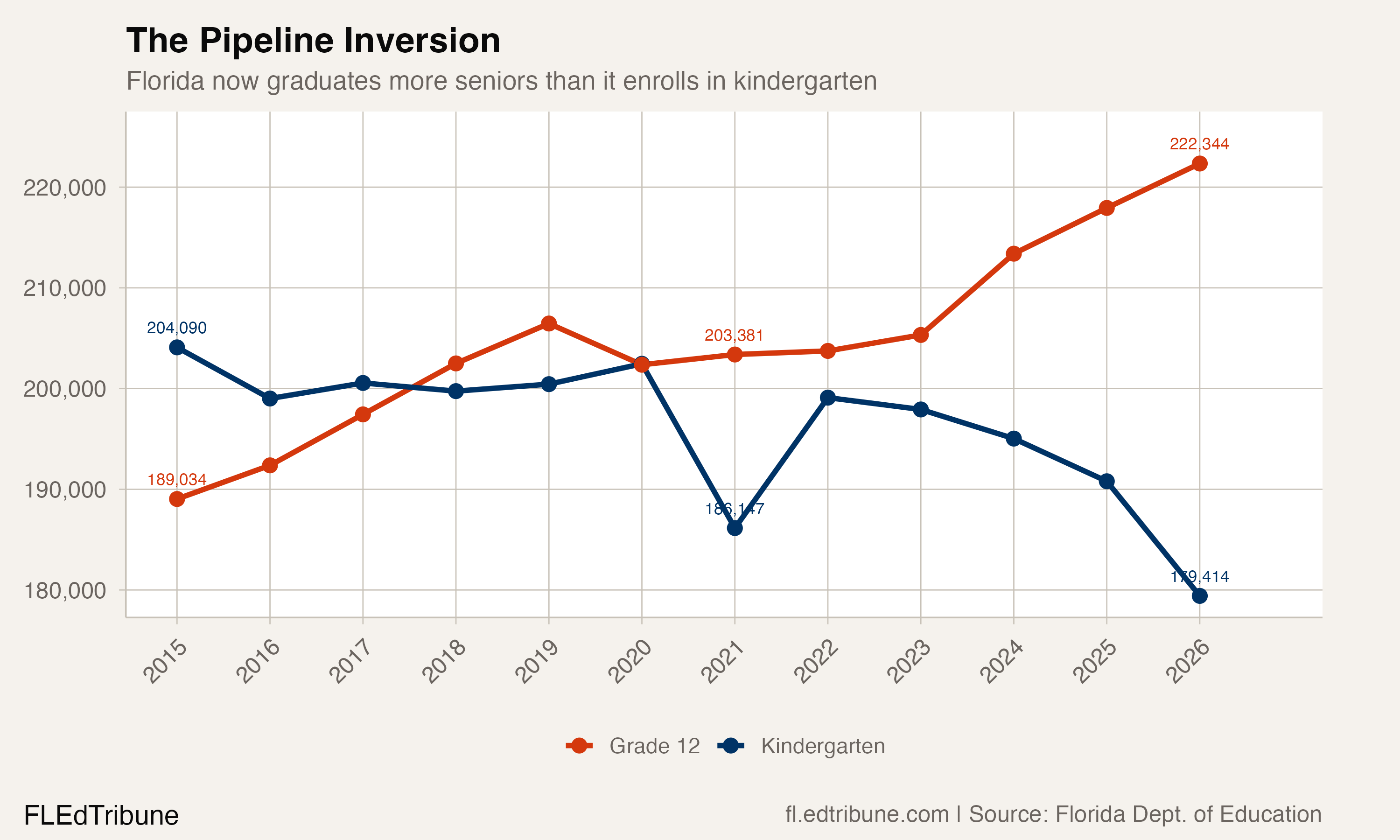
In 2026, Florida enrolled 179,414 kindergartners and had 222,344 seniors, a deficit of 42,930. Kindergarten enrollment has dropped 12.1% since 2015. Grade 12 enrollment has risen 17.6%. The system is losing students at the bottom faster than it is losing them at the top, which means the overall decline will accelerate as those smaller 2026 kindergarten cohorts progress through the grades.
Declining birth rates are the primary driver of the kindergarten drop. Pinellas County reported a 9.3% single-year decline in kindergarten enrollment. District officials there cited the combination of falling birth rates and the high cost of living as reasons families are not forming or are leaving the county entirely.
What the recovery numbers reveal
Of the 63 Florida districts that lost students during COVID, 26 had recovered to their pre-pandemic enrollment levels by 2024. By 2026, only 17 remain above their 2020 marks. The post-COVID recovery did not just stall; it reversed. Nine districts that had clawed back to pre-pandemic levels have since fallen below them again.
So much for the story of pandemic disruption followed by gradual normalization. For most Florida districts, the pandemic was not a temporary shock but the start of a contraction that has not stopped. Only 27% of COVID-affected districts are now at or above where they were before the pandemic started.
The question ahead
The fiscal math is already biting. Broward's $94 million budget gap from a single year of enrollment loss is the most visible example, but the same arithmetic applies everywhere: in Florida's per-pupil funding model, every absent student is absent revenue. Hillsborough dropped from 224,528 students in 2023 to 213,391 in 2026, a loss of 11,137 students in three years. The Tampa Bay area is already seeing staffing reductions and service cuts in response.
The kindergarten pipeline suggests this is not a temporary correction. With 42,930 fewer kindergartners than seniors, Florida's enrollment is structurally contracting. The question for the 2027 school year is whether the state has found the bottom or whether, without a pandemic as cover, the system will quietly shed another 50,000 to 70,000 students while the debate over vouchers, housing costs, and birth rates continues.
Detailed code that reproduces the analysis and figures in this article is available exclusively to EdTribune subscribers.
Discussion
Sign in to join the discussion.
Loading comments...