St. Johns County↗ET added 151 students in 2025-26. That number would barely fill a single school bus. But in a state where every other top-20 district lost enrollment in 2026, it was enough to make St. Johns the last one standing.
Part of the Florida Enrollment 2026ET series.
RELATED: Nearly 9 in 10 Florida Districts Lost Students in 2026ET
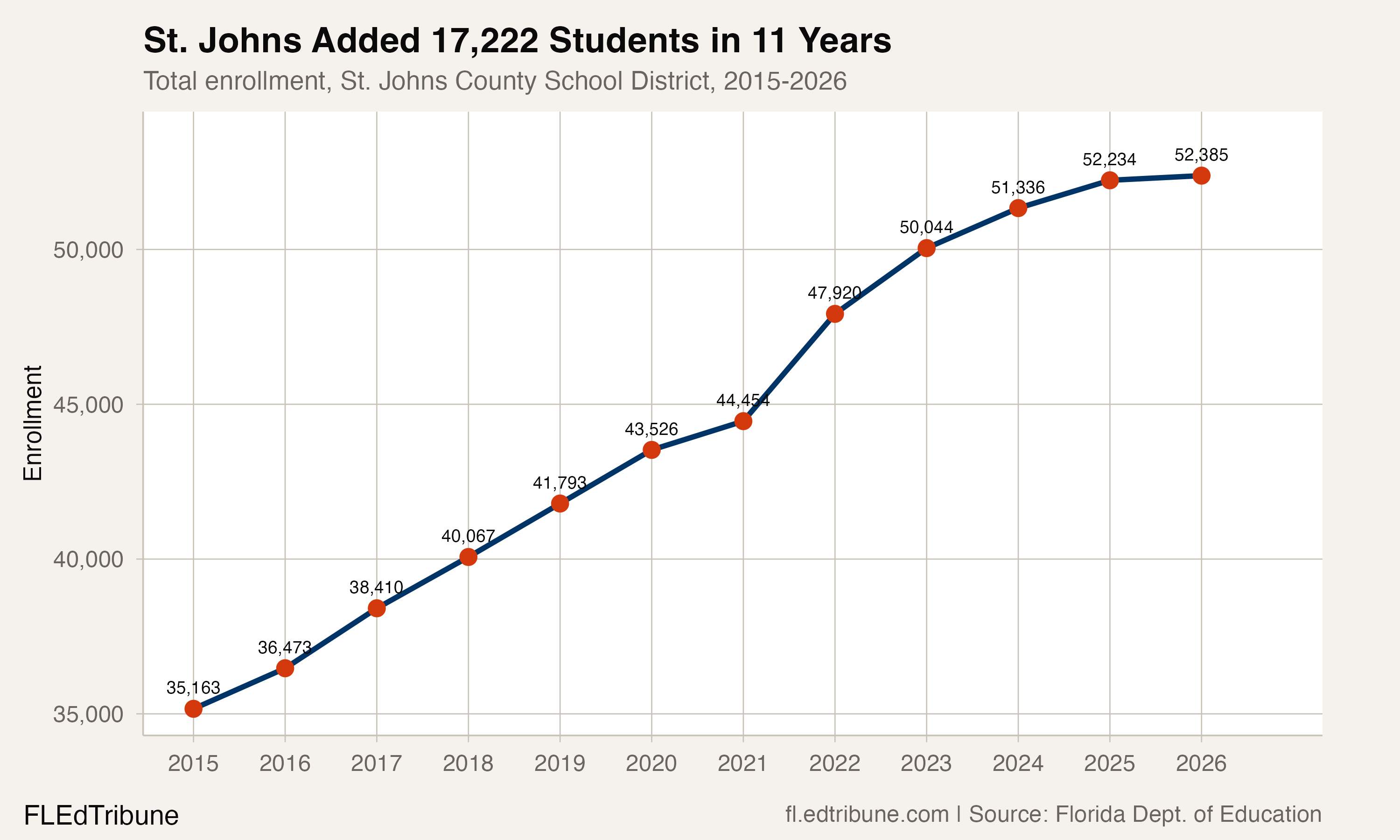
The district has grown every year since 2016, an 11-year streak that added 17,222 students and pushed enrollment from 35,163 to 52,385, a 49.0% increase. Among Florida districts with more than 10,000 students, nothing else comes close. Only three other districts in the state, Charlotte, Sumter, and Walton, have growth streaks of even five years, and none enrolls more than 17,100 students.
From Fastest-Growing to Barely Growing
The streak is intact, but the trajectory has changed. St. Johns grew by 7.8% in 2022, its fastest expansion on record, adding 3,466 students in a single year. That pace was unsustainable, and the district has decelerated every year since: 4.4% in 2023, 2.6% in 2024, 1.7% in 2025, and 0.3% in 2026.
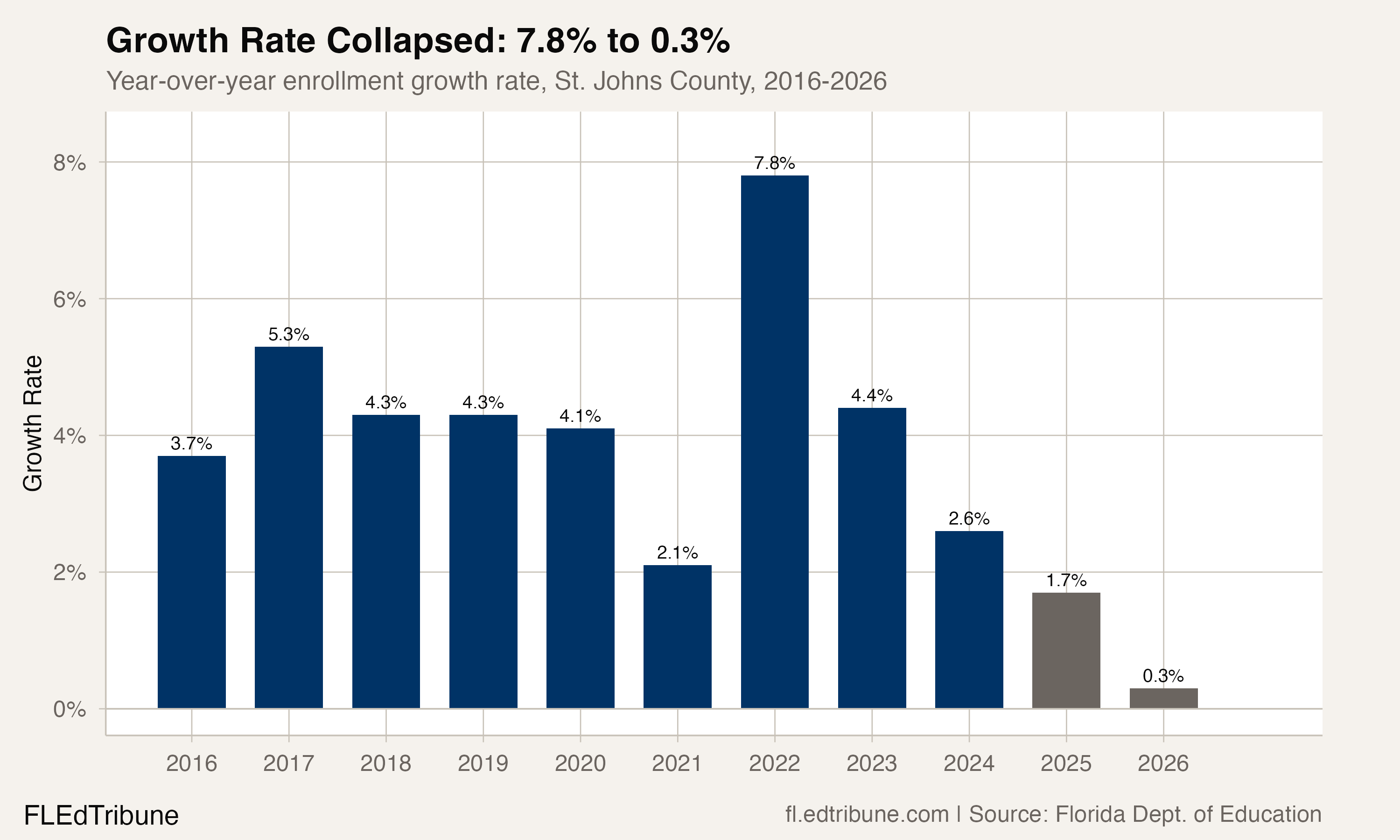
That's not a gentle cooldown. It's a near-complete stop. In 2024, St. Johns accounted for 80% of all statewide enrollment growth. Florida's public schools added just 1,616 students that year, and 1,292 of them were in St. Johns. By 2026, the state lost 66,756 students, and St. Johns could not offset even a fraction of it.
The Sole Survivor Among Florida's Largest Districts
In 2026, all 19 other top-20 districts by enrollment lost students. Duval County↗ET, St. Johns' neighbor to the north and the source of much of its in-migration, shed 2,524 students. Miami-Dade lost 14,325. Broward lost 7,276. Hillsborough lost 7,035.
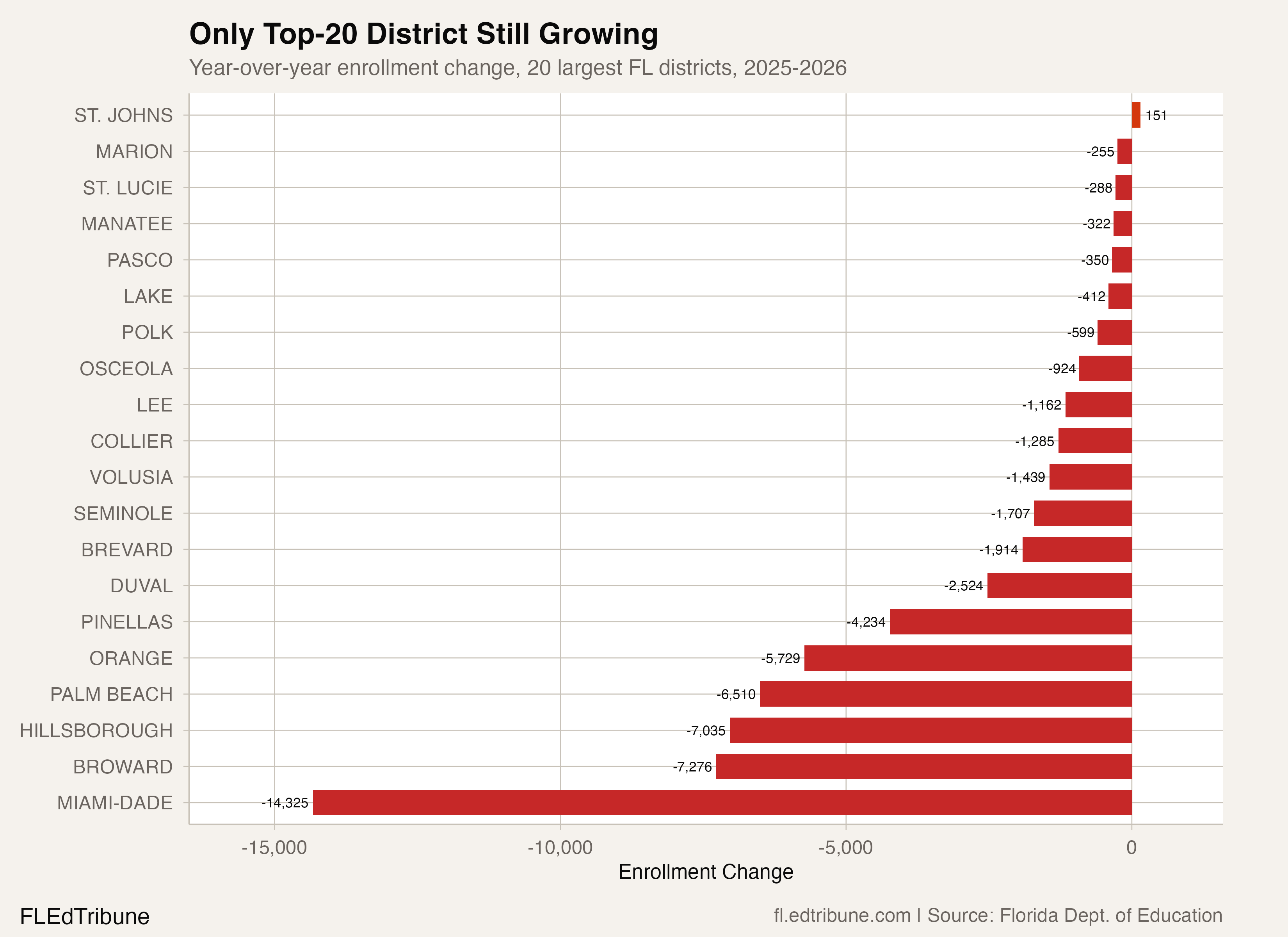
A gain of 151 students is barely a rounding error. The district that added 3,466 students four years ago is now gaining fewer than the margin of error in most enrollment counts.
What Built the Streak
St. Johns' growth rests on three things, all of which are showing stress.
The first is residential construction. More than 350 housing developments are in construction or planning in the county, which is preparing for its population to double by 2050. Master-planned communities like Silverleaf and Nocatee have attracted families from Duval County and out of state, drawn by new housing stock and top-rated schools. But the housing market has softened. Pending home sales in St. Johns County fell 27.2% in September 2025, and median home prices declined 2.0% year-over-year in December 2025, suggesting that the flow of new families is decelerating.
The second is school quality. St. Johns ranked second among all Florida districts with an "A" grade in 2024, with math proficiency at 73% and reading at 72%, both well above the 52% state average. That reputation pulls families across the county line from Duval, where the district has consolidated schools and courted charter operators to fill underused buildings. But overcrowding is eroding the quality advantage. Parents at a February 2025 superintendent search forum described portables at newly opened schools and 33 teacher vacancies at Beachside High, which opened just three years earlier.
"The quality of the schools and stuff has gone down dramatically, the overcrowding of schools." -- Angelica Worsham, parent, News4Jax, Feb. 2025
The third is Florida's broader voucher expansion. Approximately 500,000 students statewide now use school vouchers, and the universal eligibility program adopted in 2023 has accelerated departures from public districts. St. Johns is not immune: the district reported more than 1,000 vouchers issued in 2025-26, diverting over $10 million in state funding to private and home-school students.
A Budget Shaped by Growth That No Longer Arrives
In February 2026, Superintendent Brennan Asplen warned of a $10 million to $15 million deficit for the 2026-2027 school year. The district had already frozen non-critical vacant positions and cut three administrative roles, saving $4.5 million. Student meal debt climbed to $228,500, up from $188,700 the previous year.
The fiscal math is straightforward. St. Johns' per-student funding exceeds $9,100, but the voucher program diverted $10 million that would otherwise flow through the Florida Education Finance Program. The district added just 151 students in 2026 while absorbing $1.7 million in teacher raises across 3,500 educators and unfunded pay increases for bus drivers, custodians, and maintenance workers. The infrastructure built for 3,000 new students a year now serves 151.
A Different District Than a Decade Ago
The families moving into St. Johns look different from the ones who were there in 2015. White students still make up the majority at 65.8%, but that share has fallen from 79.0% over 11 years, a 13.2 percentage-point decline. Hispanic enrollment nearly tripled, from 2,752 to 7,581, growing from 7.8% of the student body to 14.5%. Asian enrollment also nearly tripled, from 1,250 to 3,643. Multiracial students quadrupled from 810 to 3,561.
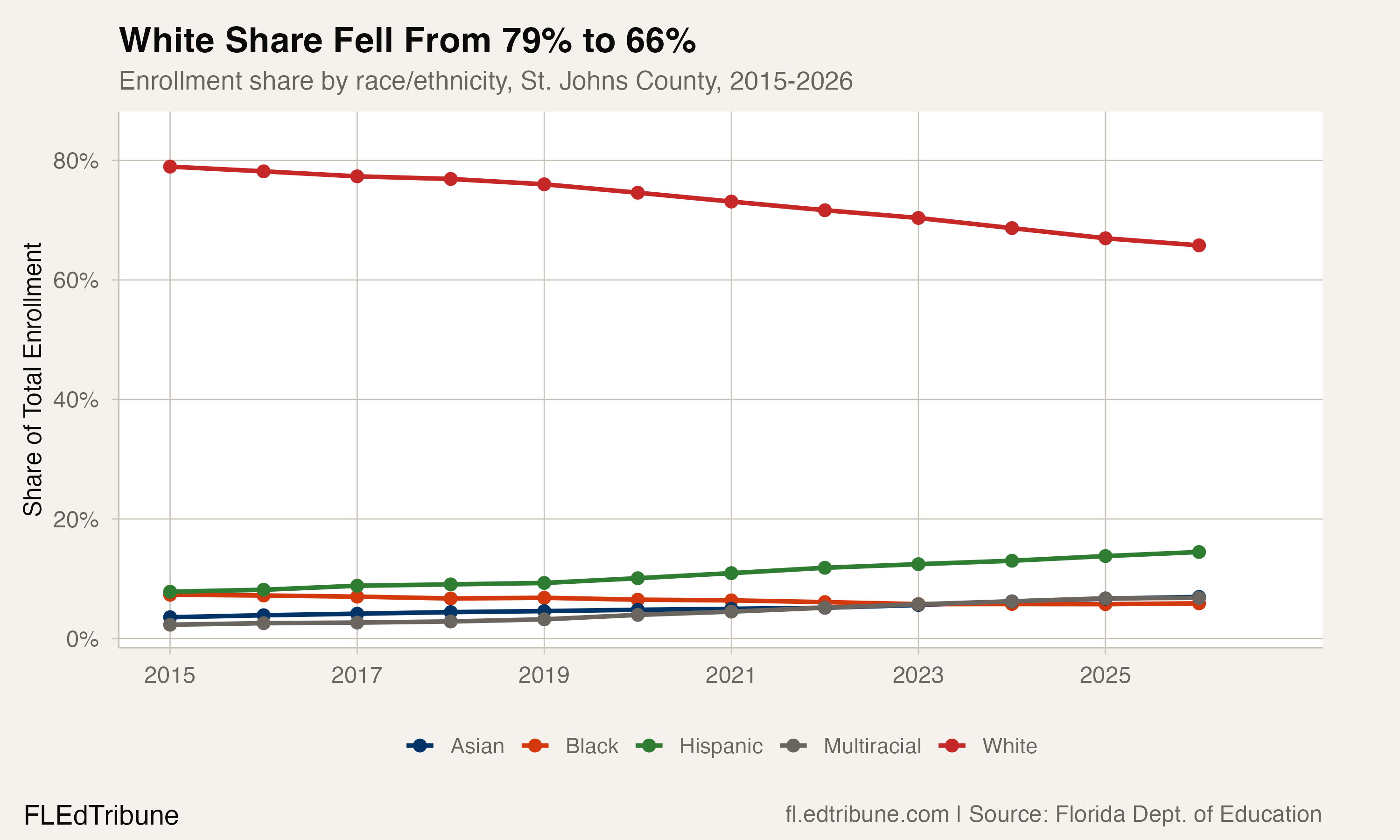
Black enrollment grew more slowly in absolute terms, adding 506 students, and its share actually fell from 7.3% to 5.9% as other groups grew faster. The non-white share of St. Johns' student body has risen from 21.0% to 34.2%. The district that once looked like a demographic outlier in Northeast Florida is converging, slowly, toward the state profile.
The Duval Mirror
St. Johns' story is inseparable from Duval's. The two districts share a metro area, and families who leave Duval County Public Schools often land in St. Johns. Since 2015, Duval has oscillated between 126,802 and 130,283 students while St. Johns climbed steadily from 35,163 to 52,385. Indexed to 2015 enrollment, St. Johns reached 149 while Duval hovers near 99.
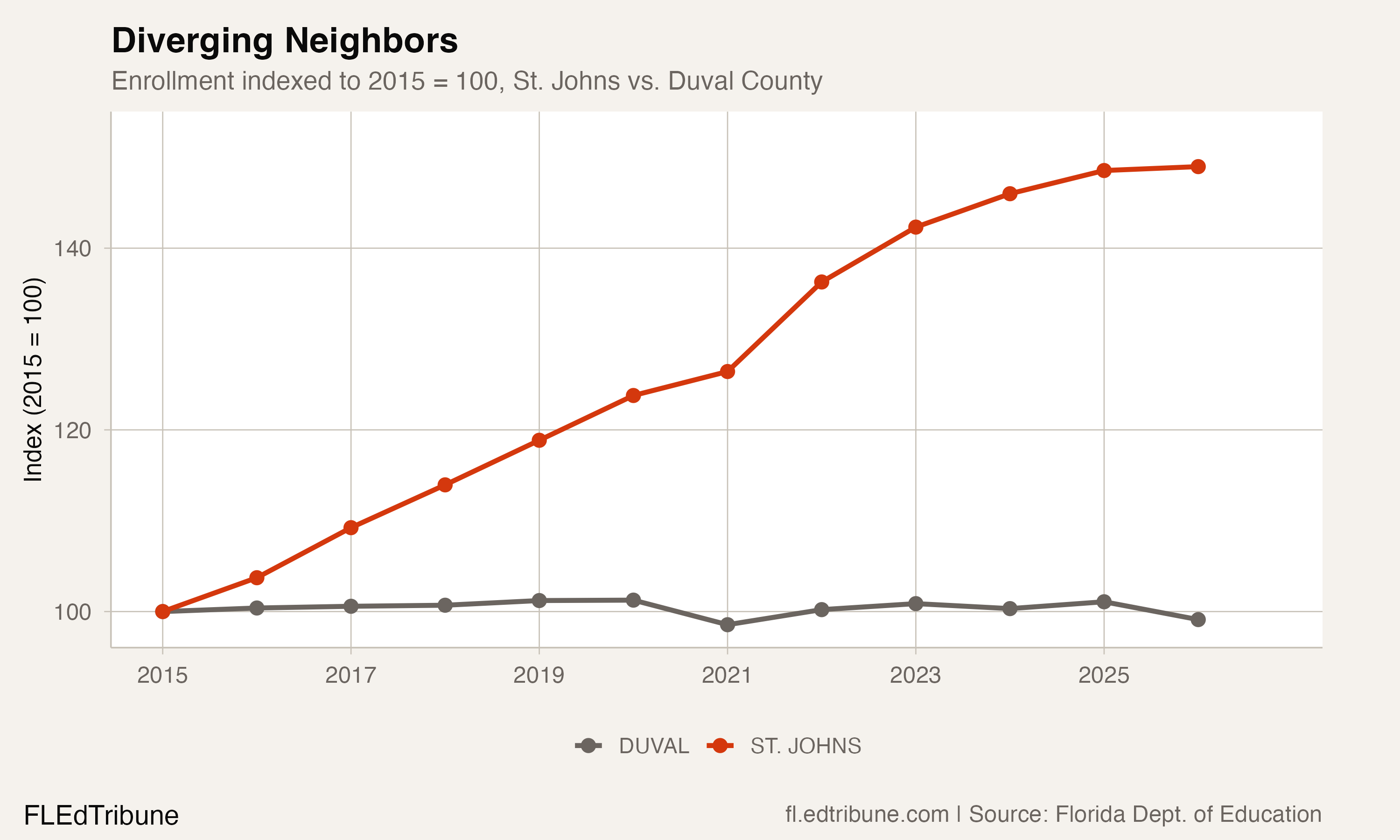
Duval lost 2,524 students in 2026, its second-largest single-year decline in the dataset. The district is considering consolidation of several schools and has explored selling its Southbank headquarters. Whether the families Duval is losing are going to St. Johns, to private schools, or out of the metro entirely is a question enrollment data alone cannot answer.
What Kindergarten Says About What Comes Next
St. Johns' kindergarten enrollment peaked at 3,215 in 2024 and has since declined to 3,077 in 2026. The pipeline is thinning. Meanwhile, the district's 12th-grade class stands at 4,299, larger than the incoming kindergarten cohort by more than 1,200 students. That gap did not exist a decade ago, when the district enrolled 2,432 kindergartners against smaller upper-grade classes in a district half the current size.
At 0.3%, the growth streak is functionally over. What matters now is what happens to a district whose infrastructure, staffing model, and budget were built for 3,000 new students a year when that number drops to 151 — and the kindergarten pipeline says it won't recover.
Detailed code that reproduces the analysis and figures in this article is available exclusively to EdTribune subscribers.
Discussion
Sign in to join the discussion.
Loading comments...