Correction (September 30, 2026): An earlier version of this article said that among 73 Florida districts with comparable data, only Hendry County had a chronic absenteeism rate below its pre-COVID level. Hendry's lower rate comes from Digital Academy of Florida, an online school counted in the district that recorded none of its 6,838 students as chronically absent; across Hendry's other schools the rate rose. No district of the 73 is below its pre-COVID level. The earlier version also said Collier is larger than Brevard (Brevard enrolls more students), that St. Johns and Brevard are both at least 3 points above Collier (St. Johns is 2.7 points above), and that Collier's lead over the state grew every year since 2017-18 (it narrowed from 2018-19 through 2020-21 before widening). Collier's own figures were not affected.
Every year the Florida Department of Education publishes chronic absenteeism data, Collier County↗ET appears in the same place: below the state average. Not by a little. By a lot, and by a growing margin.
In 2023-24, Collier's chronic absenteeism rate was 17.4%, while the state average sat at 31.4%. That 14-point gap is the widest it has been in the state's data. In 2017-18, the difference was 8.5 points. It narrowed slightly over the next three years, to 7.6 points in 2020-21, then widened sharply as Collier recovered from the pandemic spike faster than the state.
Part of the Florida Chronic AbsenteeismET series.
A recovery that actually happened
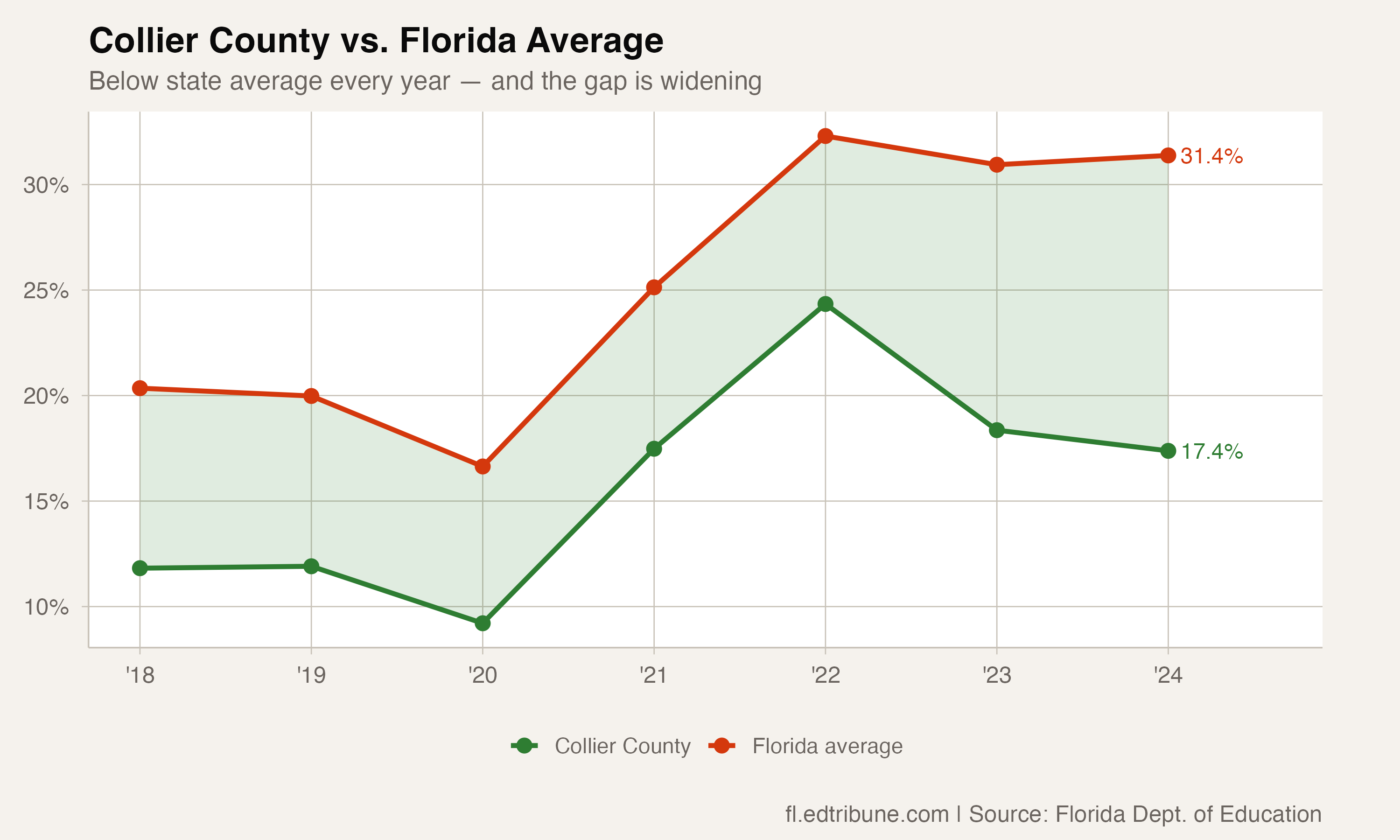
Collier was not immune to COVID. Its chronic rate jumped from 11.9% in 2019 to 24.3% in 2022, tracking the statewide surge. What happened next is what sets Collier apart. The rate dropped to 18.4% in 2023 and 17.4% in 2024, a two-year improvement of nearly 7 percentage points. Collier's current rate is closer to pre-pandemic Florida (20.0%) than to the Florida of today (31.4%).
Collier is still above its own pre-pandemic rate of 11.9%. So is every other district: among the 73 with comparable data, none has returned to its pre-COVID level once each district's rate is checked against its own schools. Collier's improvement is straightforward: the district got students back to school, on a consistent basis, in numbers that show up clearly in the data.
Among the best of the large districts
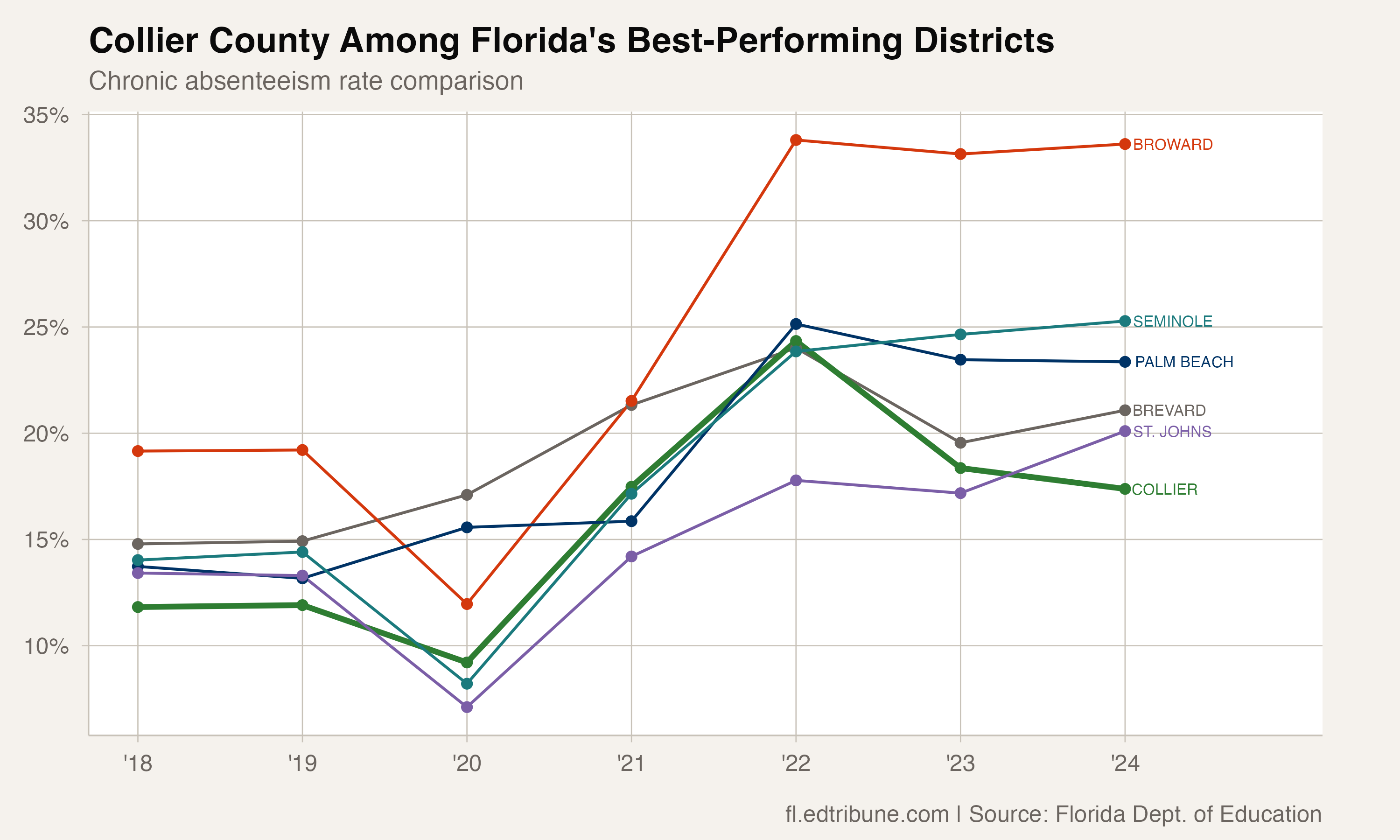
With 51,833 students, Collier is not a small district where a few dozen families can swing the rate. It is a major school system in Southwest Florida, comparable in size to Lake County (51,345 students). Among districts with 50,000 or more students, Collier has the lowest chronic absenteeism rate in the state. St. Johns↗ET (20.1%) and Brevard↗ET (21.1%) are the closest peers; St. Johns sits 2.7 points higher.
The gap between Collier and the struggling large districts is enormous. Broward↗ET, with five times the enrollment, has a chronic rate nearly double Collier's (33.6%). Duval is at 44.8%. Polk is at 39.1%.
The growing advantage
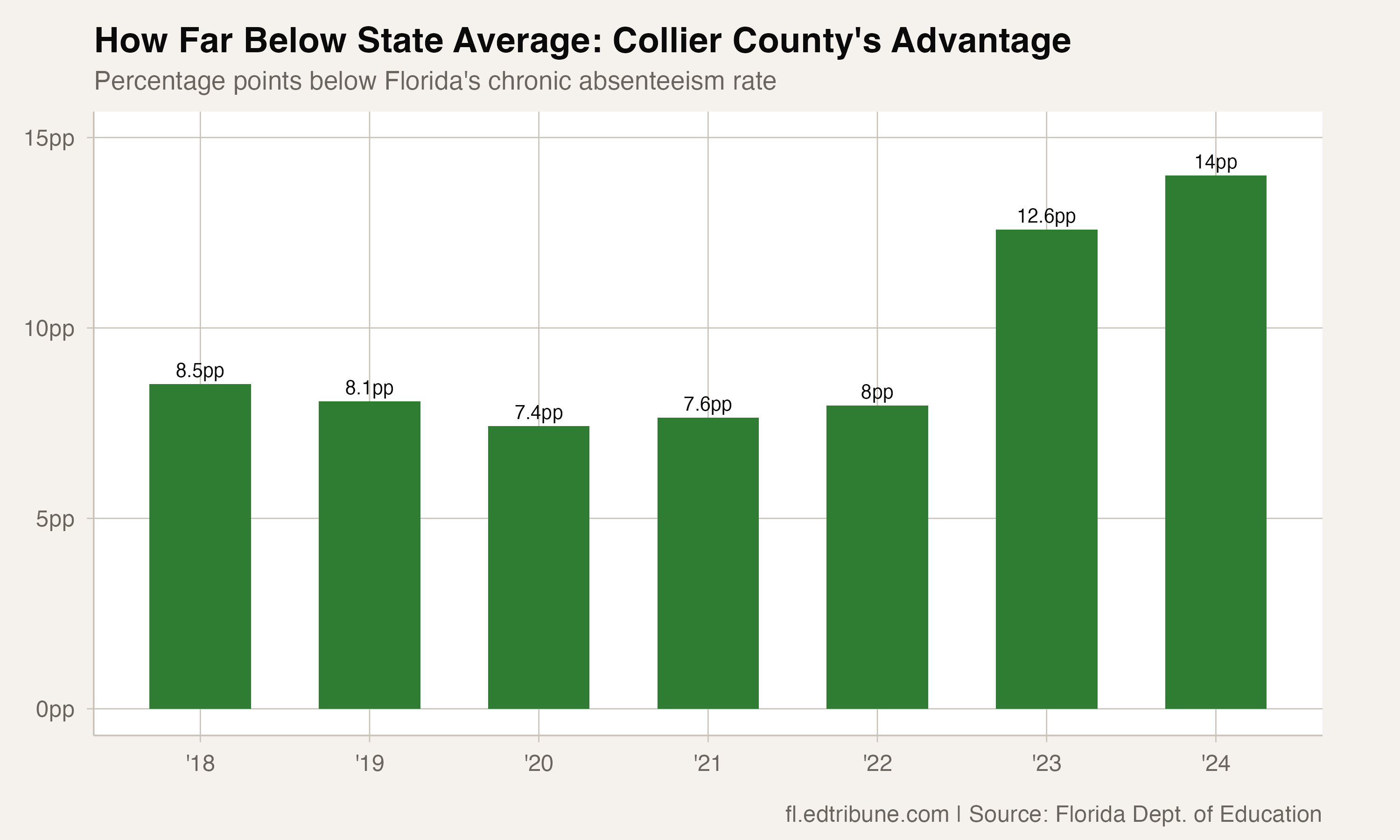
The most telling chart may be the simplest. In 2018, Collier's advantage over the state average was 8.5 points. It held between 7.4 and 8.1 points through the pandemic years, then widened to 14.0 points by 2024. Collier is not merely holding its own while the state stalls. Since the pandemic peak, it has been separating from the pack.
Florida's absence data does not include demographic breakdowns, so it is not possible to determine from the data alone whether Collier's advantage reflects its student demographics, its school culture, its community engagement practices, or some combination. Collier County is a relatively affluent area (Naples is its county seat), but it also enrolls a diverse student population, and wealth alone does not guarantee low absenteeism.
What the data does show is that a large Florida district can achieve a chronic absenteeism rate that most of its peers cannot. Collier's 17.4% would have been considered unremarkable in 2018, when the state average was 20.4%. In 2024, it is exceptional. The question for the rest of Florida is whether whatever Collier is doing can be understood well enough to replicate it, and whether the state is interested in finding out.
Detailed code that reproduces the analysis and figures in this article is available exclusively to EdTribune subscribers.
Discussion
Sign in to join the discussion.
Loading comments...