Florida's public schools lost 68,685 white students between 2024 and 2026. That two-year decline is larger than the white enrollment loss from the entire preceding three-year period, which included the COVID disruption. White students account for 86.3% of the state's total 79,633-student drop, even though they make up only a third of enrollment.
Part of the Florida Enrollment 2026ET series.
RELATED: 66,756 Students Gone: Florida's Enrollment Cliff Matches COVIDET
The pace is accelerating. Annual white losses averaged about 10,700 from 2015 to 2020. By 2024-2026, that figure had tripled to 34,342 per year. Only one year in the 12-year dataset shows a white enrollment gain: 2022, when 4,858 students returned in the post-COVID bounce. Every other year is red.
A 12-year slide, then a cliff
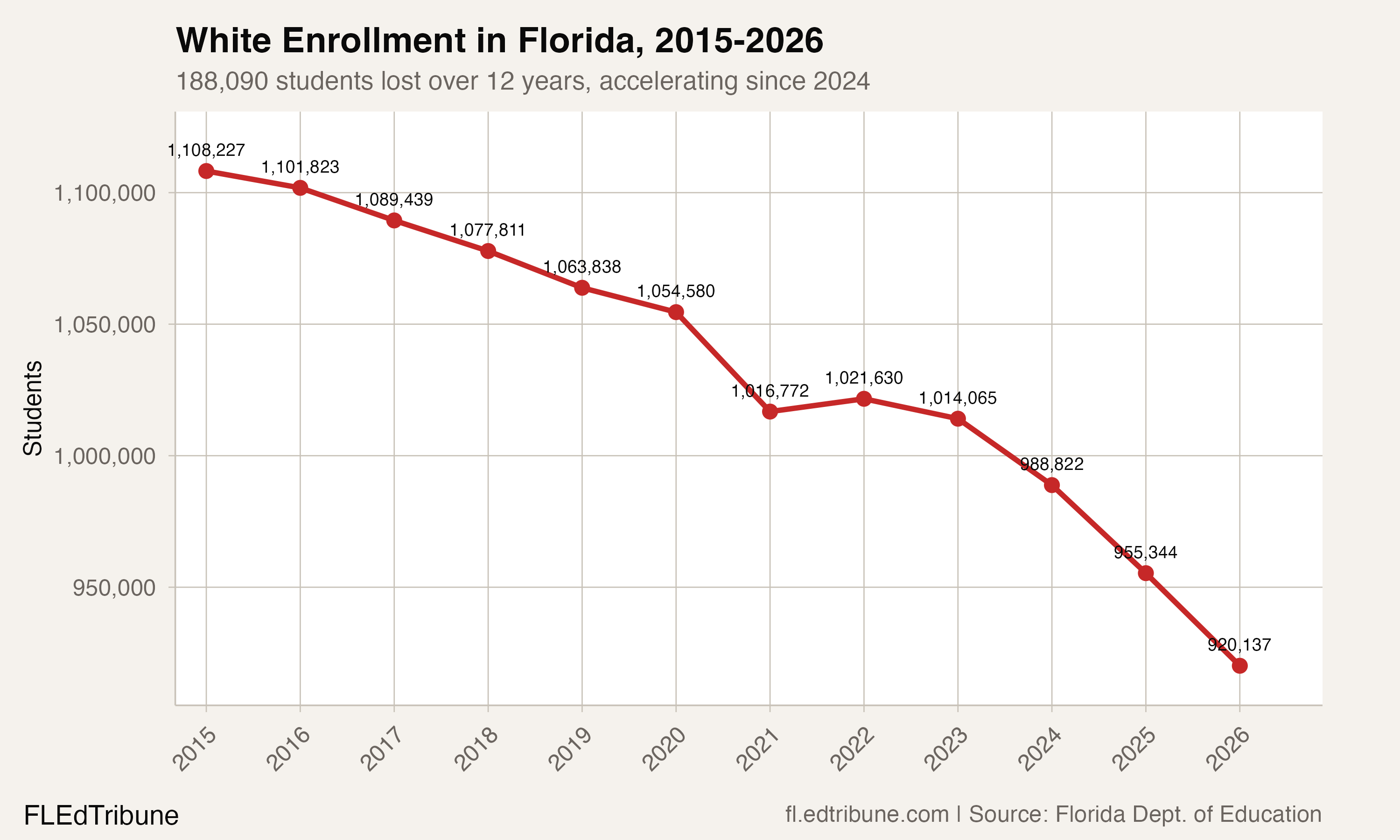
White enrollment peaked at 1,108,227 in 2015 and has fallen in 10 of 11 years since, a cumulative loss of 188,090 students, or 17.0%. The trajectory has two distinct phases. From 2015 through 2023, losses were steady but moderate, averaging about 11,800 per year. Starting in 2024, losses more than doubled: 25,243 that year, then 33,478 in 2025, then 35,207 in 2026.
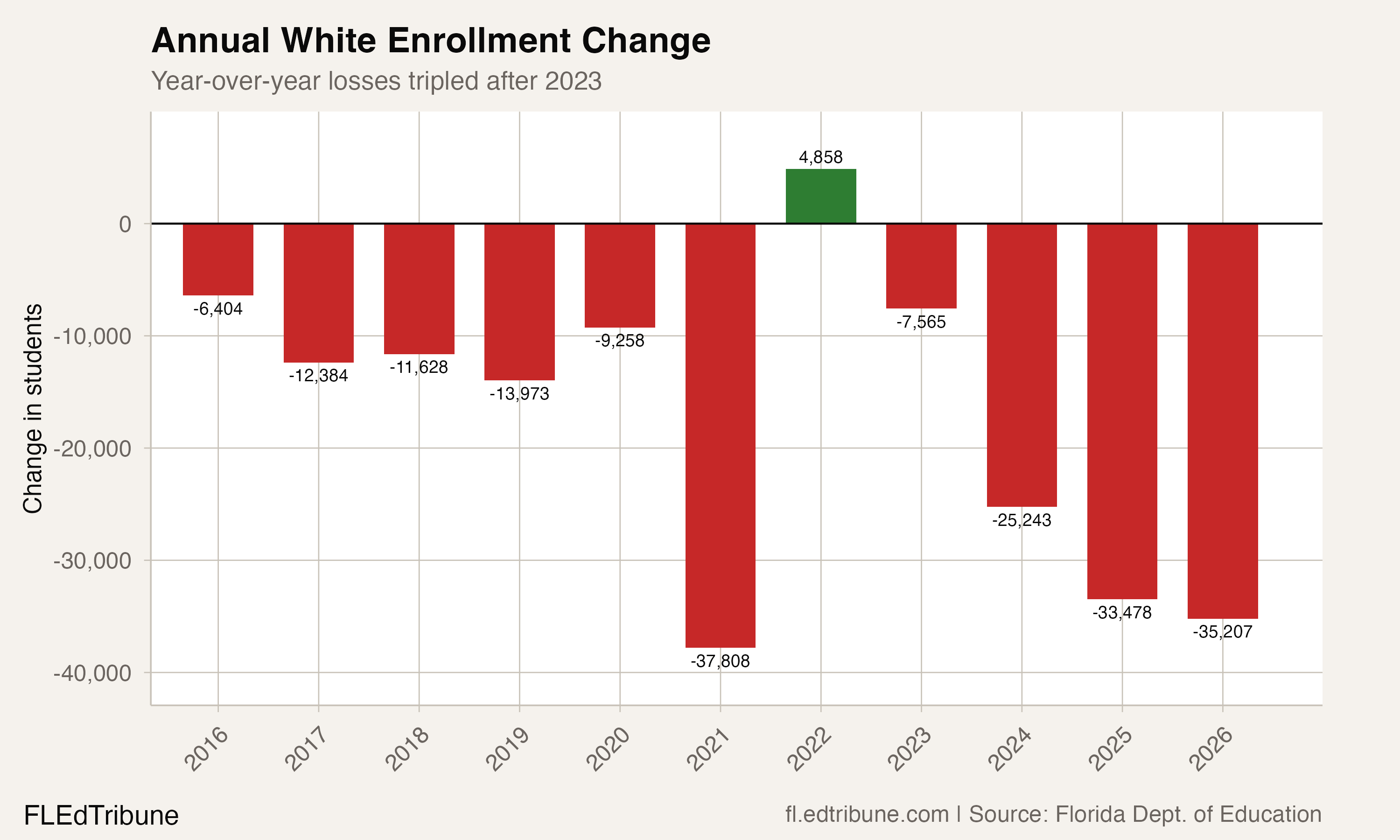
The 2021 COVID trough, when white enrollment dropped by 37,808, was treated at the time as a one-year shock. The 2025 and 2026 figures now approach that magnitude as a sustained annual rate.
Who's leaving, who's staying
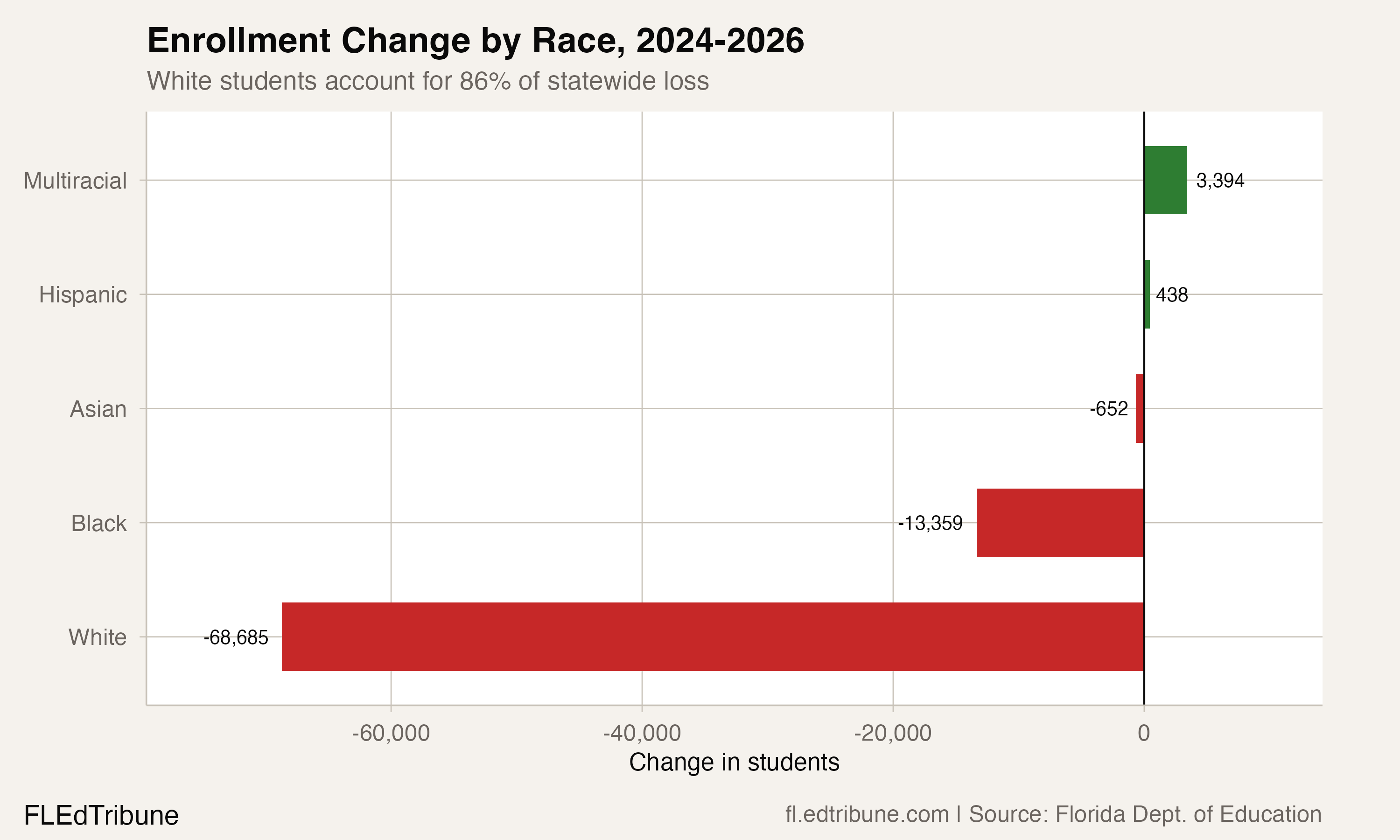
The composition of Florida's enrollment loss is overwhelmingly one group. Between 2024 and 2026, white enrollment fell by 68,685. Black enrollment declined by 13,359 (2.2%). Hispanic enrollment was essentially flat over the two-year window, gaining just 438 students, though this net figure conceals a sharp reversal: Hispanic enrollment grew by 21,339 in 2025 before dropping by 20,901 in 2026, its first non-COVID decline in the dataset. Multiracial enrollment, the only category with consistent growth, added 3,394 students.
The Hispanic dip in 2026 is notable. Every year from 2015 through 2025 (except the 2021 COVID year) saw Hispanic growth of 21,000 to 40,000 students. Whether the 2026 reversal reflects immigration enforcement effects, housing costs, or a separate demographic shift is not clear from enrollment data alone.
The crossover that keeps widening
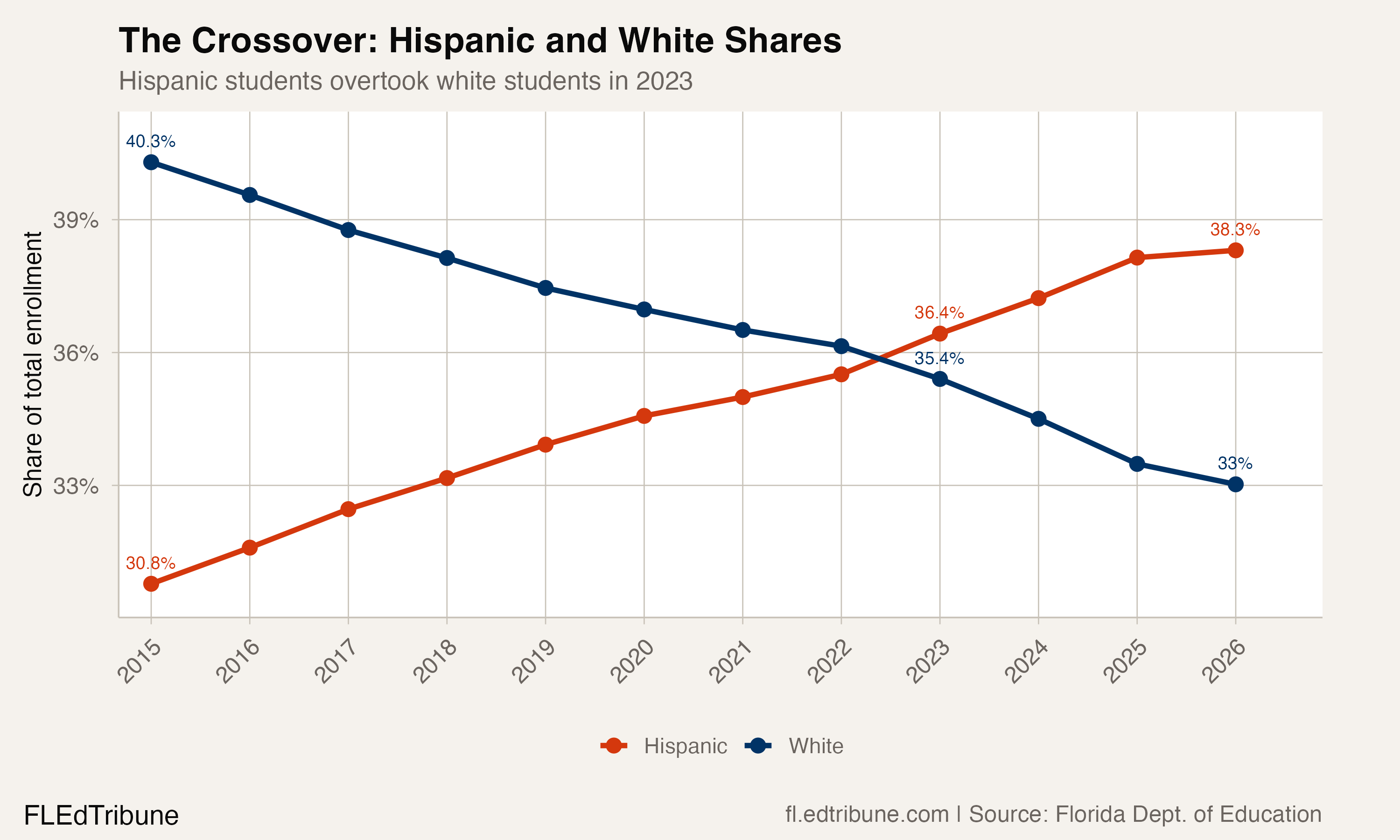
Hispanic students overtook white students as Florida's largest enrollment group in 2023, when Hispanic share reached 36.4% compared to white share at 35.4%. That gap has widened every year since. By 2026, Hispanic students comprise 38.3% of enrollment versus 33.0% for white students, a 5.3-percentage-point spread.
In 2015, white students held a 9.5-point lead over Hispanic students. The lines crossed in eight years. White share is now dropping at roughly 0.75 percentage points per year, a rate that would push it below 30% before the end of the decade.
Where the losses concentrate
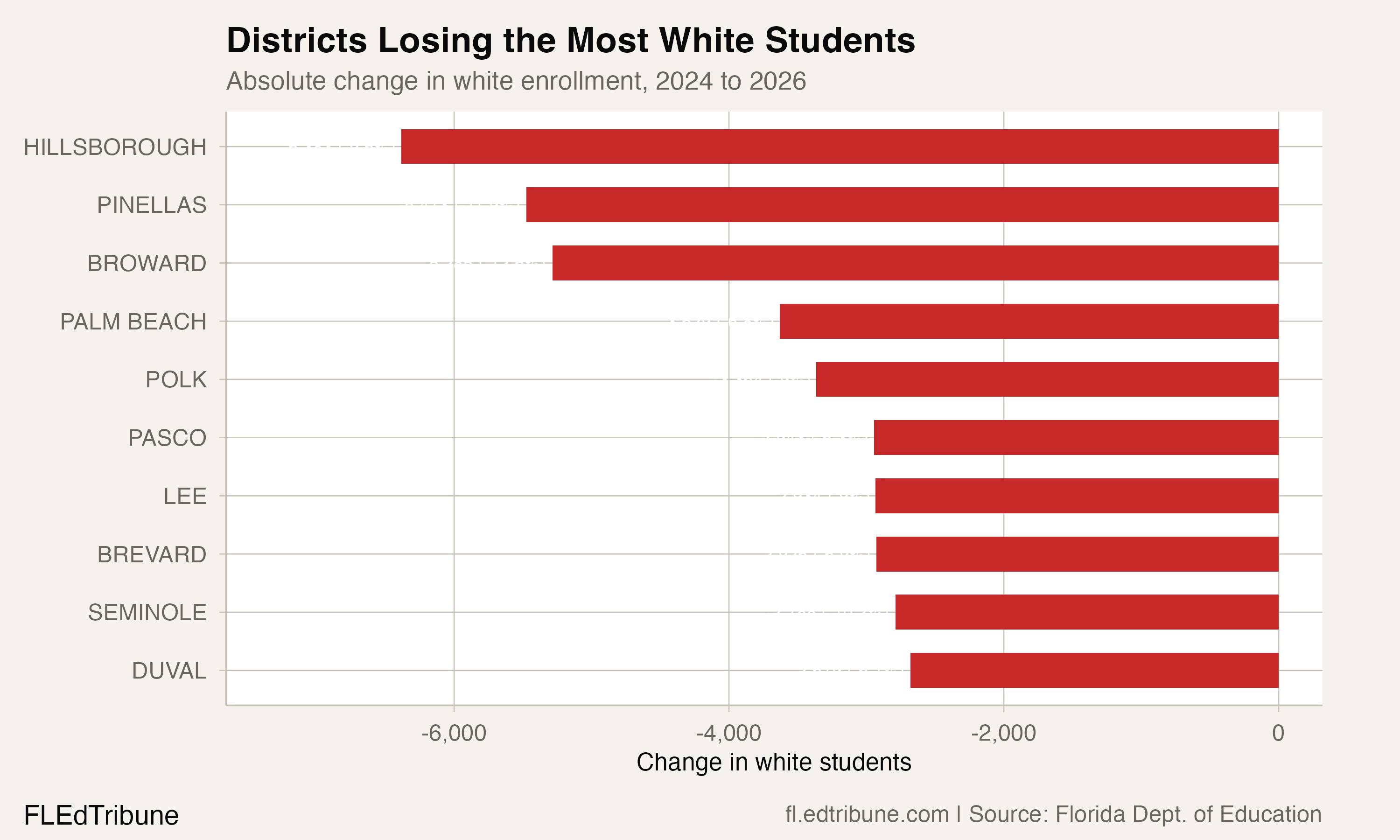
Sixty-four of 75 reporting districts lost white students between 2024 and 2026. Only nine gained. The losses concentrate in the state's largest suburban and urban districts: Hillsborough lost 6,383 white students (9.6%), Pinellas lost 5,473 (11.9%), Broward lost 5,285 (12.6%), and Palm Beach lost 3,629 (6.8%). Those four districts alone account for 30.2% of the statewide white decline.
In several mid-sized districts, white losses exceeded total enrollment losses, meaning non-white enrollment partially offset the departures. Brevard lost 2,926 white students but only 2,138 total. Duval lost 2,679 white students but only 1,555 total. Volusia lost 2,573 white students but only 2,453 total. In each case, Hispanic or multiracial enrollment growth cushioned the headline number.
Pinellas stands out for the rate of its white decline: 11.9% in two years. The district already plans to close additional schools amid shrinking enrollment. Births in the county dropped from over 10,000 in 1990 to fewer than 7,400 in 2021, and the share of children attending public schools has fallen below 70%.
Vouchers, housing, and competing explanations
Three things could explain the acceleration. The enrollment data can't tell you how much weight each one carries.
The most obvious is Florida's universal voucher program, which expanded eligibility to all families regardless of income starting in 2023. By 2025-2026, over 350,000 students use vouchers statewide, with state funding redirected to private schools rising from $1.4 billion to $3.8 billion in three years. About 25% of voucher recipients now come from families earning $125,000 or more annually. The program does not publish racial demographics of participants, but the income profile and the fact that 69% of new voucher users were already in private school suggest the expansion is subsidizing families who had already left public schools rather than pulling new students out. Still, even if the voucher program primarily formalized existing private enrollment, it removes the financial incentive to return.
Then there's outmigration. Florida's net domestic migration plummeted from roughly 310,000 people in 2022 to about 22,500 in 2025, a 93% decline. The departing population skews young, with a median age of 32.4, precisely the demographic with school-age children. Rising housing costs, insurance premiums, and post-hurricane risk are pushing families toward Georgia, North Carolina, and Tennessee. If the families leaving are disproportionately white, this would directly reduce white enrollment even without any shift to private schools.
The third factor is the birth rate. Florida births have fallen steadily, and the pipeline effect is visible: statewide kindergarten enrollment dropped 8.0% in just two years, from 195,032 in 2024 to 179,414 in 2026. Race-specific birth data from March of Dimes shows white births comprised 41.2% of Florida births in the 2021-2023 period, but this three-percentage-point premium over white enrollment share (33.0%) suggests births alone cannot explain the gap. Families are leaving after enrollment, not just before it.
What the districts are saying
"Our public schools are struggling to make ends meet. Fewer programs for kids, larger class size for our students." -- Andrew Spar, Florida Education Association president, WLRN, December 2025
Money follows students out the door. Florida funds schools on a per-pupil basis at $9,130 per student. Every 1,000 students lost costs a district $9.1 million. Hillsborough faces an $18.3 million shortfall driven partly by enrollment declines. Orange County is considering closing seven schools after losing over 5,500 students. Broward, which has lost 23,964 students since 2021, is evaluating 34 schools for closure, repurposing, or consolidation to address what the superintendent called an "oversized footprint" with over 45,000 empty seats.
"It's so expensive to live in Pinellas County that families, or people who would have a family, don't want to live here." -- Pinellas Classroom Teachers Association president, FOX 13 Tampa Bay, September 2025
State Rep. Kelly Skidmore characterized the voucher expansion as "just a subsidy for wealthier people, people who already have the advantage."
The question the data cannot answer
The enrollment data shows that white families are leaving Florida public schools at a rate three times the pre-COVID baseline. It can't say how many moved out of state, how many switched to private schools with voucher subsidies, and how many were never replaced by incoming births. All three forces pull in the same direction, which is why the acceleration is so sharp. If voucher usage stabilizes and housing costs moderate, the rate could slow. If not, white enrollment will drop below 900,000 by 2027 and Florida's public school system will serve a student body that looks nothing like the one it was built for a decade ago.
The kindergarten pipeline offers the clearest early warning. With 179,414 kindergartners in 2026, down 8.0% in two years, the losses visible in the 2026 state data will compound for years as smaller cohorts move through the grades. For districts like Pinellas and Broward, already closing schools and cutting programs, the question is not whether to downsize but how fast.
Detailed code that reproduces the analysis and figures in this article is available exclusively to EdTribune subscribers.
Discussion
Sign in to join the discussion.
Loading comments...