Six years ago, Polk County↗ET had one of the more manageable attendance pictures among Florida's large districts. Its chronic absenteeism rate of 19.0% in 2017-18 was just below the state average, unremarkable enough that it did not merit special attention.
By 2023-24, the rate had more than doubled to 39.1%, and 50,277 of the district's 128,510 students were chronically absent. The doubling happened in two waves: a pre-COVID drift upward, then a pandemic-era surge that never receded.
Part of the Florida Chronic AbsenteeismET series.
Two surges, no recovery
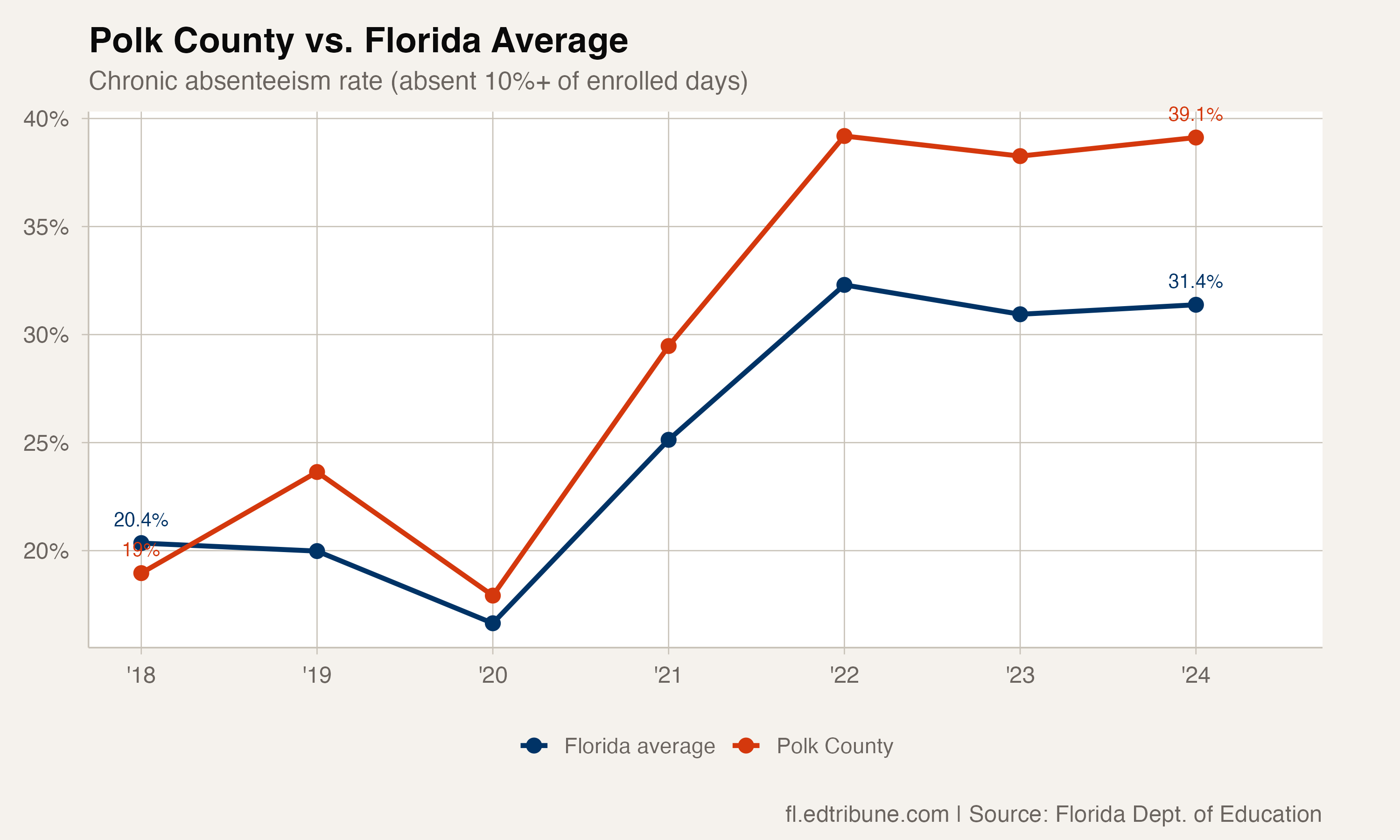
Polk's trajectory has a peculiar feature. The first significant jump came before the pandemic: from 19.0% in 2018 to 23.6% in 2019, a 4.7-point increase in a single pre-COVID year. Whatever was driving attendance problems in Polk County was already accelerating before school closures.
The pandemic year of 2019-20, when truncated calendars and relaxed absence tracking reduced rates almost everywhere, brought Polk back down to 17.9%. Then the post-COVID surge began: 29.5% in 2021, 39.2% in 2022. The rate has stayed locked near 39% for three consecutive years (39.2%, then 38.3%, then 39.1%) with no downward momentum.
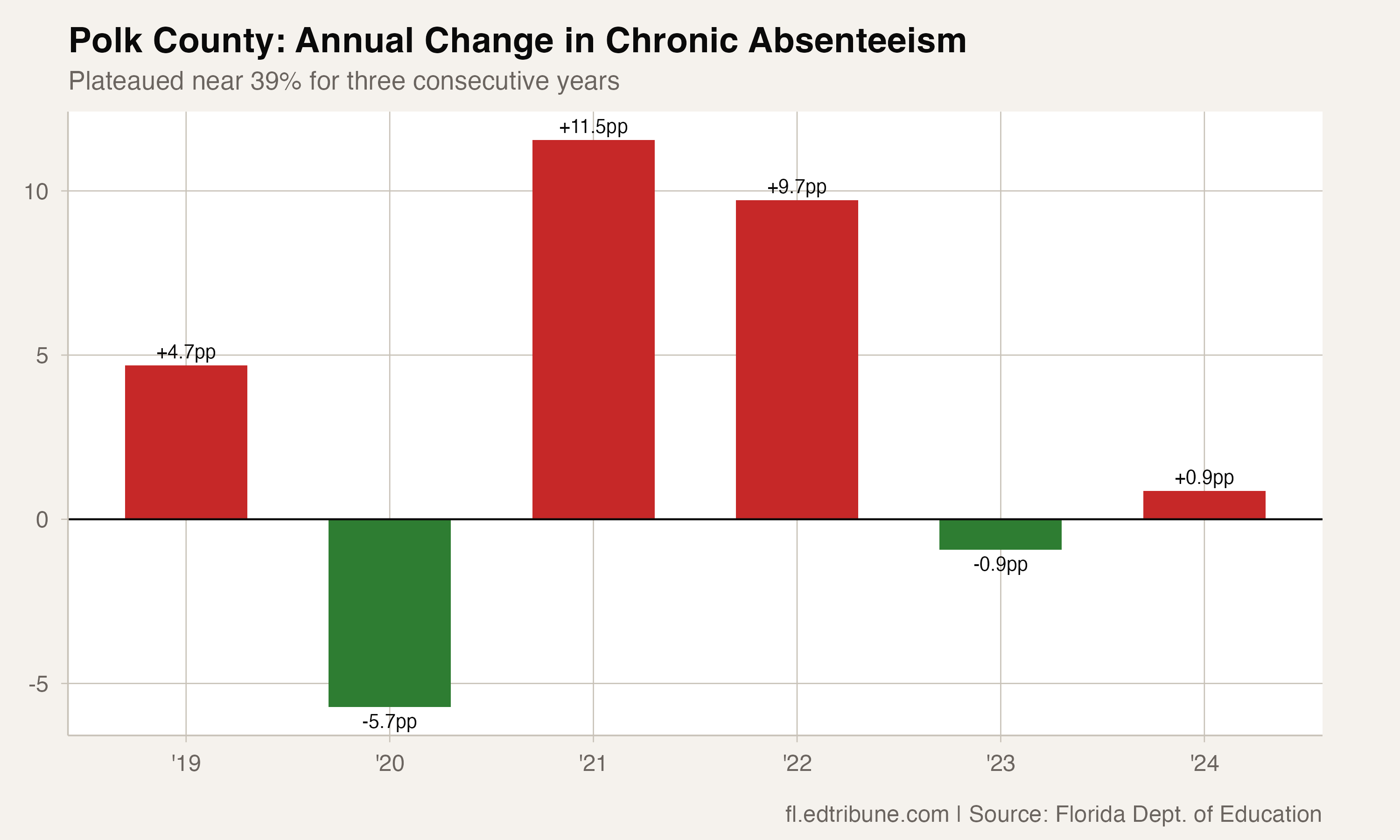
The plateau is arguably worse than continued increases. A district that is getting worse might at least generate the urgency needed to provoke intervention. A district that is stuck at 39% risks having that number become accepted as normal, baked into expectations, accommodated rather than challenged.
50,277 students
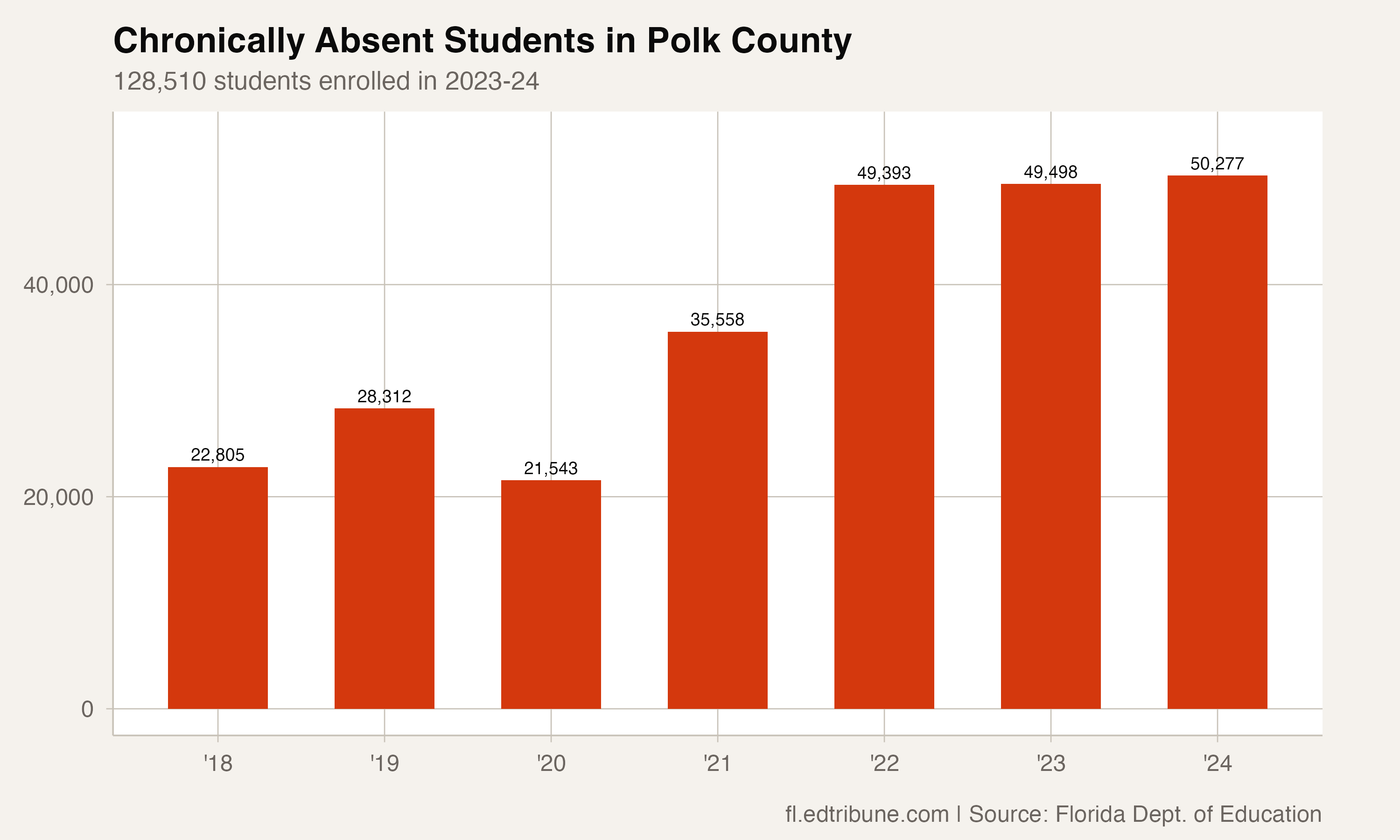
The absolute number tells a story the percentage can obscure. In 2018, roughly 22,800 Polk County students were chronically absent. In 2024, 50,277 are. That increase of 27,472 students happened while total enrollment grew by only 8,245, from 120,265 to 128,510. The absent count is growing far faster than the student body.
Polk accounts for 5.1% of all chronically absent students in Florida, a share disproportionate to its 4.1% share of statewide enrollment. That gap has widened since 2018, when Polk's chronic count was roughly proportional to its enrollment. The district is becoming an outsized contributor to the state's attendance crisis.
The eighth-largest district with the second-worst rate
Among Florida's 20 districts with 50,000 or more students, only Duval County (44.8%) has a higher chronic rate than Polk. The others in the top tier, including Orange (35.2%), Lee (34.6%), and Broward (33.6%), are all elevated but several points below Polk's 39.1%.
The comparison with similar-sized districts outside of Polk's geography is instructive. Brevard County, with 78,425 students, has a 21.1% rate. Seminole, with 68,967, sits at 25.3%. These districts are not immune to the post-COVID attendance crisis, but they are managing it at rates 14 to 18 points below Polk's.
Polk County sits in Central Florida, between Orlando and Tampa, and has experienced significant population growth in recent years even as some of its neighboring districts have contracted. The growth suggests that housing instability — families cycling between addresses, children changing schools — may play a role in Polk's attendance challenges, though the available data does not permit that analysis.
Detailed code that reproduces the analysis and figures in this article is available exclusively to EdTribune subscribers.
Discussion
Sign in to join the discussion.
Loading comments...