Correction (2026-03-11): An earlier version of this article stated that 2026 enrollment was 1,344 students below the 2021 COVID trough. It is actually 1,344 students above the trough. The loss figure for the seven largest non-recovered districts has also been corrected from 97,363 to 107,544.
Florida's public school system got within 1% of full COVID recovery in 2023. Then it started losing ground. By fall 2025, only 27 of 73 districts had matched or exceeded their pre-pandemic enrollment, a 37.0% recovery rate that is lower than any point in the state's post-COVID trajectory except the pandemic year itself. Two-thirds of Florida's 2.8 million public school students now attend a district that has fewer children than it did before the pandemic.
Part of the Florida Enrollment 2026ET series.
RELATED: Gadsden County Has Lost More Than a Quarter of Its StudentsET
This is not a slow fade. The 2025-2026 single-year loss was the largest since the pandemic itself, and unlike 2021, there is no external shock to explain it. The losses are compounding on top of years of unrecovered decline.

The recovery that reversed
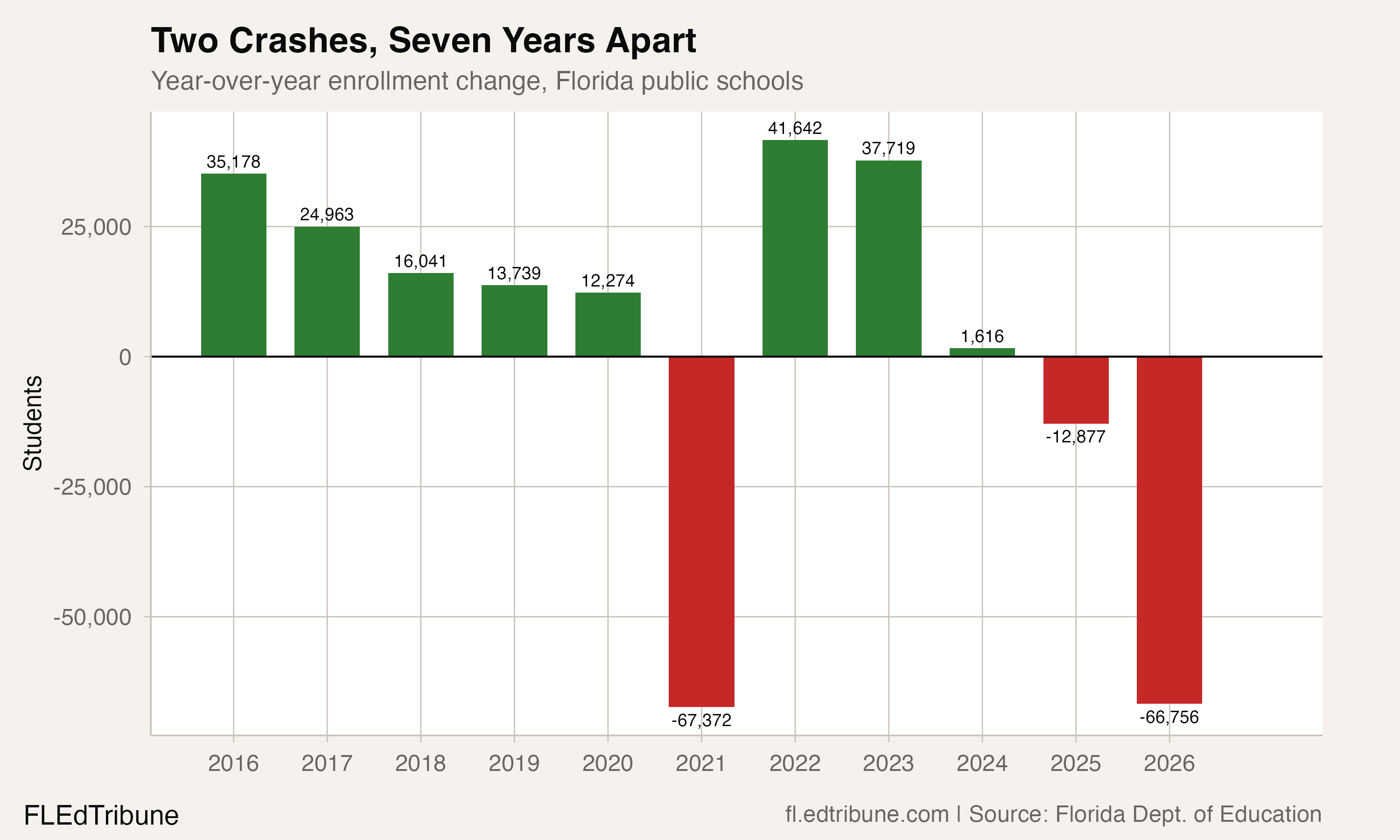
The rebound initially looked strong. Florida added 41,642 students in 2022 and another 37,719 in 2023, pushing total enrollment to 2,864,292, a new record. By 2023, 41 of 73 districts (56.2%) had recovered to or above their 2019 levels.
Then it broke. Growth flatlined in 2024, reversed in 2025, and accelerated downward in 2026, dropping total enrollment to 2,786,275, just 1,344 students above the 2021 COVID trough and 53,754 below the pre-pandemic 2019 level.
The recovery rate fell with it: from 56.2% in 2023 to 49.3% in 2024, 45.2% in 2025, and 37.0% in 2026. Each year, more districts are slipping backward.
Where the damage concentrates
Thirty-six districts never recovered from COVID and then lost additional students in 2025-2026. Their compound loss since 2019 totals 132,320 students. Meanwhile, 68.6% of all Florida public school students attend a district that remains below 2019 levels.
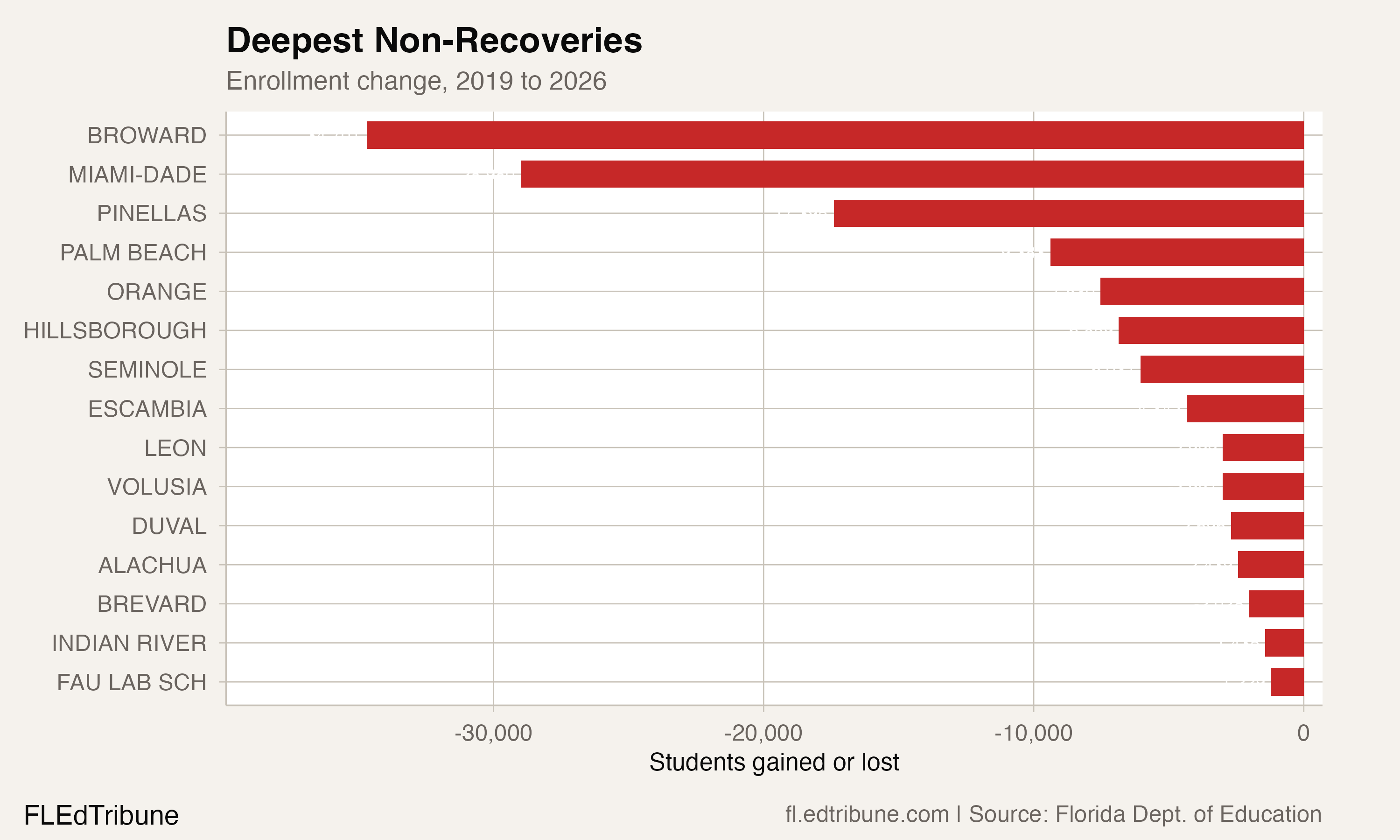
Three districts account for half the damage. Broward↗ET, Miami-Dade↗ET, and Palm Beach↗ET together account for 50.5% of the total non-recovery loss: 73,064 of 144,556 students lost statewide since 2019 among districts that have not recovered.
| District | 2019 | 2026 | Change | Pct. Change |
|---|---|---|---|---|
| Broward | 270,961 | 236,260 | -34,701 | -12.8% |
| Miami-Dade | 350,372 | 321,392 | -28,980 | -8.3% |
| Pinellas | 100,955 | 83,560 | -17,395 | -17.2% |
| Palm Beach | 194,174 | 184,791 | -9,383 | -4.8% |
| Orange | 209,102 | 201,572 | -7,530 | -3.6% |
| Hillsborough | 220,250 | 213,391 | -6,859 | -3.1% |
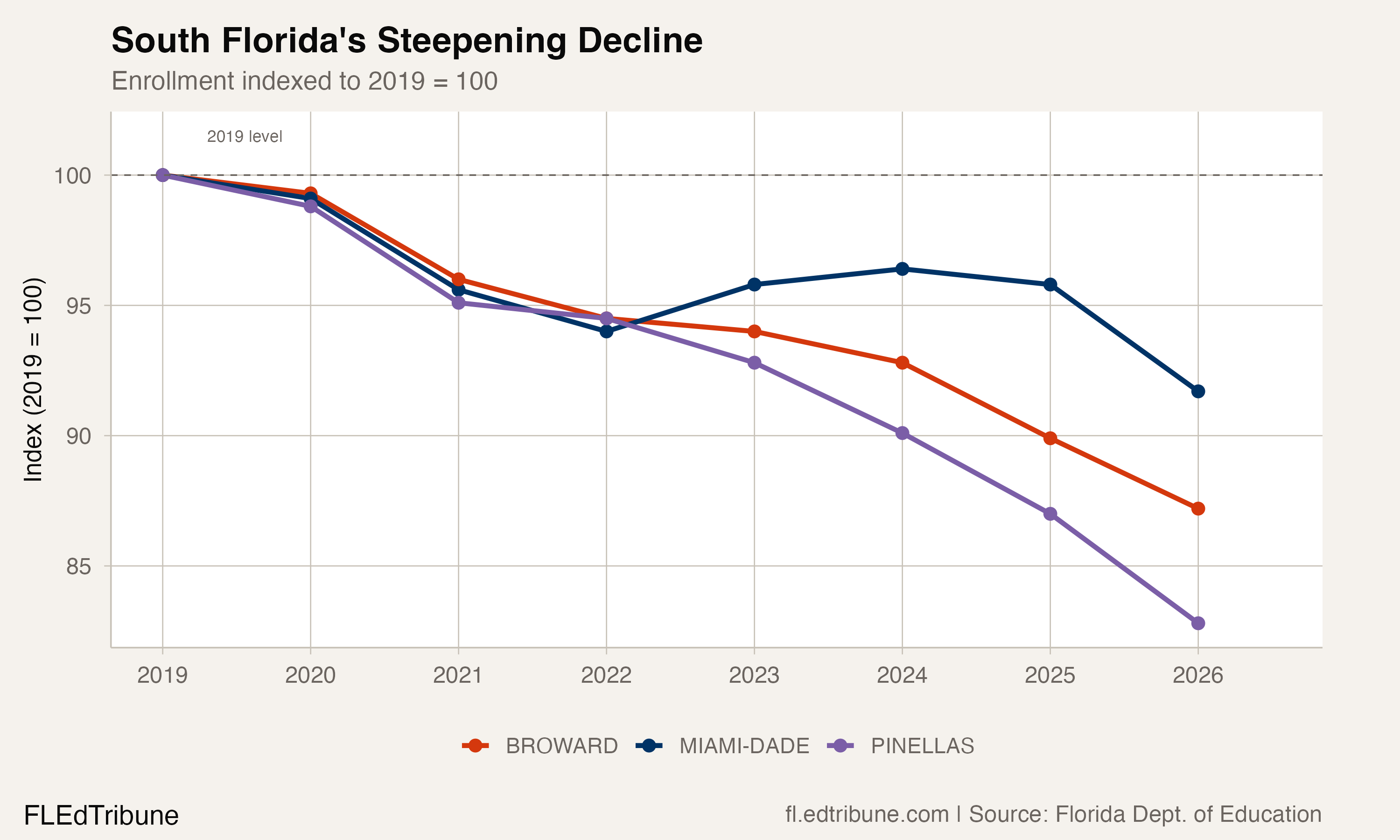
Pinellas↗ET has lost students every single year since 2019, and the pace is picking up: from -631 in 2022 to -4,234 in 2026. At 17.2% below pre-pandemic enrollment, its percentage decline is the steepest among Florida's large districts.
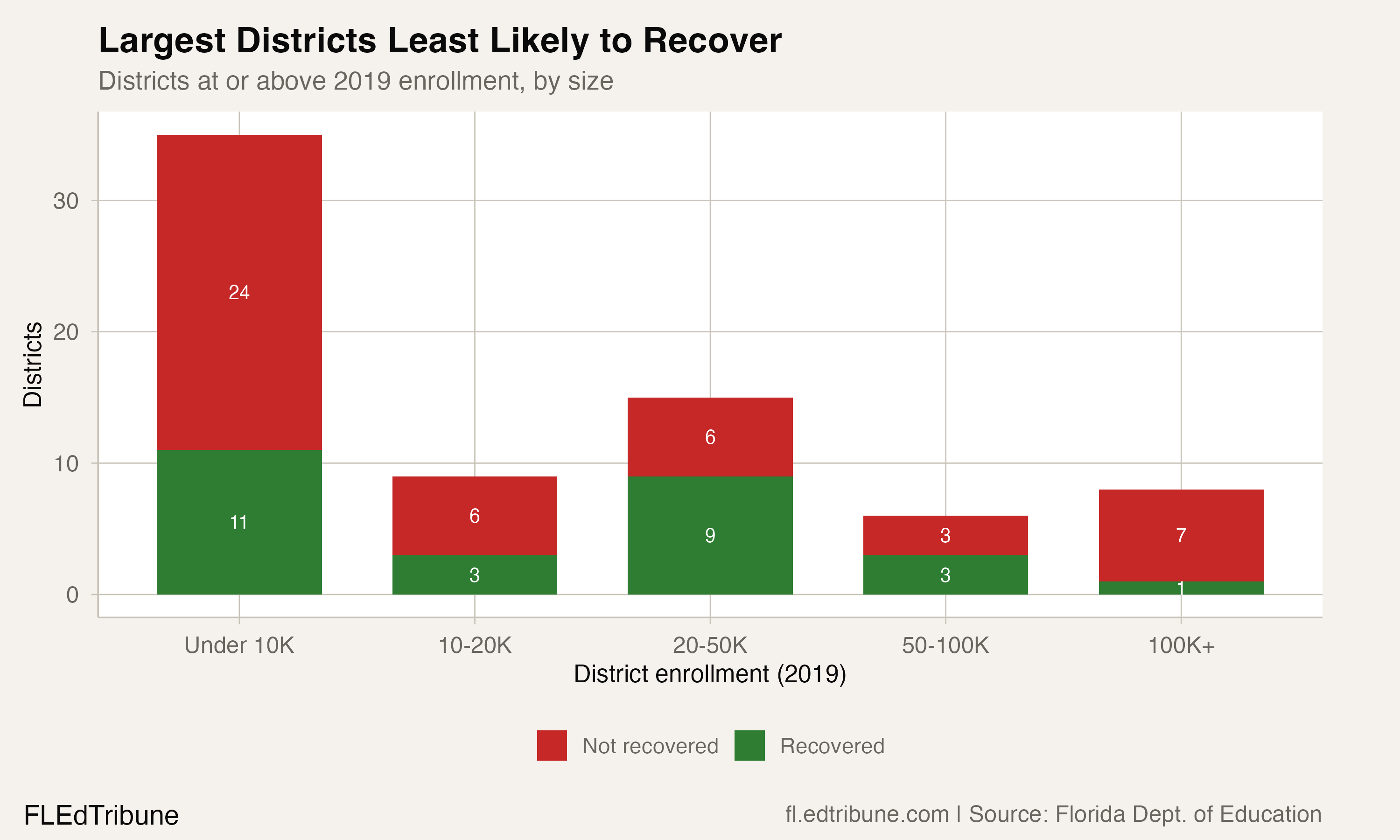
Among the eight districts with more than 100,000 students in 2019, only one, Polk↗ET County, has recovered. Seven of eight remain below pre-pandemic levels, and together those seven have lost 107,544 students since 2019.
South Florida's compounding losses
Broward has not gained students in a single year since at least 2019. Its decline accelerated sharply in 2025 and 2026, losing 7,861 and 7,276 students in consecutive years after several years of losses in the 1,000-to-4,000 range. The district now has approximately 50,000 empty seats and faces a $94 million budget shortfall from the 10,000 students it lost in the most recent year alone, according to WLRN.
Broward has begun consolidating schools in response, approving the merger of six schools in January 2026 as part of its "Redefining Our Schools" initiative, with 34 campuses under review for closure or repurposing.
Miami-Dade followed a different path. It partially recovered between 2022 and 2024, gaining 8,127 students over those two years. Then 2026 hit: a single-year loss of 14,325 students, the district's worst year in the dataset. District officials have attributed the decline primarily to reduced immigration and the rising cost of living in Miami rather than competition from private or charter schools.
Multiple forces, uncertain weights
There is no single cause. At least three mechanisms are operating at once, and the data cannot cleanly separate them.
Florida's universal voucher expansion, signed in 2023, is the most politically visible factor. Statewide, more than 500,000 students now attend private school on a voucher, and 1.4 million total are enrolled in some form of school choice. But the voucher program's direct impact on public school enrollment is difficult to isolate. Reporting by the University of Florida's Fresh Take Florida found that roughly 69% of students new to using the voucher were already enrolled in private schools, meaning the program is primarily subsidizing families already outside the public system rather than converting current public school students. In Miami-Dade, Dotres noted that charter and private schools together accounted for approximately 1,026 of the district's 13,000-student loss.
Demographics and economics may matter more, though the evidence is harder to pin down. Florida's inbound migration has slowed substantially, with major metros showing sharp reversals in 2024: Miami's net outflow grew to 67,418 residents, Fort Lauderdale lost 26,339, and Orlando's net inflow collapsed from 16,357 to just 779. Broward Superintendent Howard Hepburn has pointed to a lack of new families with young children moving into the county. In Pinellas, local officials have noted that annual births in the county have fallen from 10,000 to 6,000 over the past 15 years.
Kindergarten enrollment across Florida has dropped 10.5% since 2019, from 200,437 to 179,414, a loss of 21,023 kindergartners. That pipeline compression means the enrollment decline is partially generational. It will persist regardless of policy changes.
Size predicts vulnerability
Bigger districts are doing worse. Among districts with over 100,000 students, only one of eight (12.5%) has recovered. Mid-sized districts in the 20,000-to-50,000 range have fared best, with a 60.0% recovery rate. The pattern reflects where growth is happening in Florida: inland and suburban districts like Pasco↗ET (+11,199), St. Johns (+10,592), and Polk (+10,181) are absorbing families leaving the coast, while the state's urban cores contract.
That creates an obvious fiscal problem. Large districts that have lost thousands of students still have to heat the same buildings, run the same bus routes, and honor the same staffing contracts. Broward's $94 million shortfall from 10,000 lost students implies roughly $9,400 in lost per-pupil funding per student. For Miami-Dade, which has now lost 28,980 students since 2019, the cumulative revenue impact at similar per-pupil rates runs into hundreds of millions.
What 2026 signals for what comes next
Florida's public school enrollment is no longer on a recovery trajectory. It is within 1,344 students of its COVID trough. Sixty-one of 77 districts lost students in 2026. The recovery rate has fallen for three consecutive years and now sits at 37.0%, lower than the 42.5% posted in 2022 when the state was still actively rebounding.
The kindergarten numbers offer no relief. With 179,414 kindergartners in 2026 and 222,344 seniors, the incoming classes are 19.3% smaller than the graduating ones. Unless net migration reverses or the birth rate recovers, the downward pressure on enrollment will persist. The question is whether districts that are already below their pre-pandemic levels can right-size their operations before the fiscal math becomes unmanageable.
Detailed code that reproduces the analysis and figures in this article is available exclusively to EdTribune subscribers.
Discussion
Sign in to join the discussion.
Loading comments...