Six districts set enrollment records in 2025-26. Thirty-two set the other kind.
Part of the Florida Enrollment 2026ET series.
RELATED: Florida's Unfinished Recovery: 46 Districts Still Below Pre-Pandemic EnrollmentET
In 2026, 32 of Florida's 67 regular school districts enrolled fewer students than in any year since state records began in 2015. The list includes the three largest districts in the state: Miami-Dade↗ET at 321,392 students, Broward↗ET at 236,260, and Palm Beach↗ET at 184,791. Together, districts at record lows account for 1.17 million students, 42.3% of all students in regular districts.
The six districts at all-time highs enrolled a combined 96,000 students. Put differently: for every district breaking an enrollment record on the upside, more than five are breaking one on the downside.
The scissors close
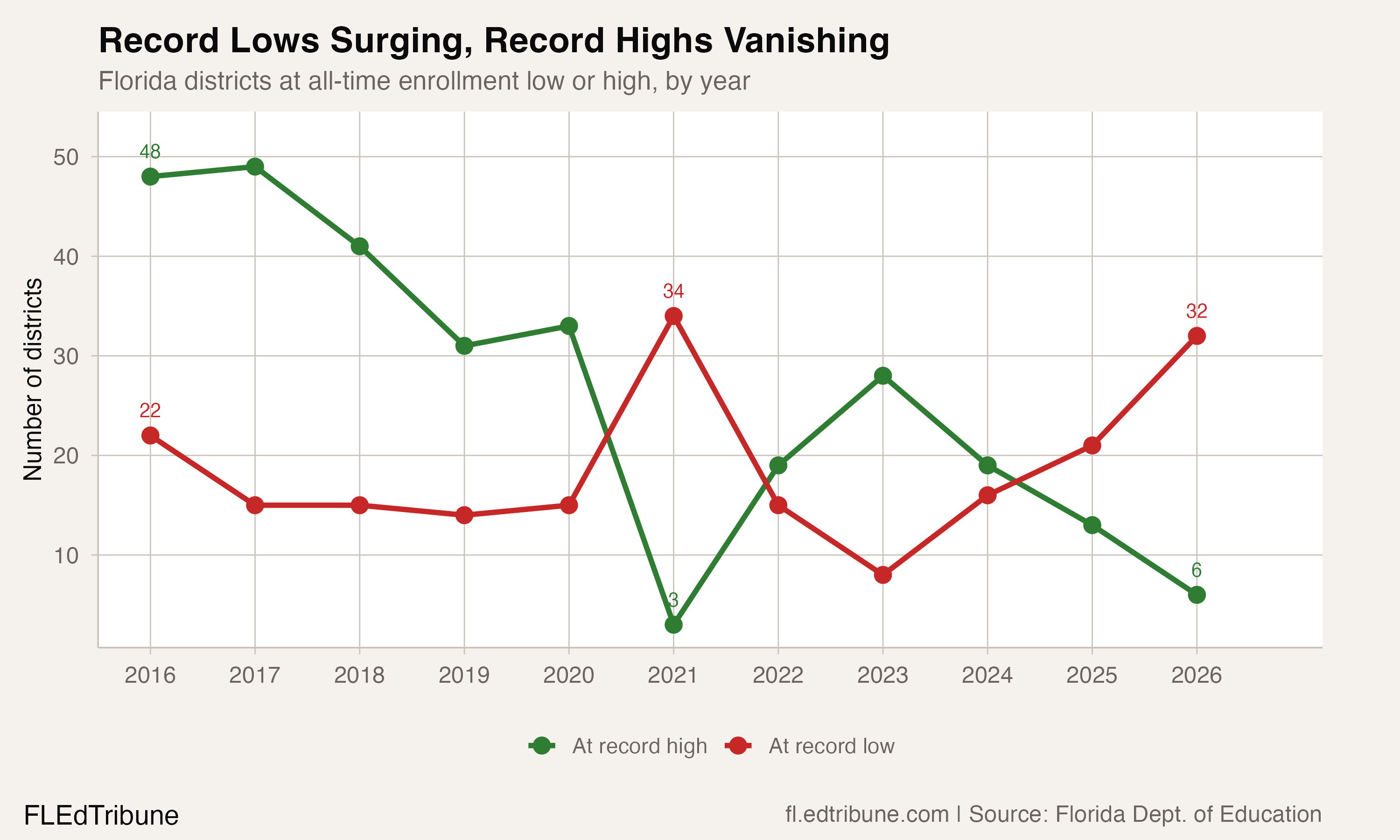
The divergence between record lows and record highs has widened every year since 2023. In 2017, 49 districts were at all-time highs and just 15 at all-time lows. By 2026, those numbers had essentially inverted: six at highs, 32 at lows.
The COVID year of 2021 foreshadowed this. That year, 34 districts hit record lows simultaneously while only three set new highs. The state appeared to recover in 2022 and 2023, when the number of at-low districts fell back to 15 and then eight. But enrollment growth stalled in 2024 (gaining just 1,616 students statewide, essentially flat) and then collapsed: a loss of 66,756 in 2026, a drop rivaling the pandemic year.
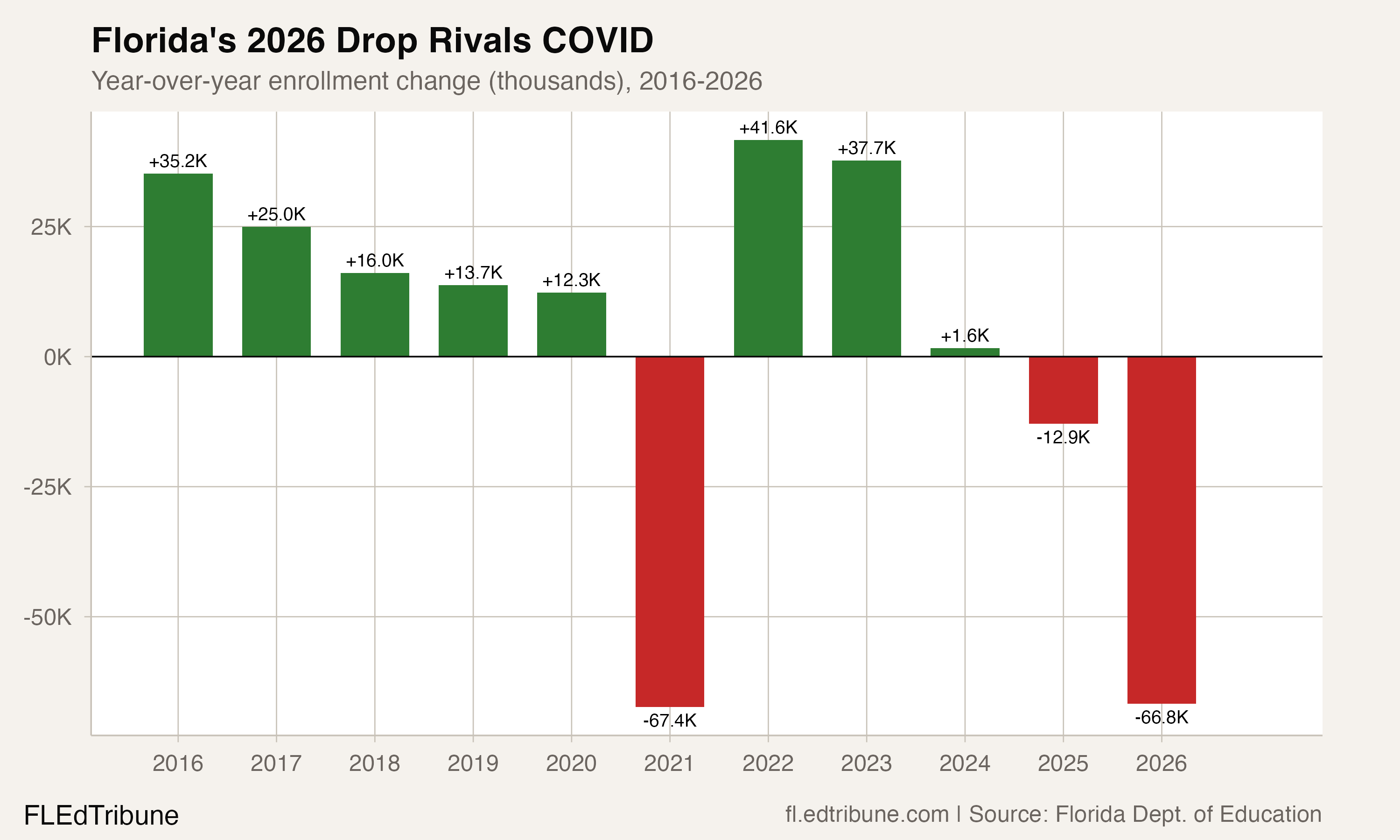
The 2026 drop differs from 2021 in one important way. COVID losses were abrupt and partially reversible. This decline has accelerated through 2025 and 2026 with no external shock to blame, and 72.6% of districts that lost students during COVID still have not recovered to their pre-pandemic levels.
Where the losses are deepest
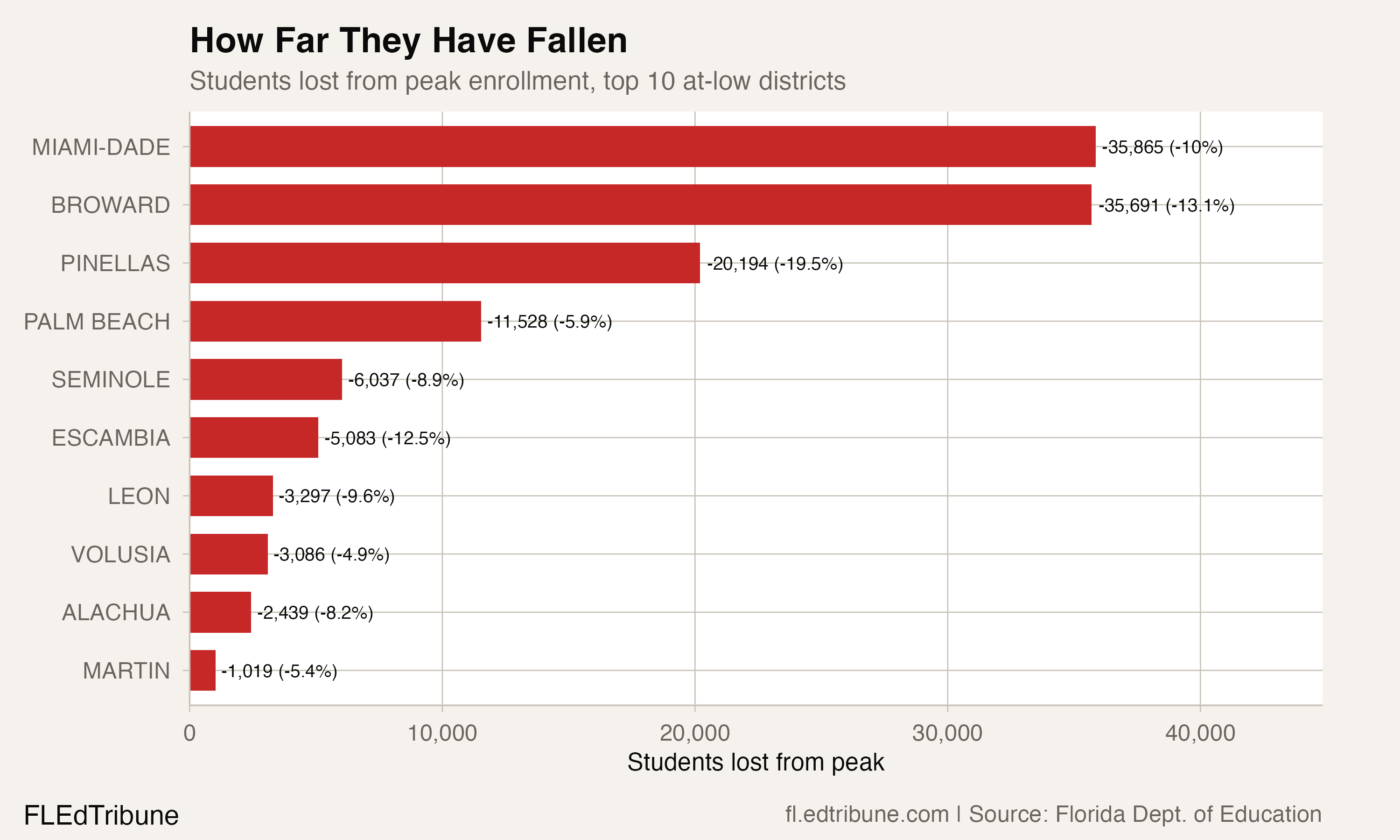
Miami-Dade and Broward have each lost more than 35,000 students from their peaks, a combined 71,556 students. Those two districts alone account for more than half of all losses across the 32 at-low districts. Pinellas↗ET is a different kind of outlier: it has declined every single year in the dataset. Eleven consecutive years. Down 20,194 students (19.5%) since 2015.
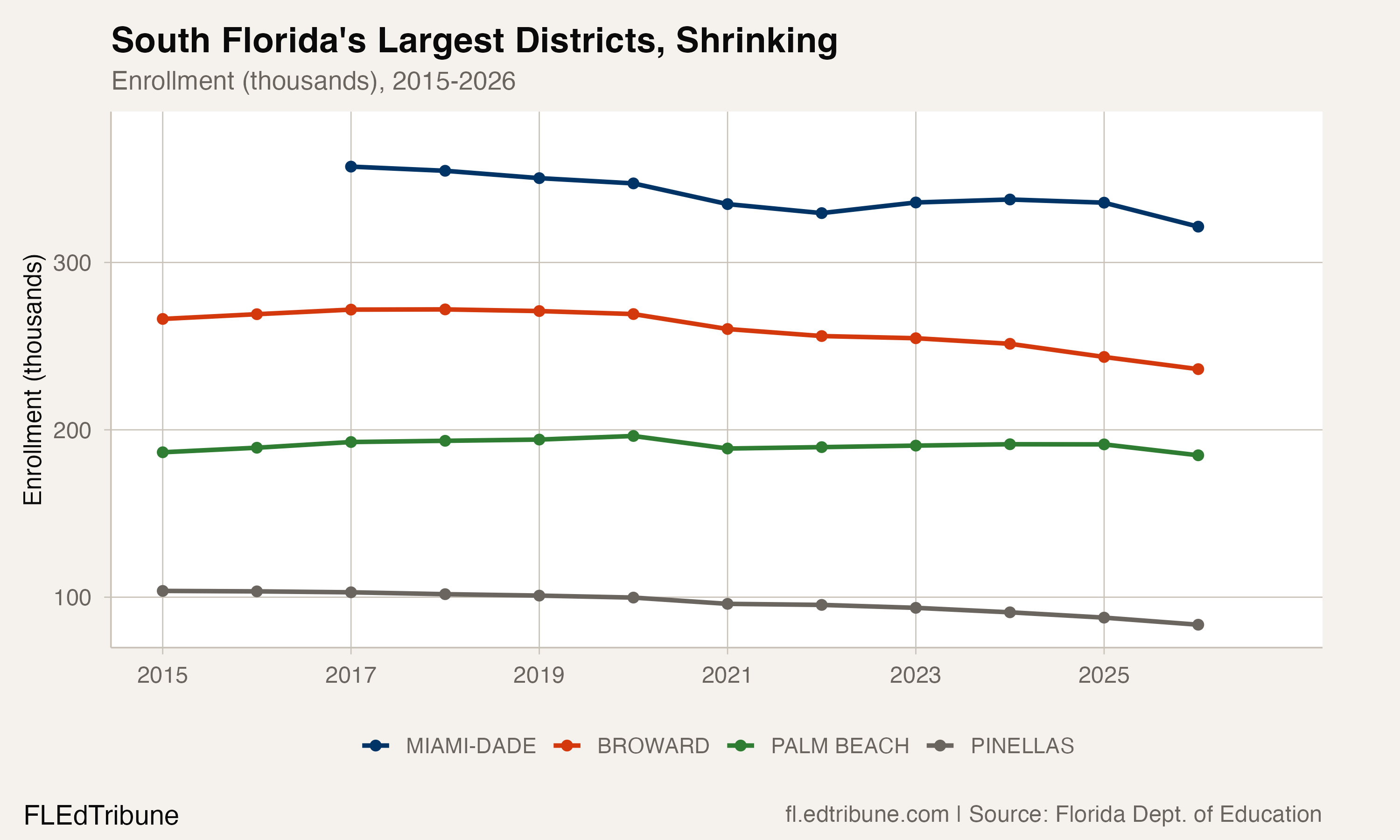
Broward's eight-year decline streak has forced the district into action. The school board identified 34 schools for potential closure, repurposing, or consolidation in August 2025, with Superintendent Howard Hepburn recommending seven for closure in December. The district has approximately 50,000 empty seats, and some elementary schools are operating at just 40% capacity.
"What we're trying to do is spend more money on the kids we have and less on the empty seats in an oversized footprint." -- Board Member Allen Zeman, WLRN, Aug. 2025
Pinellas followed a similar path. The school board approved two closures in March 2026, with additional consolidations planned for 2027, projecting $15 million in savings from reduced operating and maintenance costs.
The smaller at-low districts are losing students at steeper percentage rates. Jefferson County, at 535 students, has lost 31.5% from its 2015 peak of 781. Madison has lost 28.5%, Gadsden 27.1%. These are rural districts in the Florida Panhandle and Big Bend region where each lost student represents a proportionally larger blow to funding and viability.
Three forces, one outcome
District leaders across the state keep saying the same thing: the decline is driven more by students who never arrive than by students who leave. Falling birth rates, fewer immigrant families entering the state, and the rising cost of living in South Florida are all compressing the incoming pipeline.
The second force is the state's universal voucher program, which eliminated income requirements in 2023 and has grown rapidly since. Most new voucher recipients were already enrolled in private schools, which limits how much of the public enrollment decline can be attributed directly to voucher migration. But even a modest share of departing families compounds the losses in districts already shrinking from demographic pressure.
Third, the cost of staying in South Florida keeps rising. Florida homeowners insurance averaged $10,996 in 2023, the highest in the country, and costs have continued to climb. Some homeowners cannot secure private coverage at all.
These three forces are difficult to disaggregate in the enrollment data. A family that moves from Broward to North Carolina because of insurance costs shows up the same way as a family that switches to a private school on a voucher. The data records only who is no longer there.
The six who bucked the trend
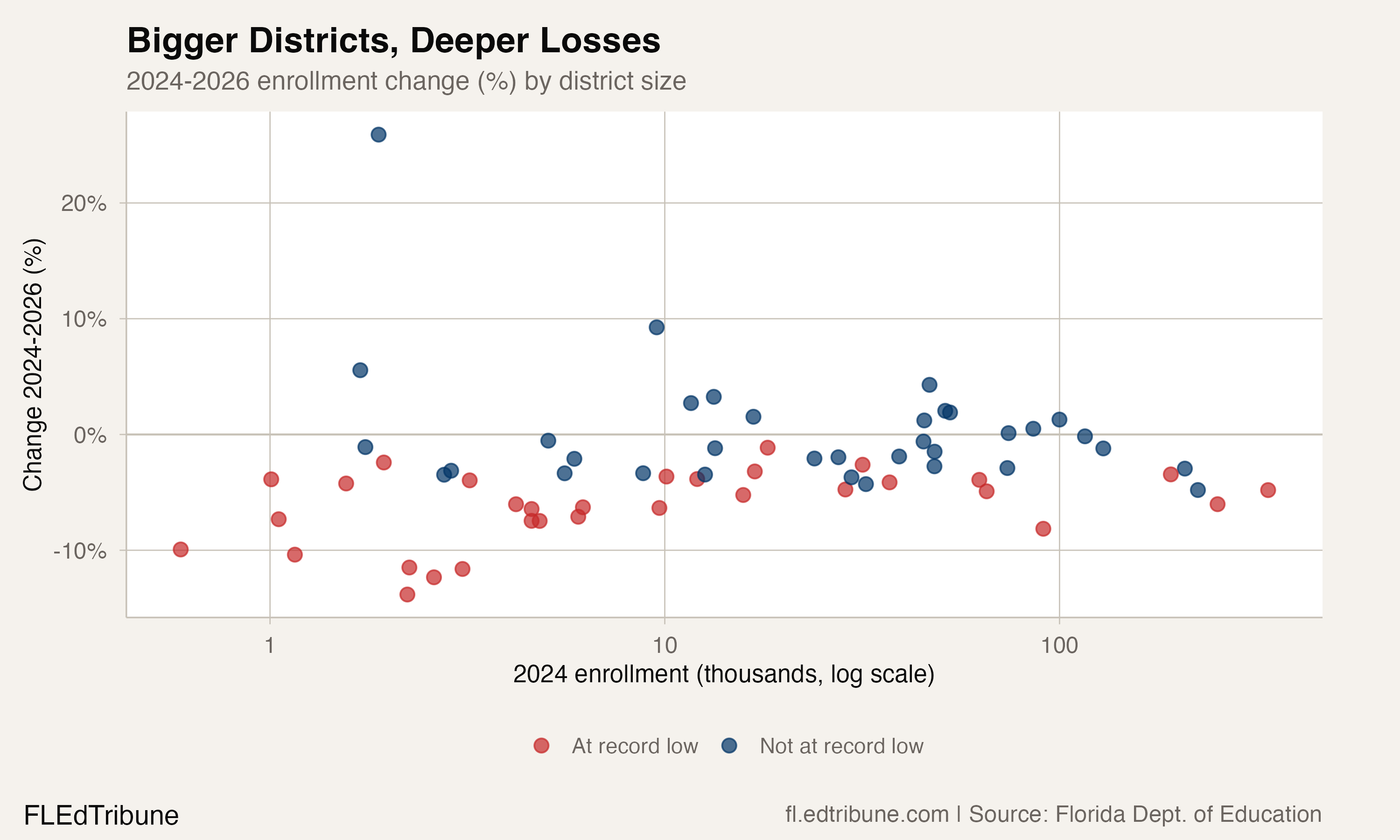
Only six regular districts set enrollment records in 2026: St. Johns↗ET (52,385), Charlotte (17,029), Walton (11,969), Sumter (10,422), Dixie (2,372), and Glades (1,787). St. Johns has grown 49.0% from its 2015 trough of 35,163 students, fueled by sustained residential development in the Jacksonville suburbs. Sumter, home to The Villages retirement community, has grown 26.7% as retiree-driven development brings younger families into adjacent areas.
What the growth districts have in common: they are inland or suburban, in corridors where housing remains relatively affordable. The at-low districts include every major coastal metro south of Jacksonville.
What $94 million of empty seats looks like
Enrollment decline does not reduce costs proportionally. A school that loses 30% of its students still needs a principal, maintenance staff, and heating. Broward estimates its 10,000-student loss in 2025 alone created a $94 million budget hole. Miami-Dade's superintendent ordered reductions in hourly personnel, overtime, and travel after the district lost 13,059 students in a single year, and the district's 2025-26 budget came in roughly $100 million below the prior year.
The fiscal pressure compounds. Districts that have declined for three, five, or eight consecutive years have already cut what is easy to cut. What remains are structural costs: buildings, bus routes, specialized staff mandated regardless of enrollment. Closing schools turns empty seats into savings, but each closure displaces families and removes a community anchor.
Florida's districts are making these decisions now. The question is whether the decline stabilizes or whether the 32 districts at record lows in 2026 become 40 in 2027. Broward projects losing another 25,000 students over five years. Pinellas expects school-age population to continue declining or plateau through 2050. For districts already at their lowest point in a decade, closures may stop being optional well before the decline stops.
Detailed code that reproduces the analysis and figures in this article is available exclusively to EdTribune subscribers.
Discussion
Sign in to join the discussion.
Loading comments...