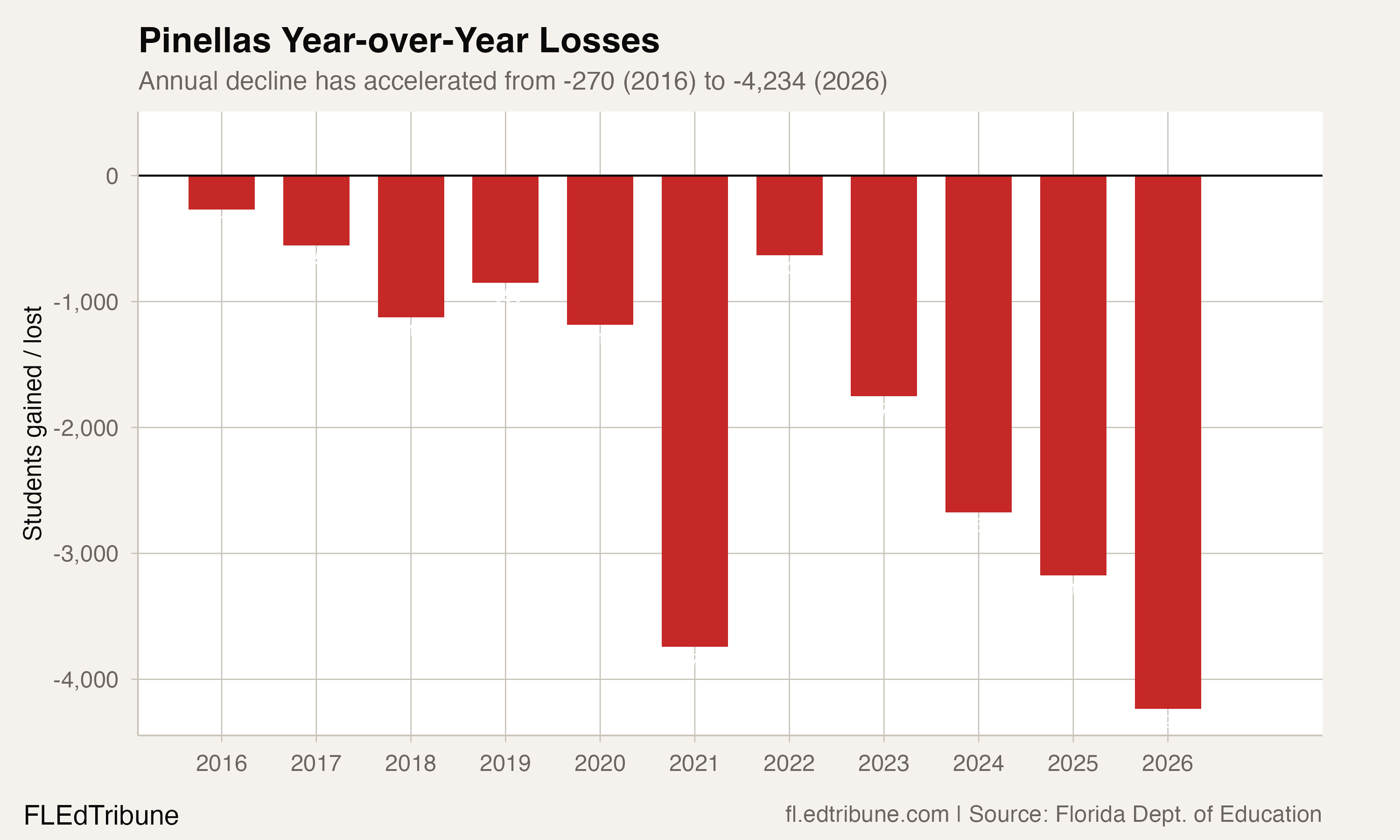
The worst year in Pinellas↗ET County's enrollment decline was supposed to be 2021, when the pandemic ripped 3,743 students out of the district in a single year. It wasn't. In 2026, Pinellas lost 4,234 students, a 4.8% drop that surpassed its COVID-era losses and extended the district's unbroken decline to 11 consecutive years.
Part of the Florida Enrollment 2026ET series.
RELATED: St. Johns: Florida's Last Growing GiantET
Broward↗ET and Leon↗ET come closest, each at eight consecutive years. But Pinellas has been losing students every year since 2016, a run that has erased 20,194 students, 19.5% of its enrollment, and dropped the district from Florida's 7th-largest to its 10th.
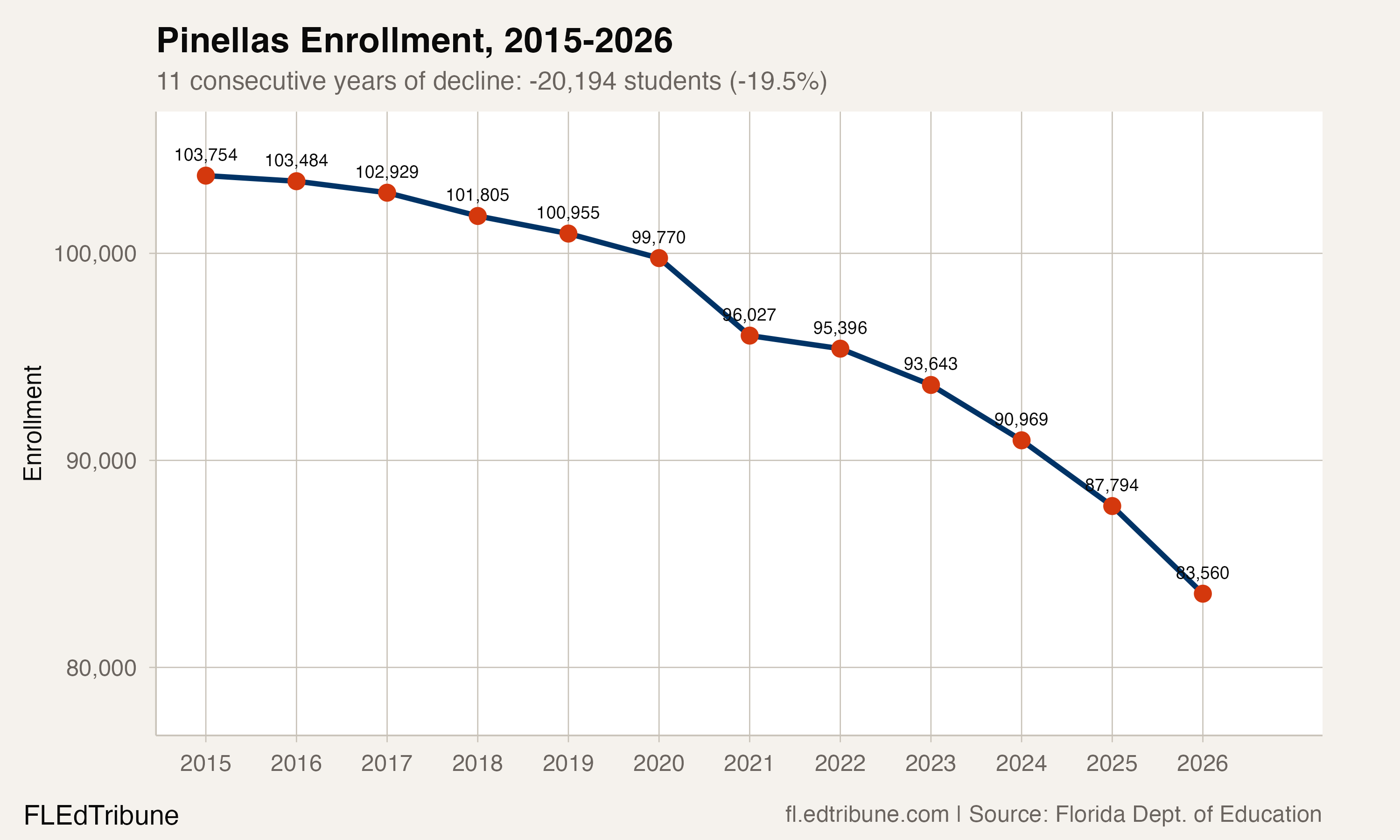
The decline is accelerating
Most districts that took a COVID hit bounced back. Pinellas didn't. Before the pandemic, the district was losing an average of 700 students per year. Since 2022, it has lost an average of 2,493 per year, 3.6 times the pre-COVID pace.
The year-by-year pattern reveals a district where each year sets a new floor. The 2022 loss of 631 students looked like stabilization after COVID's shock. It wasn't. Losses expanded to 1,753 in 2023, then 2,674, then 3,175, and now 4,234.
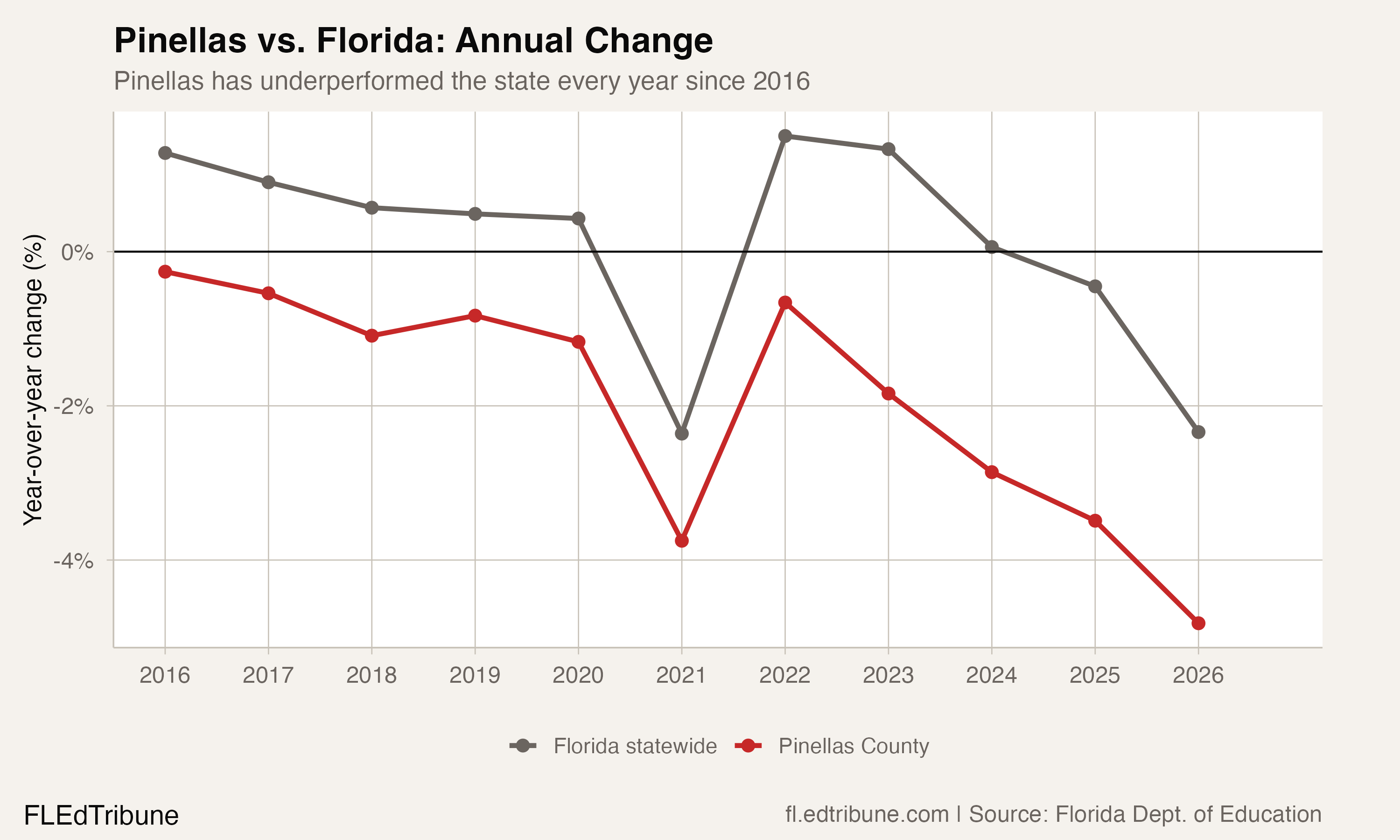
Compared to the state as a whole, Pinellas has underperformed Florida in every single year since 2016. In every year from 2016 through 2020, the state was growing while Pinellas was shrinking. Even in 2021, when the entire state lost students, Pinellas fell 3.8% while the state dropped 2.4%. And in 2026, Florida's statewide enrollment fell 2.3%. Pinellas fell 4.8%, more than double the state rate.
Where did the students go?
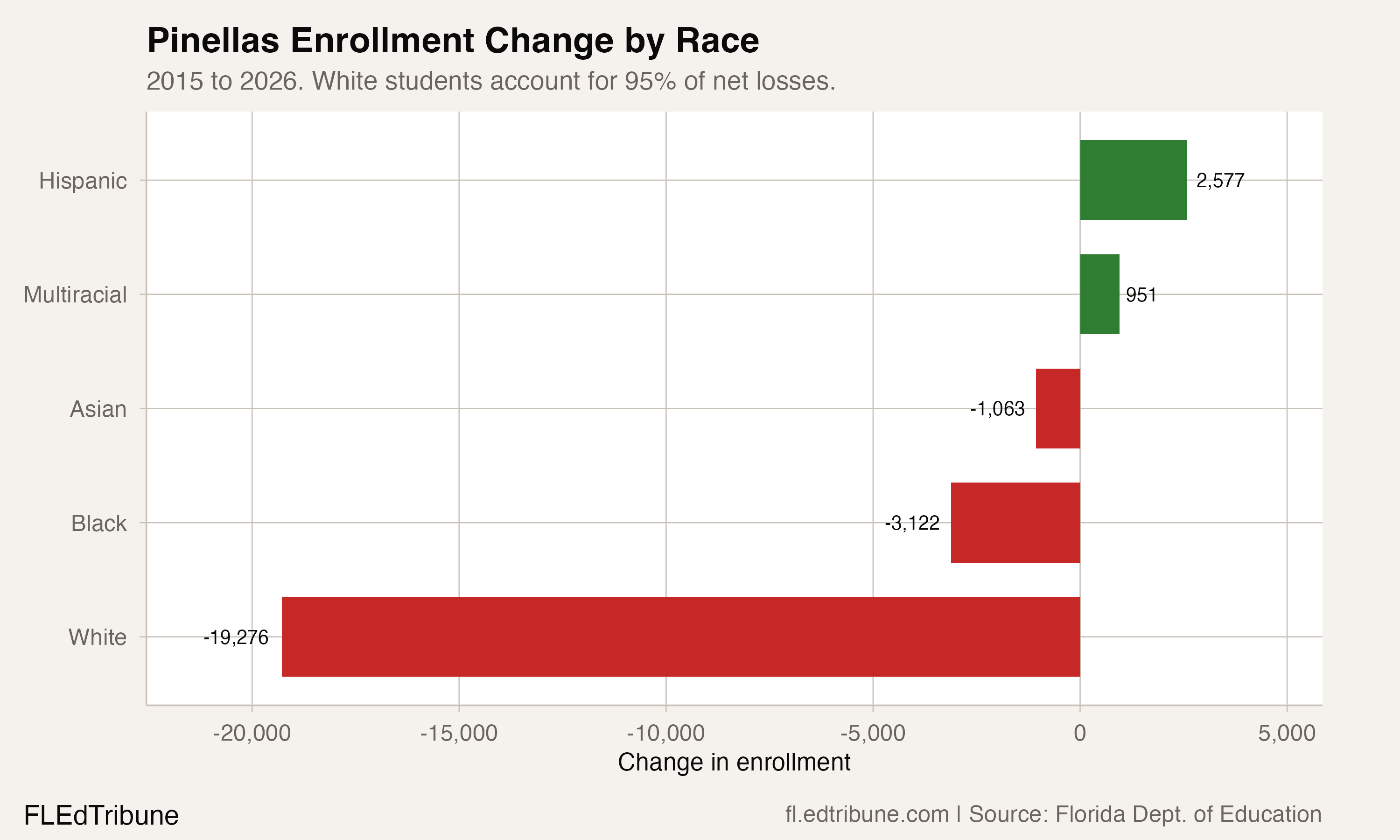
The demographic picture is lopsided. Of the 20,194 students Pinellas has lost since 2015, white students account for 19,276 of them — 95.5% of the net decline. White enrollment fell from 59,608 to 40,332, a 32.3% drop that pushed white students below 50% of the district for the first time in 2025. By 2026, the share had fallen to 48.3%.
Black enrollment declined by 3,122 students (16.1%), and Asian enrollment fell by 1,063 (24.3%). Only two groups grew: Hispanic enrollment added 2,577 students (16.5%), and multiracial enrollment rose by 951 (22.3%). But those gains were nowhere near large enough to offset the white exodus.
A county that can't afford young families
Pinellas County's median age is 49, according to Census data, making it one of the oldest large counties in Florida. Only about 13% of residents are under 15. The population over 65 makes up roughly 26% of the county. District officials have pointed to a local birth rate decline, noting that Pinellas went from approximately 10,000 births per year 15 years ago to roughly 6,000 now.
Kindergarten enrollment tells the same story. Pinellas enrolled 7,409 kindergartners in 2015 and 5,162 in 2026, a 30.3% decline. That pipeline collapse guarantees the broader enrollment decline will persist for years regardless of any policy changes.
The cost of living compounds the birth rate problem. A 2024 United Way Suncoast report found that a family of four with two young children in Pinellas needs to earn nearly $100,000 per year to cover basic expenses, the highest threshold of any Florida county. That figure sits more than $30,000 above the county's median household income.
"We know families are resilient, we know that they're going to try and be very creative to figure out ways to make ends meet." — Doug Griesenauer, United Way Suncoast, via WUSF
Roughly 46% of Pinellas households either fall below the poverty line or qualify as ALICE (Asset Limited, Income Constrained, Employed), according to the same report. When families with children can't afford to live in the county, the school district shrinks.
Florida's universal voucher expansion, which removed income eligibility requirements beginning in the 2023-24 school year, is another contributing factor. The timing overlaps with Pinellas's sharpest acceleration: the district lost 10,083 students in the three years since the expansion took effect, compared to 6,127 in the three years before it. The voucher program and the affordability crisis are likely reinforcing each other. Families priced out of Pinellas leave entirely; families who remain gain a new option to leave the public system.
Pasco pulls ahead
For a decade, Pasco↗ET County was the smaller neighbor to the north, growing steadily while Pinellas contracted. In 2015, Pinellas enrolled 34,536 more students than Pasco. That gap narrowed every single year, to 23,126 in 2020, to 5,161 in 2024, to just 1,210 in 2025. In 2026, Pasco passed Pinellas for the first time, enrolling 86,234 students to Pinellas's 83,560.
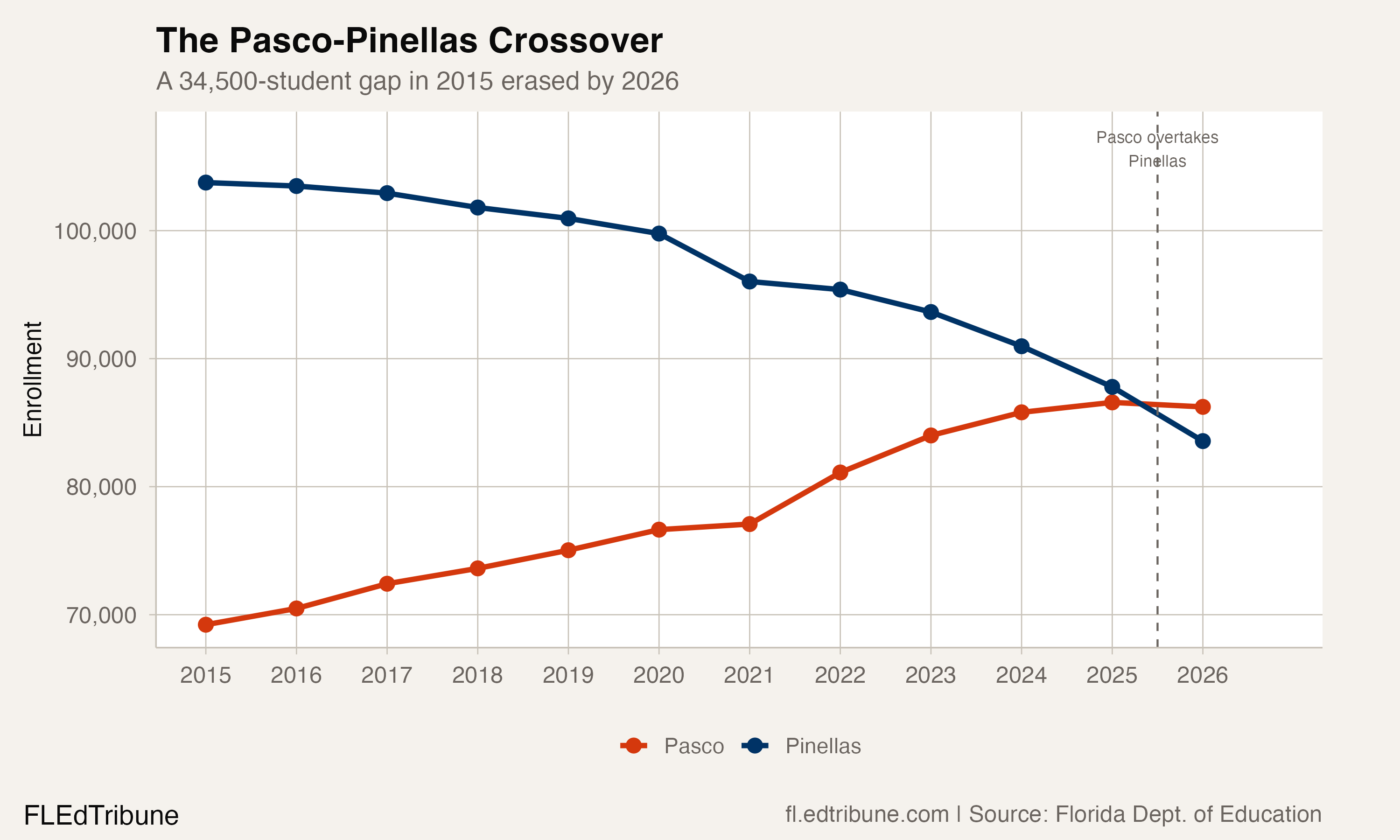
Tampa Bay's school-age population is shifting north. Pasco added 17,016 students over this period while Pinellas lost 20,194. A family that finds Pinellas unaffordable can buy a house in Pasco and commute to a Tampa Bay job.
Closing schools, consolidating campuses
In February 2026, the Pinellas County School Board voted to close Cross Bayou Elementary in Pinellas Park, which was operating at 40% capacity, and Disston Academy in Gulfport, at 20% capacity. The board also approved merging Bay Point Elementary and Bay Point Middle into a K-8 campus and expanding Oldsmar Elementary into a K-8 school.
"We've certainly heard from Cross Bayou Elementary School community members who are not happy with this recommendation, and we should expect that. It is my responsibility, though, and obligation, to provide our families with excellent academic choices and programs while maintaining a balanced budget." — Superintendent Kevin Hendrick, via WUSF
District officials estimate the changes will save about $15 million in maintenance and operating costs. Cross Bayou alone needed $5.1 million in capital improvements. More closures are expected: the district's utilization rate has dropped from 87% a decade ago to 68% district-wide, and officials have said a second round of recommendations will come in fall 2026.
The district has stated that school-age children in Pinellas will continue decreasing or plateau through 2050, and that the population of residents aged 80 or older is expected to double in the same period. If those projections hold, the current round of closures is a down payment, not a resolution.
What the enrollment data doesn't show
These numbers tell you who is enrolled in Pinellas public schools. They don't tell you where the others went. Some left for private schools on vouchers. Some moved to Pasco, Hillsborough, or Manatee. Some represent children who were never born. Without student-level tracking across the public-private divide, the relative weight of each factor is unknowable.
What the data does show is that the decline is broad-based. Every racial group except Hispanic and multiracial students has shrunk. Every grade level from kindergarten through 12th grade has fewer students than in 2015, with the steepest losses in the earliest grades: first grade is down 29.1%, second grade is down 28.6%. The 2026 kindergarten class of 5,162 is the district's smallest in the dataset.
Two school closures and two consolidations. A district losing 4,234 students in a single year and projecting continued decline through midcentury. At the current rate of acceleration, Pinellas could fall below 75,000 students within three years.
Detailed code that reproduces the analysis and figures in this article is available exclusively to EdTribune subscribers.
Discussion
Sign in to join the discussion.
Loading comments...