For eight years, the two lines moved toward each other at a steady, almost metronomic pace. White enrollment share fell roughly 1 percentage point per year. Hispanic share rose by about the same. In 2022, the gap between them had narrowed to six-tenths of a point. Then, in the fall of 2023, the lines crossed.
Part of the Florida Enrollment 2026ET series.
RELATED: Florida Lost One in Eight KindergartnersET
Hispanic students became the largest racial or ethnic group in Florida's public schools that year, 36.4% to 35.4%. It was the first time in the history of the nation's third-largest school system that white students were not the plurality. By 2026, the gap had widened to 5.3 percentage points: 38.3% Hispanic, 33.0% white.
Then came a complication. In 2026, Hispanic enrollment fell for only the second time in the dataset, dropping by 20,901 students. A group that had been growing by 25,000 to 40,000 students per year suddenly shrank. The crossover held. The growth engine behind it did not.
Two trends, one intersection
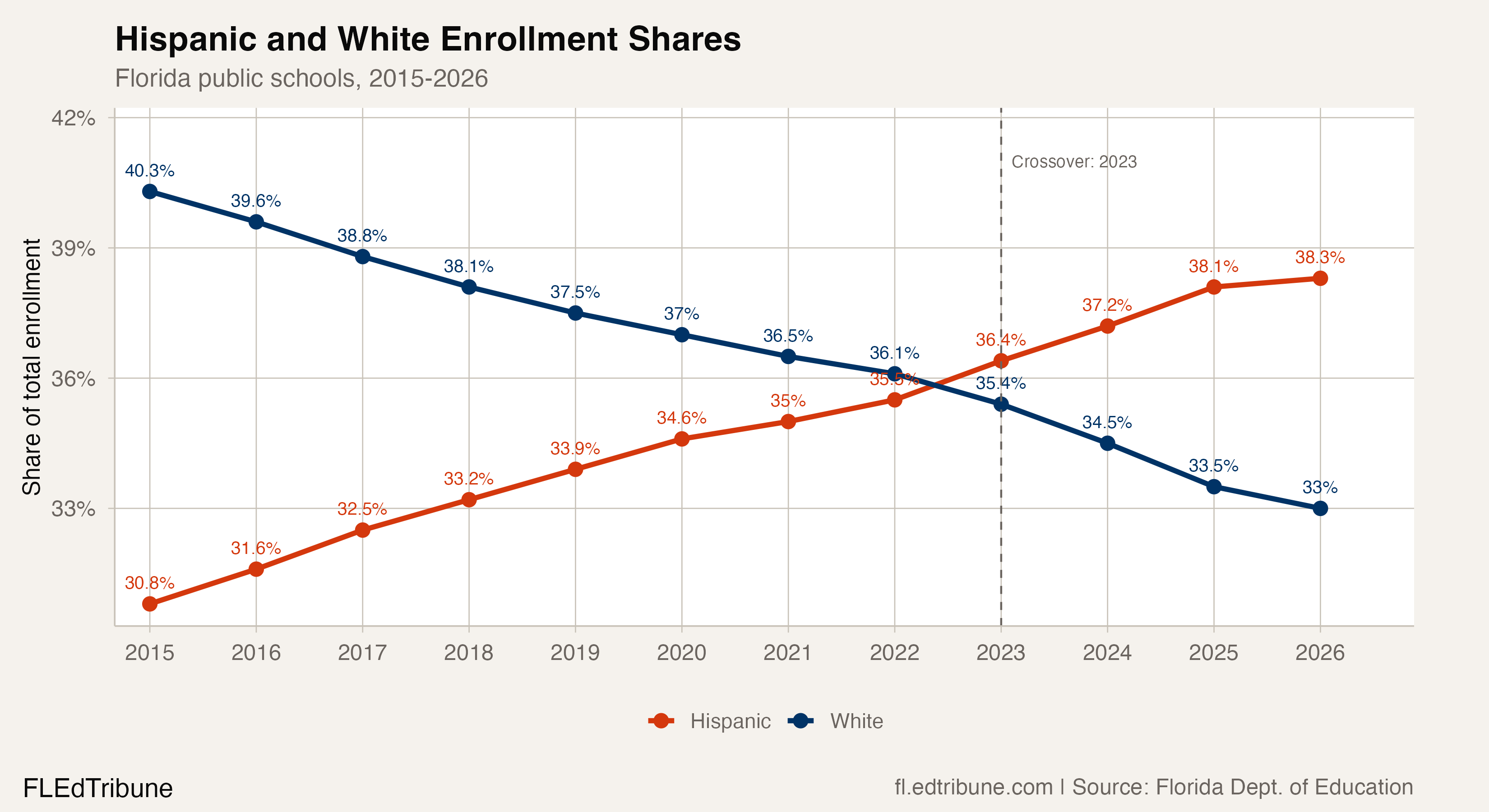
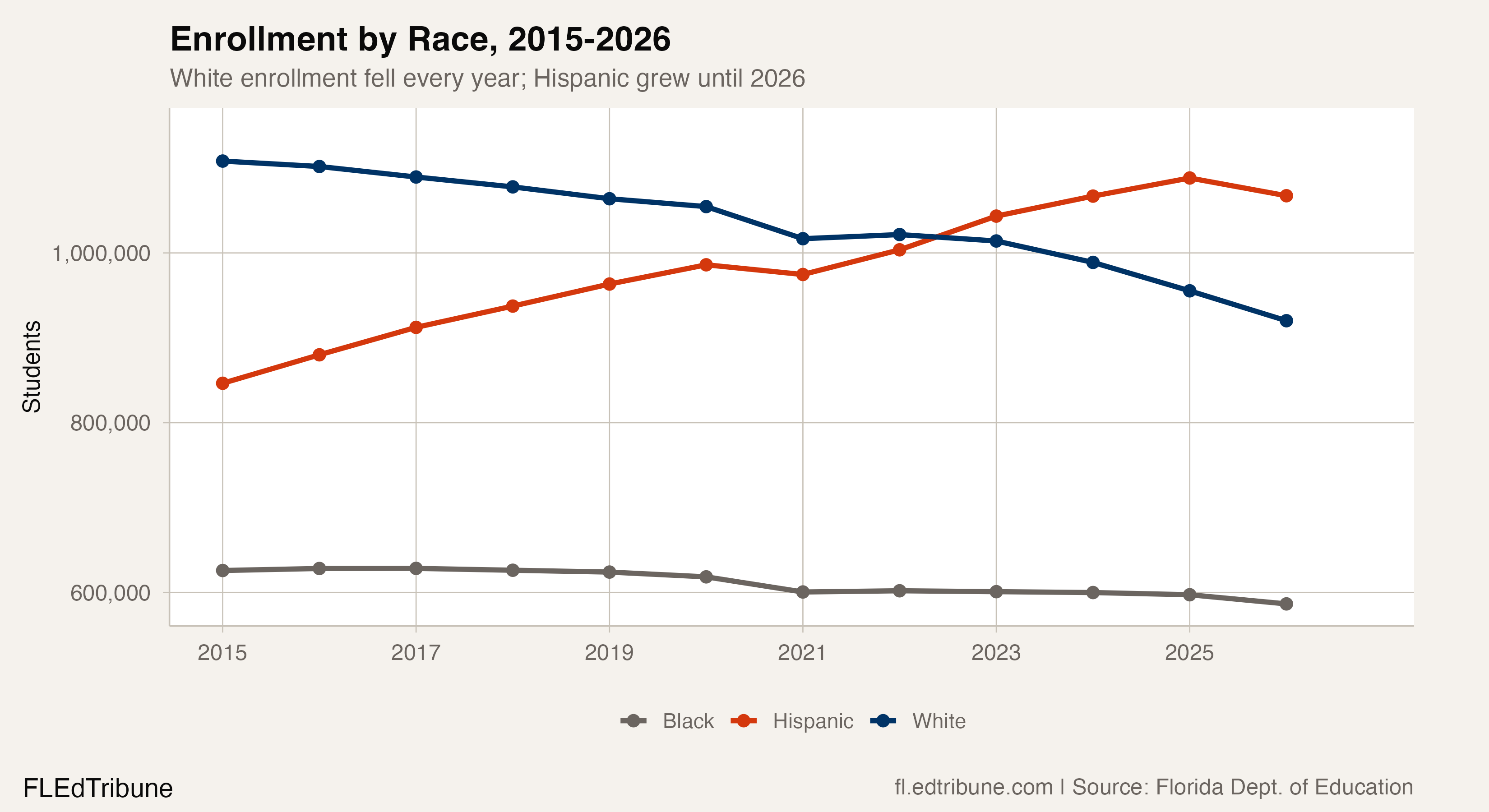
Both sides moved. Since 2015, Hispanic enrollment grew by 220,948 students, a 26.1% increase. White enrollment fell by 188,090, a 17.0% decline. Those two movements account for nearly all of the compositional shift in a system that enrolled 2,786,275 students in 2026.
The crossover was not close. In 2023, the year it happened, Hispanic enrollment surged by 39,731 students, the largest single-year gain in the dataset. White enrollment fell by 7,565 the same year. By 2024, the gap had widened to 2.7 points. By 2025, 4.6 points.
Black enrollment, the third-largest group at 21.0%, has been comparatively stable in share terms even as absolute numbers fell by 39,332 (6.3%) since 2015. Multiracial students are the only group whose share has grown in every single year, rising from 3.2% to 4.4%.
What built the crossover
Several forces pushed the lines together. Florida has been the top destination for domestic migration for much of the past decade, and a disproportionate share of those arrivals have been Hispanic families. A 2024 Florida Chamber of Commerce report documented the migration patterns, and a Florida Trend analysis noted that since 2010, Florida added more Hispanic residents than all other racial and ethnic groups combined.
Puerto Rican migration is a big part of the picture. An estimated 800,000 people have left the island over the past two decades, with Florida as a primary destination. The Orlando metro area has seen the largest demographic shift in the state, with its Hispanic share reaching 32% by 2019.
On the other side, white enrollment losses have accelerated sharply. Between 2024 and 2026 alone, white enrollment fell by 68,685, accounting for 86.3% of the system's total decline of 79,633 students. The white share of the student body has now dropped below the white share of the general population, a pattern consistent with older demographics: white Floridians skew older, Hispanic Floridians skew younger.
Florida's universal voucher program, which took effect in 2023-24 and now serves more than 500,000 students in private schools, is a competing explanation for the white enrollment decline. The voucher program does not publish demographic breakdowns of participants, so the enrollment data cannot distinguish between white families leaving public schools for private ones and white families leaving Florida entirely. Both are likely happening. The migration data shows Florida's net domestic migration plummeted from 310,892 in 2022 to just 22,517 in 2025, driven by rising housing costs and insurance premiums.
The 2026 reversal
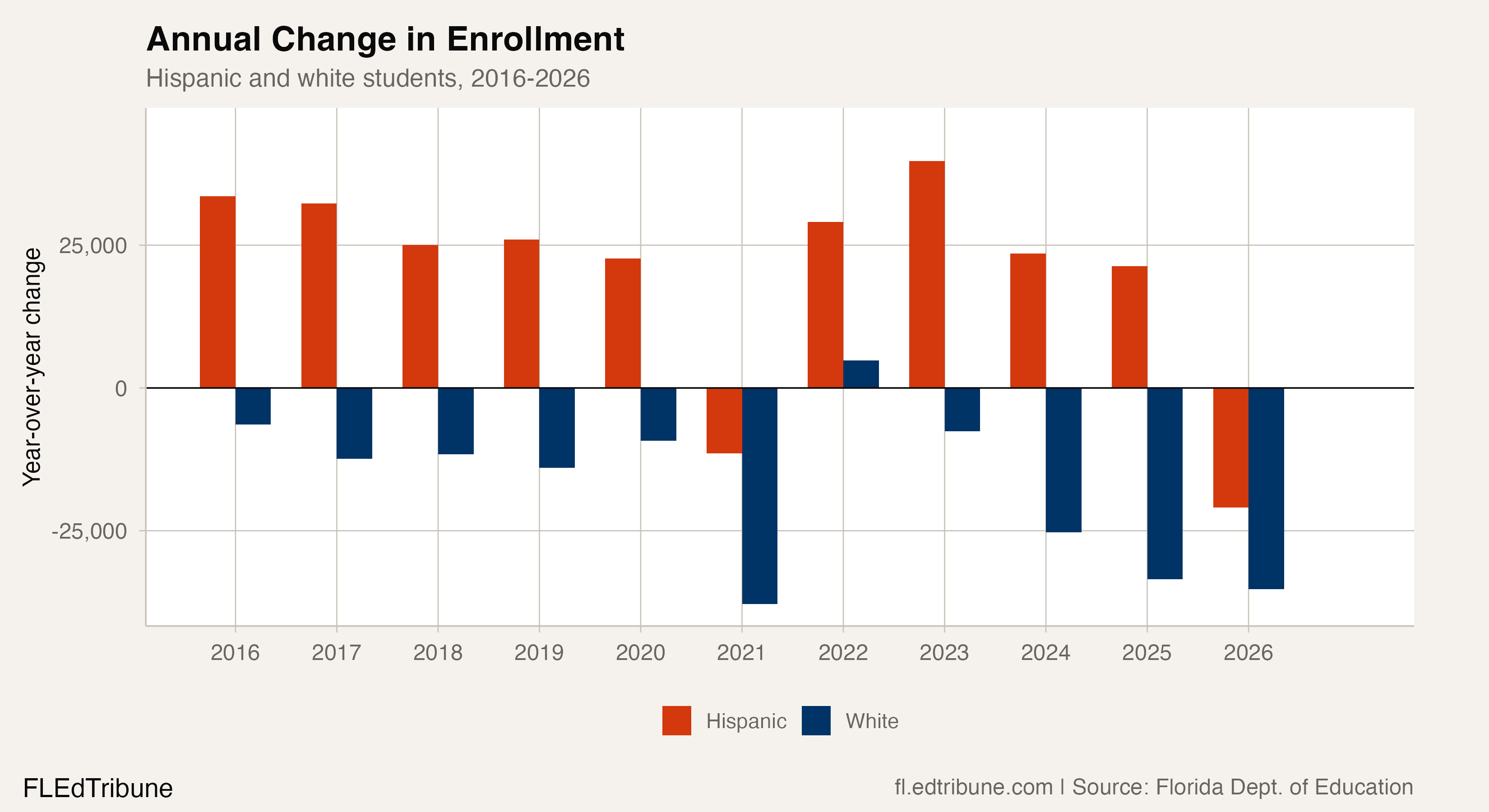
The 2026 numbers complicate the story. Hispanic enrollment dropped by 20,901 students, the first non-COVID decline in the dataset. The only prior decline was in 2021, when the pandemic pulled 11,417 Hispanic students out of public schools. This time, the drop was nearly twice as large.
Every major racial group lost students in 2026. White enrollment fell by 35,207. Black enrollment fell by 10,778. Hispanic enrollment fell by 20,901. Only multiracial students grew, by 1,492. The total decline of 66,756 students was the largest single-year loss in the dataset outside of 2021.
State demographers have been explicit about the cause. Florida's Office of Economic and Demographic Research reported that the 2025-26 enrollment forecast fell short by 46,455 students, noting that the shortfall "signals that the universe of K-12 enrollment is atypically contracting" and that the most likely reason is "related to the chilling effects from recently implemented immigration policies."
What reporting shows
Reporting from Florida's largest districts tells the same story.
"We couldn't take it anymore. Fear of immigration arrests near schools in Florida [is] reducing enrollment, officials say." -- WUSF/Fresh Take Florida, Nov 2025
Miami-Dade, which typically gains 7,000 new students from out of state each year, received fewer than 2,000 new out-of-state students in 2025-26. Overall enrollment in the district fell by more than 13,000 students, roughly triple what the district had projected. Orange County lost approximately 6,600 students, more than double its forecast, and approved seven school closures for 2026-27.
"We started hearing from families saying, 'I'm afraid of leaving the house. I'm afraid of putting them on the school bus.'" -- Esmeralda Alday, ImmSchools Senior Director, via WUSF
Statewide, the number of students enrolled in English for Speakers of Other Languages classes dropped by more than 17,000 in 2025-26. Florida now has the most 287(g) immigration enforcement agreements in the country, requiring state and county law enforcement to assist federal immigration agents.
Nine districts, one pattern
The crossover is not just a statewide statistic. In 2015, Hispanic students were the largest group in seven of Florida's 81 districts. By 2026, that number had grown to 17. Nine districts flipped from white plurality to Hispanic plurality over the period.
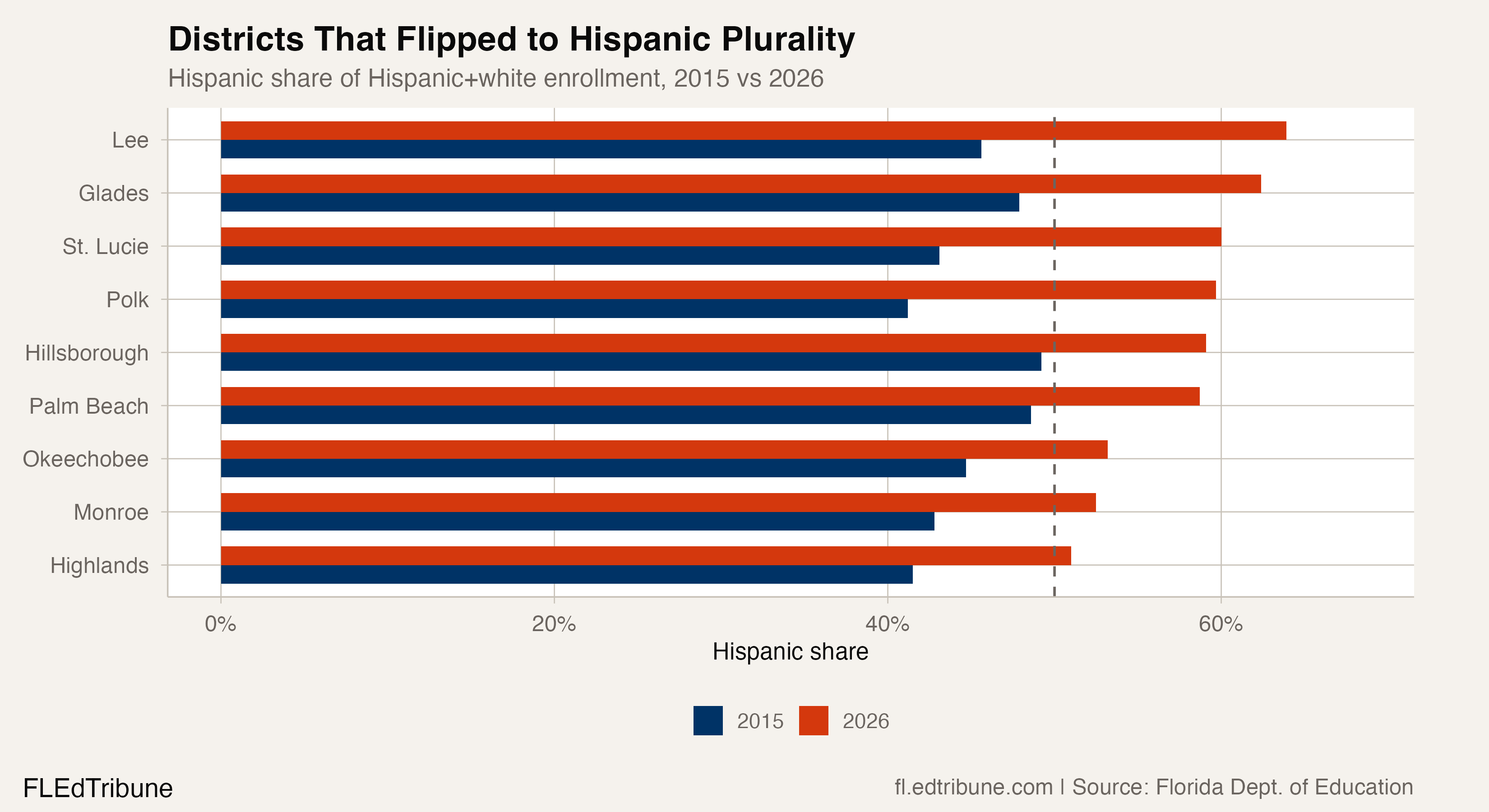
The largest flip was Hillsborough County (Tampa), where Hispanic students grew from 71,971 to 86,740 while white students fell from 74,336 to 60,101. Palm Beach County followed a similar trajectory, with Hispanic enrollment rising from 58,847 to 71,098 and white enrollment falling from 62,205 to 49,954.
Lee County saw the sharpest proportional shift. Hispanic students made up 36.8% of enrollment in 2015. By 2026 that figure was 51.9%, the largest share increase of any district in the state. Polk County's Hispanic share rose from 30.5% to 43.7%, a 13.2-point swing.
The flips span the state geographically: from the Gulf Coast (Lee, Hillsborough) to the Treasure Coast (St. Lucie) to South Florida (Palm Beach) to the agricultural interior (Polk, Highlands, Okeechobee, Glades). The pattern is not confined to any one region.
The full picture
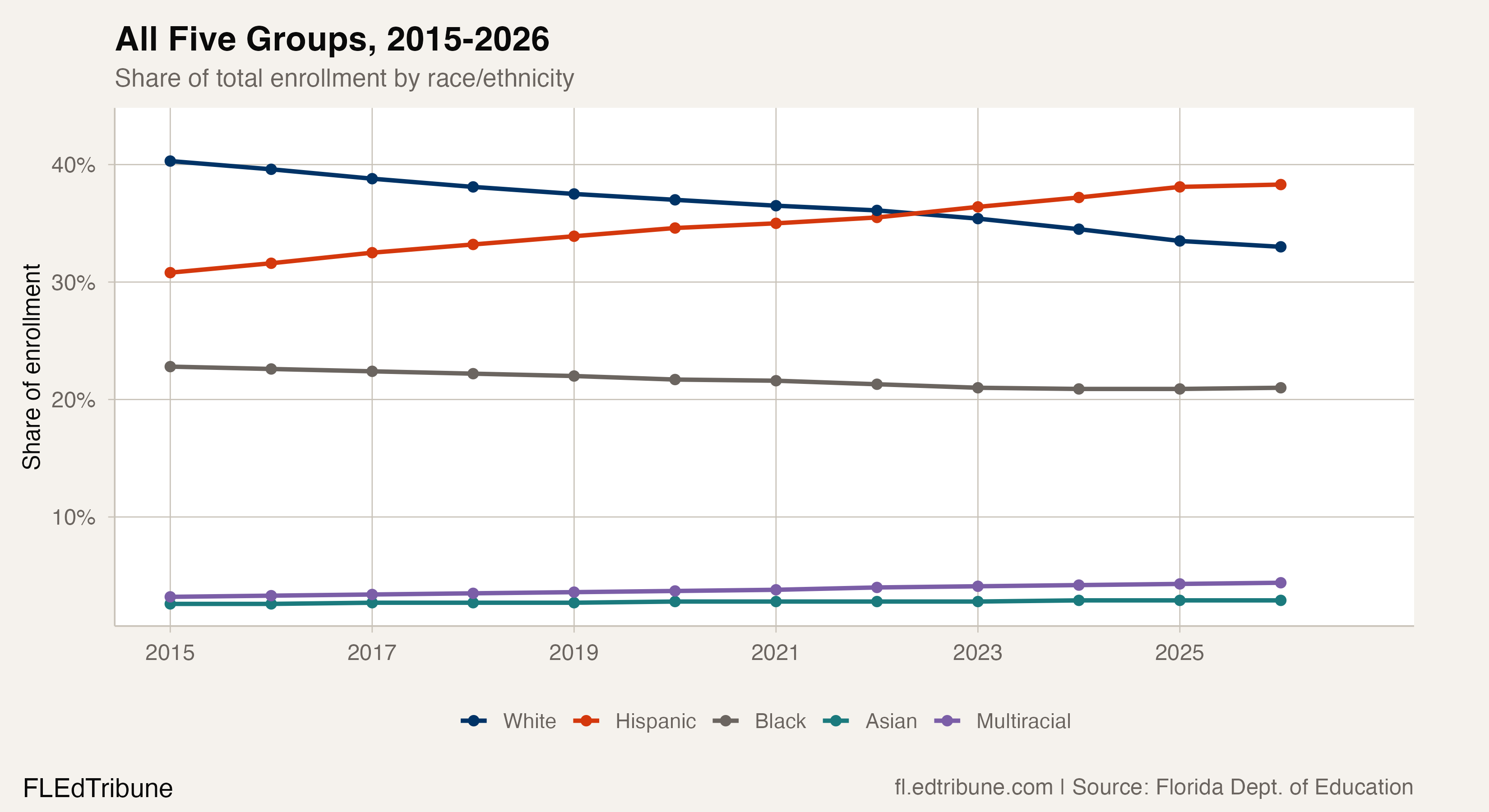
The crossover is not going to reverse. Even with Hispanic enrollment falling in 2026, the Hispanic share of enrollment ticked up slightly, from 38.1% to 38.3%, because white enrollment fell faster. The gap widened by 0.7 percentage points in a year when both groups shrank. For the crossover to reverse, white enrollment would need to grow faster than Hispanic enrollment. Nothing in the 11-year trend suggests that is plausible.
What is uncertain is whether Hispanic growth resumes. The 2026 decline represents either a one-year disruption caused by immigration enforcement, or the beginning of a new phase in which both groups decline simultaneously. If immigration policy continues to suppress enrollment, the crossover will have marked the end of an era of Hispanic growth rather than the beginning of a Hispanic majority. The 2027 data will be the first test.
Detailed code that reproduces the analysis and figures in this article is available exclusively to EdTribune subscribers.
Discussion
Sign in to join the discussion.
Loading comments...