Correction (2026-03-11): The total of the 10 largest district kindergarten declines has been corrected from 18,086 to 17,088.
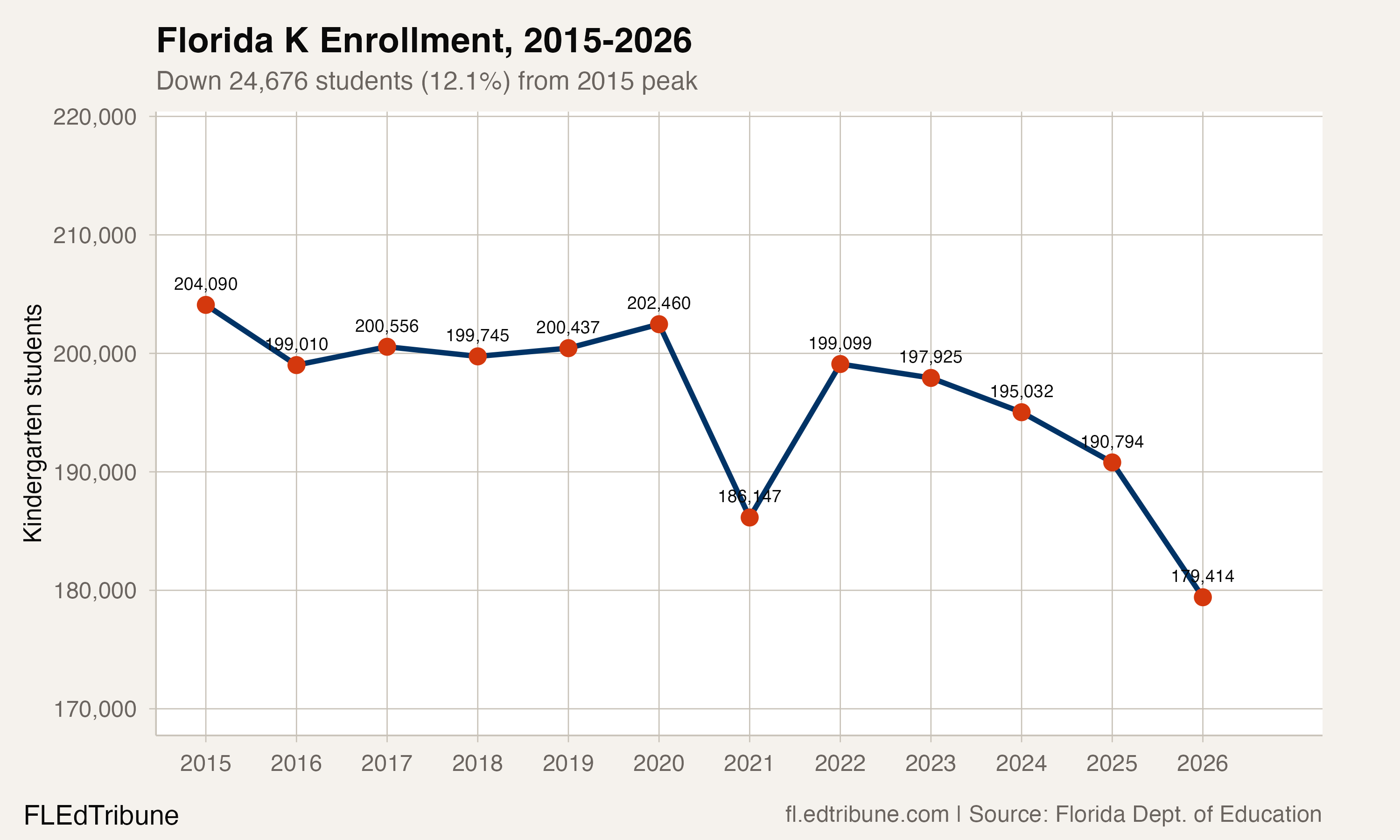
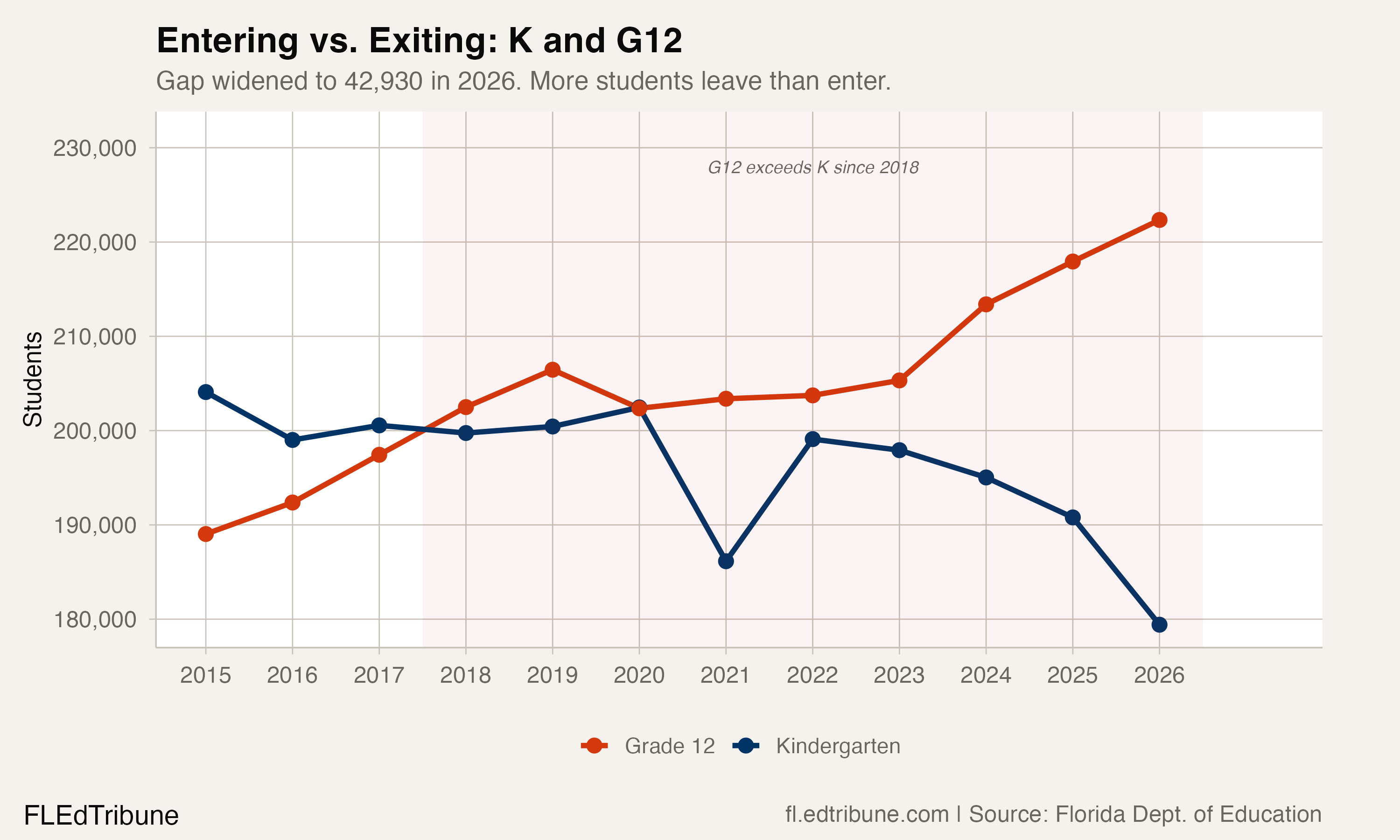
Florida enrolled 179,414 kindergartners in 2025-26. That is 24,676 fewer than the 204,090 who showed up in 2014-15, a 12.1% decline over 11 years. At the other end of the building, 12th grade grew 17.6% over the same period, to 222,344. The state now graduates 42,930 more students each year than it enrolls in kindergarten.
Part of the Florida Enrollment 2026ET series.
RELATED: Lee County's 15-Point Demographic SwingET
That gap did not exist a decade ago. In 2015, kindergarten enrollment exceeded 12th grade by 15,056. By 2018, the lines crossed. Every year since, the exiting class has been larger than the entering one, and the deficit has widened in every year but one.
The sharpest non-pandemic drop on record
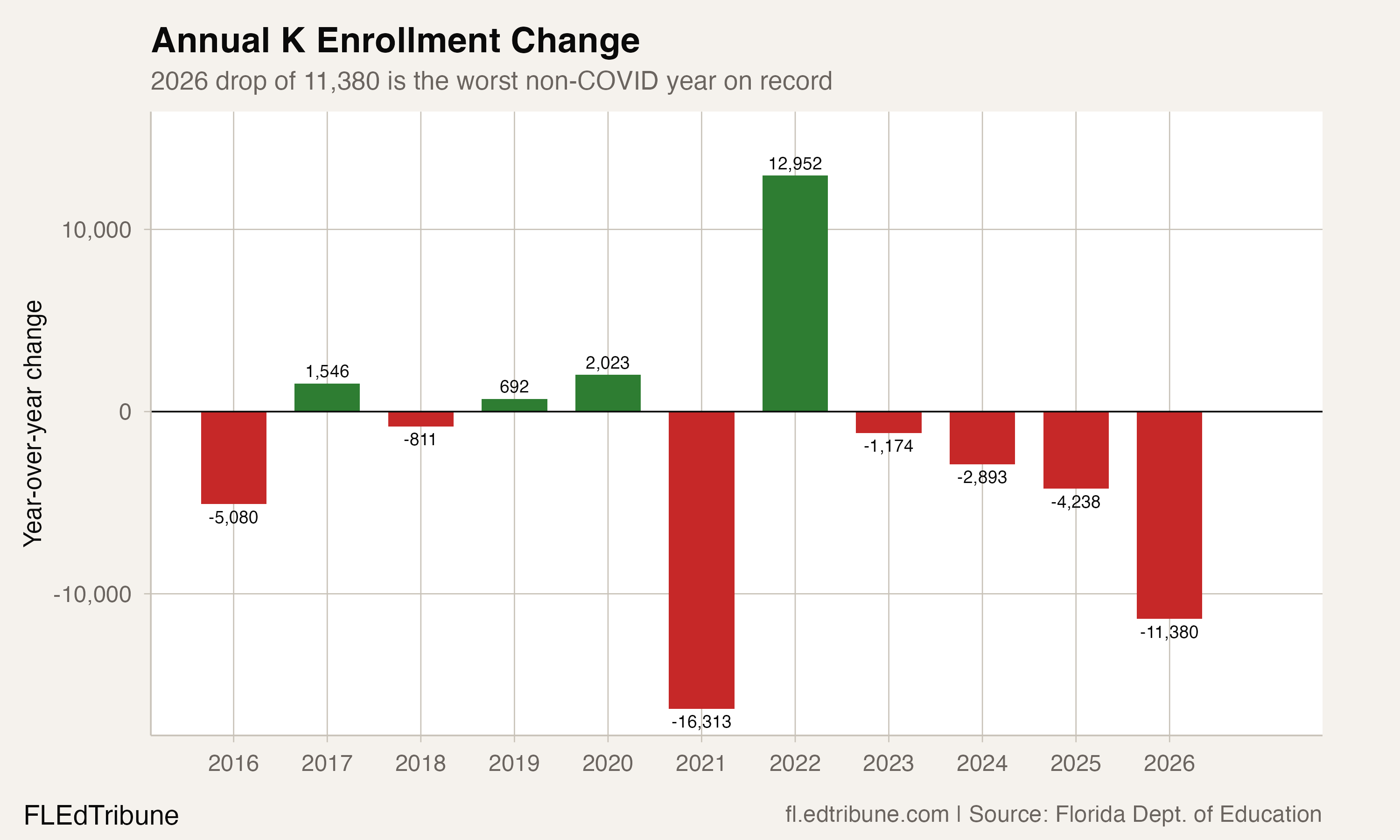
The 2025-26 kindergarten class lost 11,380 students from the prior year, a 6.0% single-year decline. Only the pandemic year of 2020-21 was worse, when kindergarten fell by 16,313 as families kept five-year-olds home. But COVID was temporary: kindergarten bounced back by 12,952 in 2021-22 as delayed entrants arrived. This time there is no deferred class waiting in the wings.
What matters is the acceleration. From 2016 to 2018, kindergarten fluctuated within a narrow band, losing an average of 1,448 per year. From 2024 to 2026, the average annual loss tripled to 6,170. The three-year cumulative decline of 18,511 kindergartners since 2023-24 is larger than the total K enrollment of all but six Florida districts.
A system that is top-heavy and getting more so
Kindergarten enrollment is a leading indicator. The children who entered K in 2026 become the first graders, the fifth graders, and eventually the high school seniors whose headcount determines how many teachers a district hires and how much money it receives from Tallahassee. When fewer children enter the front of the pipeline, the entire system contracts on a lag.
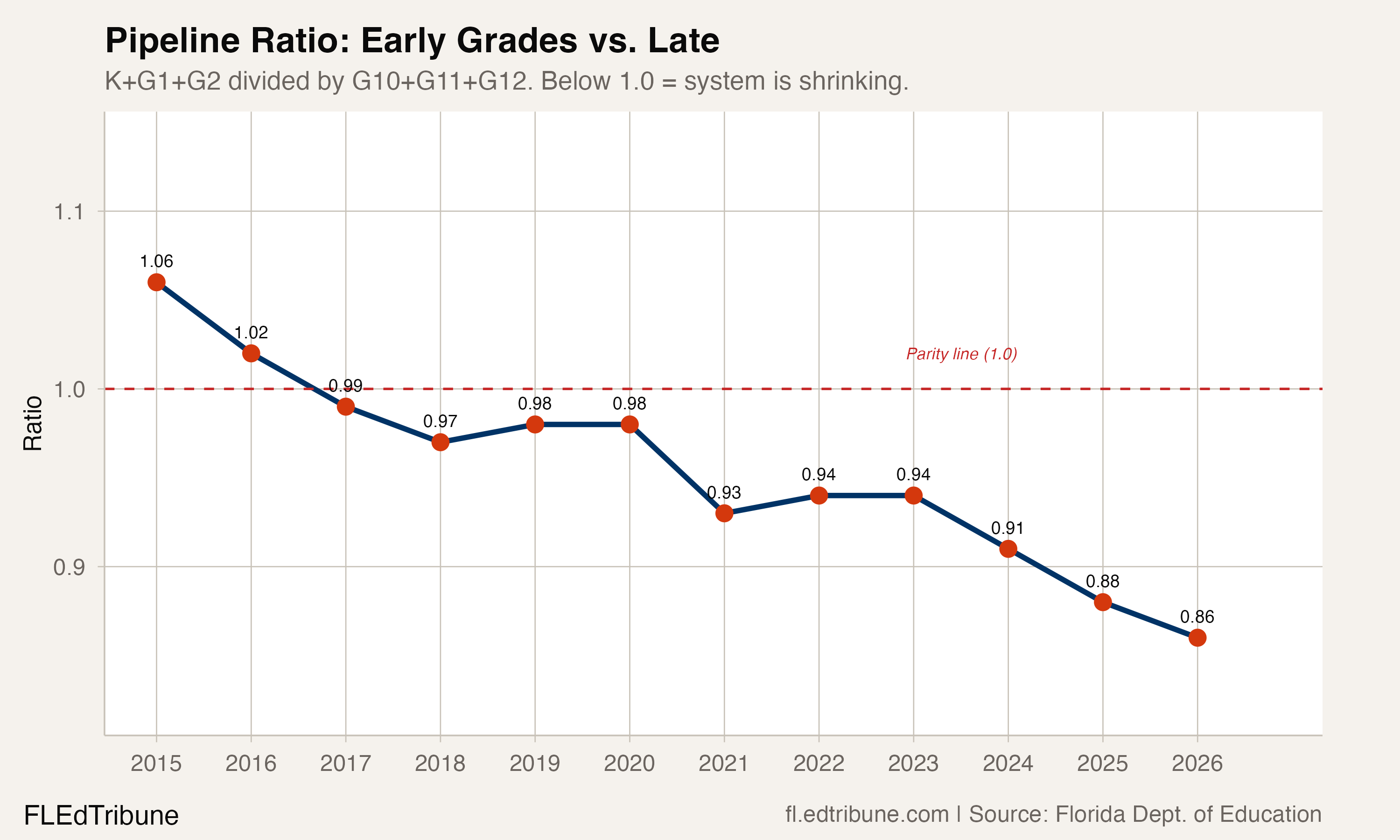
One way to measure that lag is the pipeline ratio: the combined enrollment in K through second grade divided by the combined enrollment in 10th through 12th grade. When the ratio is above 1.0, the early grades are feeding more students into the system than the late grades are releasing. When it falls below 1.0, the system is shrinking from the bottom up.
Florida's pipeline ratio crossed below 1.0 in 2017 and has never returned. It has fallen in 10 of the past 11 years, from 1.06 in 2015 to 0.86 in 2026. Right now, there are 570,989 students in K through second grade and 665,888 in 10th through 12th, a deficit of 94,899. High school's share of the K-12 system grew from 30.5% to 32.9% over the same period, while elementary's share fell from 46.8% to 44.0%.
Fewer births, more exits to private school
Two forces are squeezing the kindergarten pipeline at the same time.
The first is demographic. Florida's birth count fell from roughly 224,000 in 2017 to 209,880 in 2020, a decline that aligns closely with the kindergarten trajectory five years later. Births partially recovered to 216,535 in 2021, but that recovery fell short of pre-pandemic levels. The children born during the 2020 trough are the kindergartners of 2025-26.
The second is school choice. Florida's universal voucher expansion, signed into law in 2023, removed income eligibility requirements and made every K-12 student eligible for a taxpayer-funded scholarship of roughly $8,000. By 2024-25, more than 350,000 students statewide held vouchers, with total program funding approaching $4 billion. Roughly 70% of new voucher recipients were already enrolled in private school before the expansion, meaning the program largely subsidized existing private enrollment. But the remaining 30% represent students who left or bypassed the public system altogether.
The kindergarten-to-first-grade retention ratio offers indirect evidence of diversion. In a typical year, first grade enrollment exceeds the prior year's kindergarten by about 3.3%, as students enter from private pre-K, homeschool, and other states. In 2026, that ratio fell to 101.1%, the lowest non-pandemic rate in the dataset. Fewer families appear to be flowing into the public system at the K-to-1 transition.
Neither mechanism alone explains a 12.1% decline. Falling births set the direction; vouchers may be steepening the slope. Housing costs add a third pressure. As the president of the Pinellas Classroom Teachers Association told WUSF: "It's so expensive to live in Pinellas County that families, or people who would have a family, don't want to live here."
Where the losses concentrate
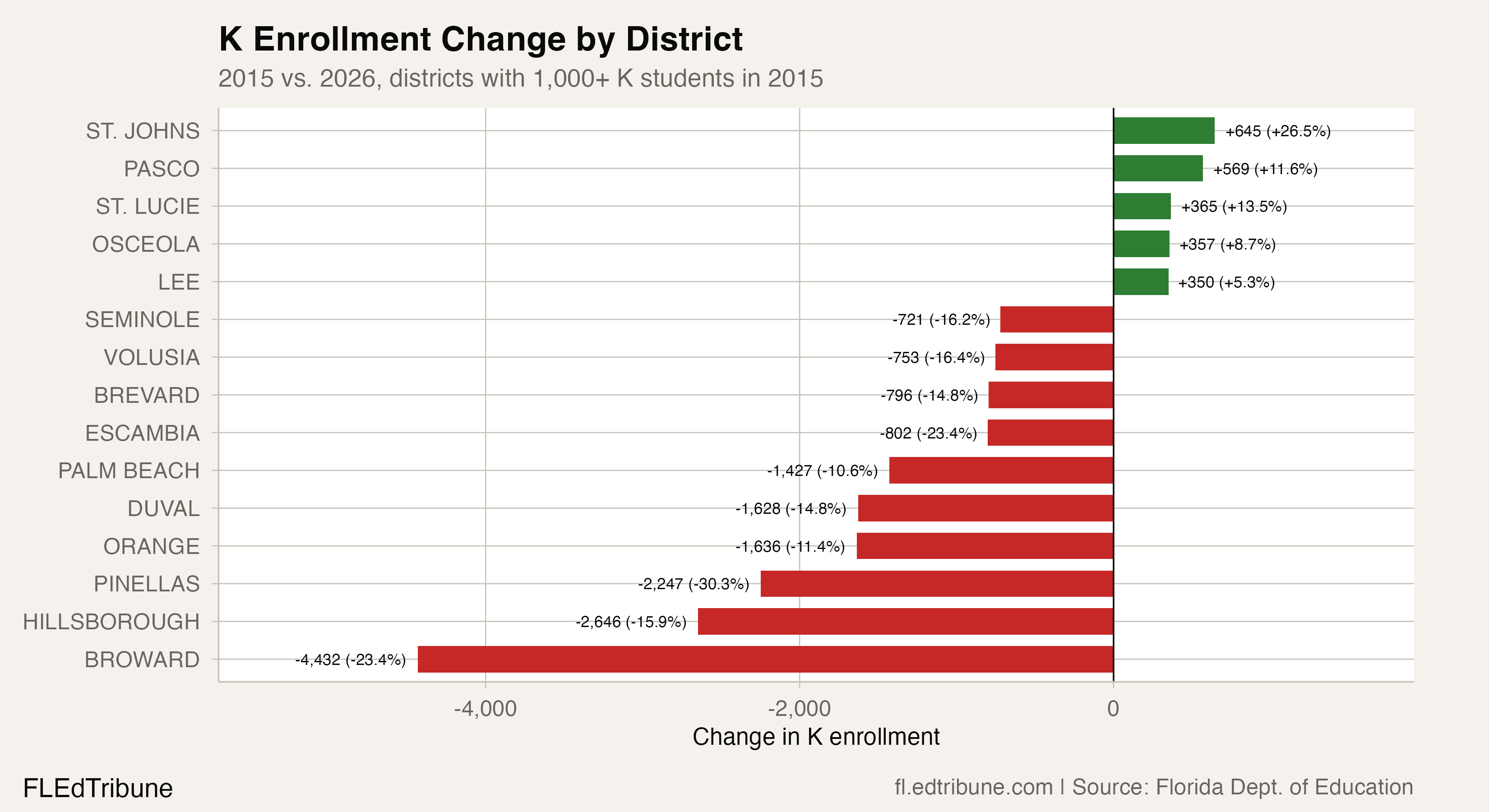
Kindergarten losses are not confined to a handful of large districts. Of 72 districts with data in both 2015 and 2026, 53 lost kindergartners, with a median decline of 12.3%. Among districts that enrolled at least 1,000 kindergartners in 2015, Pinellas↗ET lost the largest share: 30.3%, falling from 7,409 to 5,162. Broward↗ET lost the most in absolute terms: 4,432 kindergartners, a 23.4% decline. Hillsborough↗ET lost 2,646 (15.9%), and Duval↗ET lost 1,628 (14.8%).
The districts still gaining kindergartners are mostly fast-growing suburban and exurban communities. St. Johns↗ET added 645 kindergartners (26.5%), Pasco↗ET gained 569 (11.6%), and St. Lucie↗ET gained 365 (13.5%). But these gains do not offset the losses. The 10 largest district K declines total 17,088 students; the five largest gains total 2,286.
Buildings built for children who no longer exist
The closures have started. Broward, which has 45,000 empty seats across its 300 schools, approved the consolidation of six schools in January 2026, with seven more recommended for closure. Superintendent Howard Hepburn framed the decision bluntly:
"What we're trying to do is spend more money on the kids we have and less on the empty seats in an oversized footprint." — WLRN, August 2025
In Pinellas, the school board voted to close two schools operating at 20% and 40% capacity, with a second round of closures anticipated. Orange County, which lost 5,539 students in a single year, is considering closing seven schools to address a $41 million funding gap.
Florida's per-pupil funding formula sends dollars to districts based on headcount. Every kindergartner who does not show up is a missing allocation. When the entering class is 42,930 students smaller than the exiting class, the system loses revenue at one end while still staffing buildings designed for a larger population at the other.
What the pipeline predicts
The pipeline ratio of 0.86 means that for every 100 students in the upper grades, only 86 are coming up through the early grades to replace them. In-migration has historically supplemented Florida's K classes, as the K-to-first-grade ratio above 100% shows. But that supplement has been shrinking, and it would need to grow substantially to offset a 14-point pipeline deficit. Unless kindergarten enrollment reverses course, total enrollment will continue to fall for years as these smaller cohorts move through the system. The 179,414 kindergartners of 2026 will become the seniors of 2038, and the system will be calibrated to their size long before then.
The question is whether the 2026 kindergarten class represents a floor or a step on the way down. Florida's birth count in 2021 partially recovered from the 2020 trough, which should produce a modest kindergarten rebound around 2027. But the longer-term birth trend is downward, and the voucher program continues to expand. Whether the next kindergarten class is 180,000 or 175,000 will determine whether districts are planning for a plateau or a decade of closures.
Detailed code that reproduces the analysis and figures in this article is available exclusively to EdTribune subscribers.
Discussion
Sign in to join the discussion.
Loading comments...