Correction: This prepublication draft previously misstated the panel's year coverage and used an unsupported national size rank. Both have been corrected.
Miami-Dade County Public Schools↗ET graduated 91.8% of its 2024 cohort, the district's highest rate in the complete 2016-2024 package panel. The cohort included 24,927 students, and 22,891 graduated.
The latest rate was 11.4 percentage points above Miami-Dade's 80.4% rate in 2016. Applied to a cohort the size of the 2024 class, that rate difference corresponds to about 2,842 additional graduates.
The trajectory
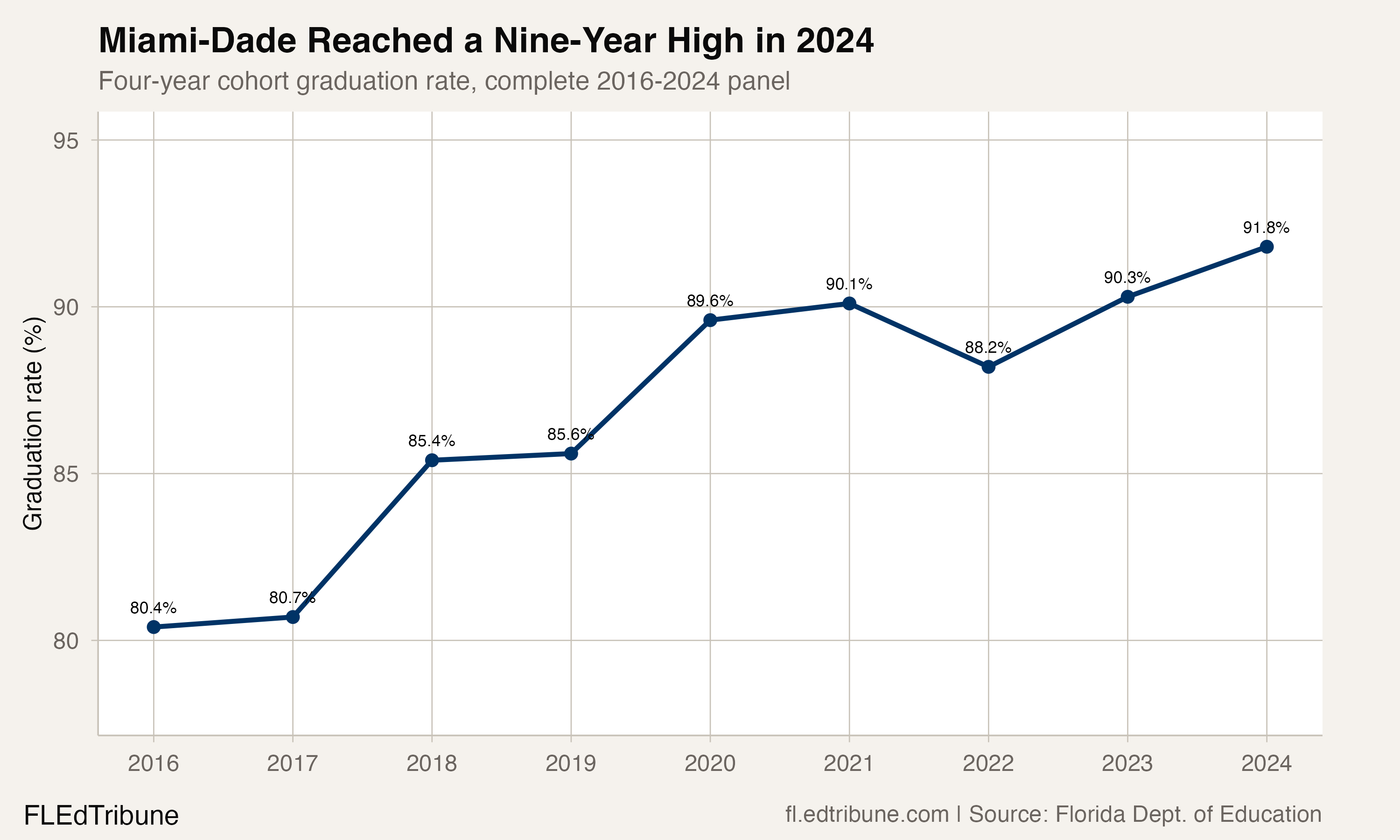
The panel contains a Miami-Dade value for each year from 2016 through 2024. The rate rose from 80.4% in 2016 to 85.6% in 2019 and 90.1% in 2021. It fell to 88.2% in 2022, then increased to 90.3% in 2023 and 91.8% in 2024.
Miami-Dade's 2024 rate was 2.1 points above Florida's 89.7% statewide rate. In 2016, the district's 80.4% rate was 0.3 points below the state's 80.7%.
The equity story
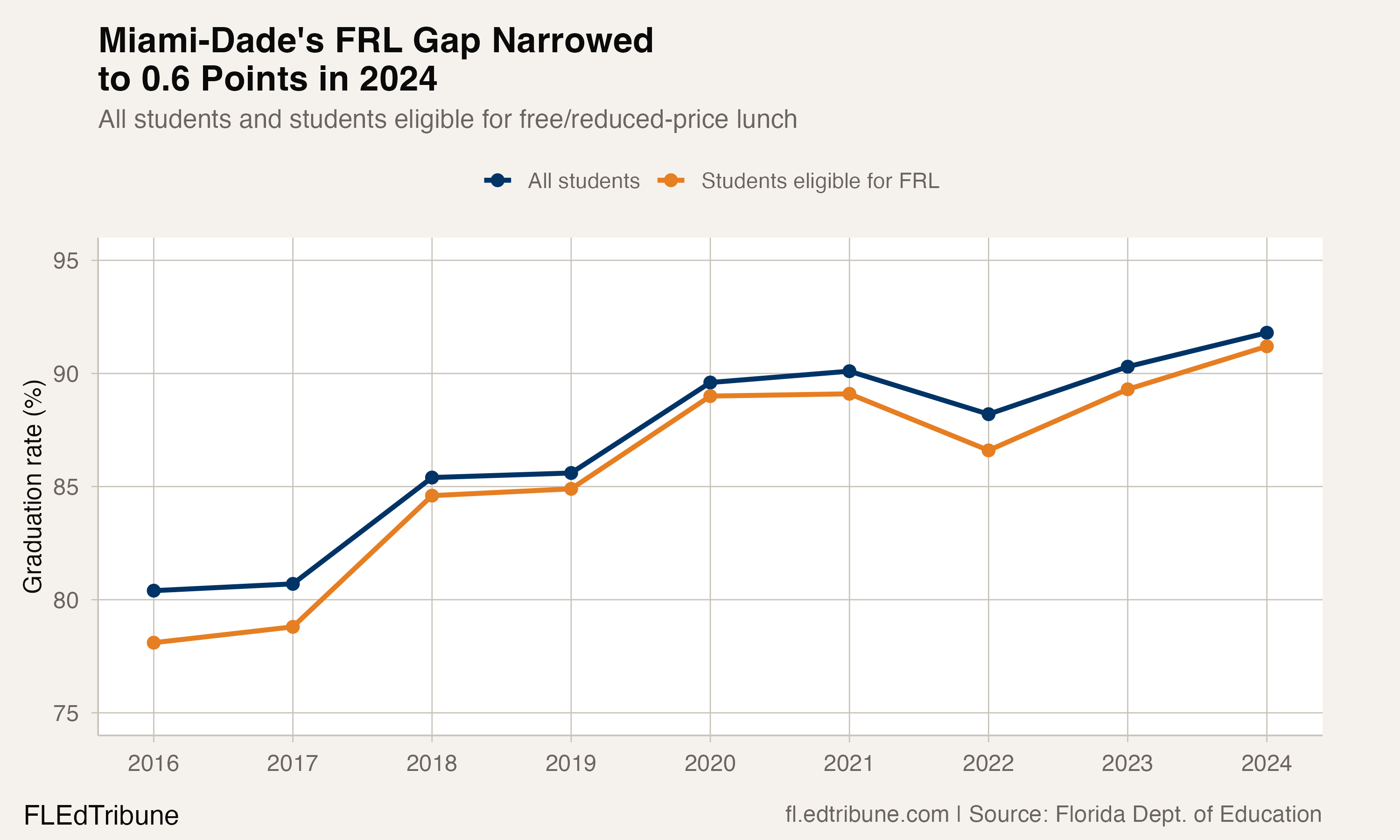
The rate for students eligible for free or reduced-price lunch was 91.2% in 2024, 0.6 points below the district's overall rate. That was the smallest FRL gap among Florida's 10 largest district cohorts; the other nine gaps ranged from 2.1 to 5.4 points. Florida's statewide FRL gap was 3.5 points.
The small gap is a result, not proof that family income no longer matters. The data does not identify which district practices or student circumstances produced it.
Students with disabilities graduated at 89.6%. English learners graduated at 84.2%, creating a 7.6-point gap from the overall rate. The rate was 90.3% for male students and 93.3% for female students, a 3.0-point difference.
Among the largest
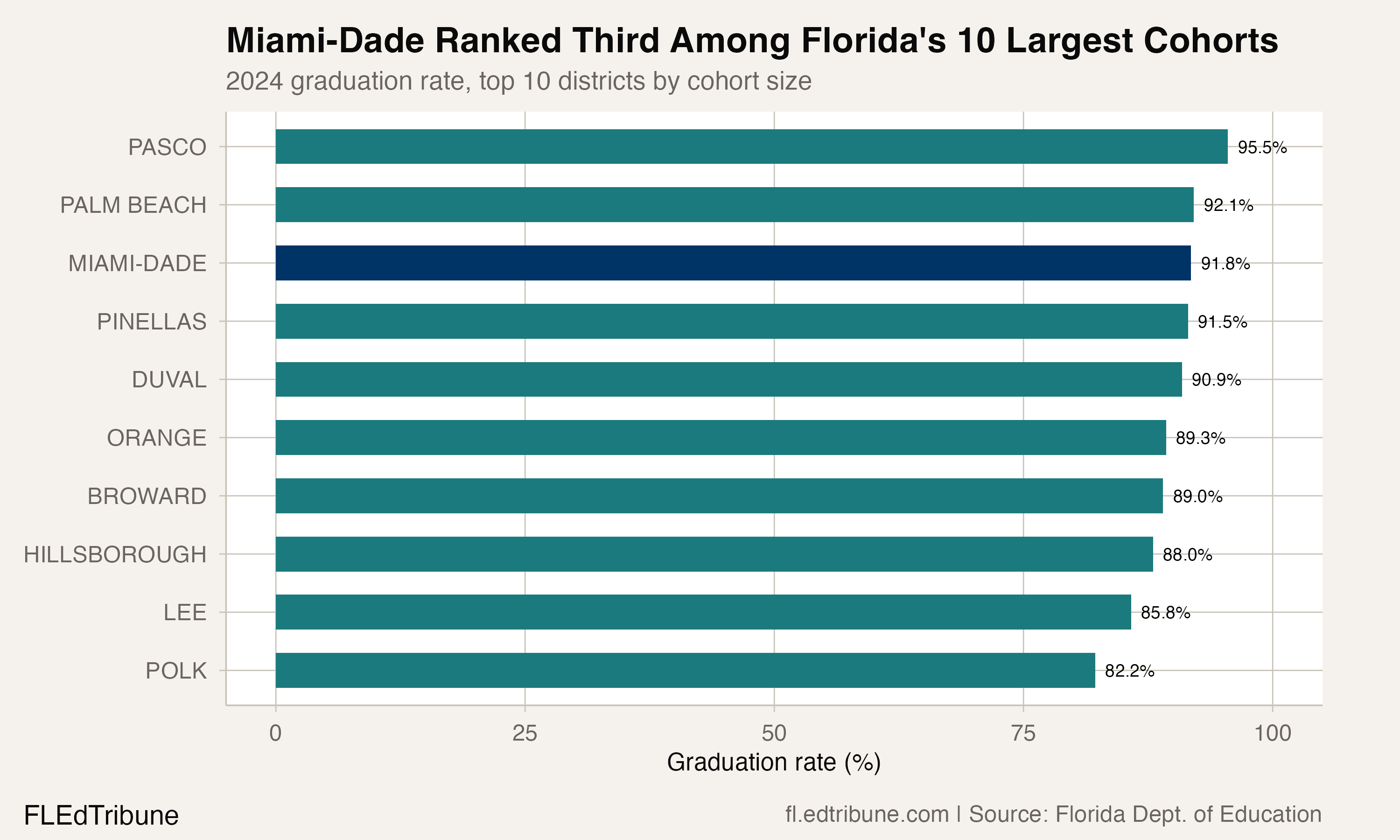
Miami-Dade had Florida's largest 2024 district cohort and ranked third in graduation rate among the 10 largest cohorts. Pasco led at 95.5%, followed by Palm Beach at 92.1% and Miami-Dade at 91.8%.
Miami-Dade's rate exceeded Broward's 89.0%, Orange's 89.3%, Hillsborough's 88.0%, and Polk's 82.2%. The comparison is statewide and cohort-based; it does not establish a national rank.
What the panel establishes
Across eight consecutive annual transitions, Miami-Dade's rate increased in seven and declined once. The 2024 value was the panel high, while the 2016 value was the low. Those findings describe a sustained long-run increase with one interruption; they do not explain its cause.
Detailed code that reproduces the analysis and figures in this article is available exclusively to EdTribune subscribers.
Discussion
Sign in to join the discussion.
Loading comments...