Correction (2026-07-23): An earlier version of this article said 15 districts had ELL graduation gaps exceeding 15 percentage points. The correct count is 17; the earlier figure came from a top-15 display list.
When Florida waived its standardized assessment requirements for graduation during the 2019-20 and 2020-21 school years, the graduation gap between English language learners and all students collapsed. In 2021, English learners graduated at 86.1 percent, just 4.0 percentage points behind the statewide rate of 90.1 percent. The gap, which had been 18.7 points in 2016, appeared to be nearing closure.
Then assessment requirements came back.
In 2022, the ELL graduation rate plummeted from 86.1 to 73.0 percent, a 13.1-point drop in a single year. The gap tripled, from 4.0 to 14.3 points. By 2024, it had partially recovered to 9.0 points, with ELL students graduating at 80.7 percent. But the rate remains well below where the pre-COVID trajectory of gradual improvement would have placed it.
The V-shaped gap
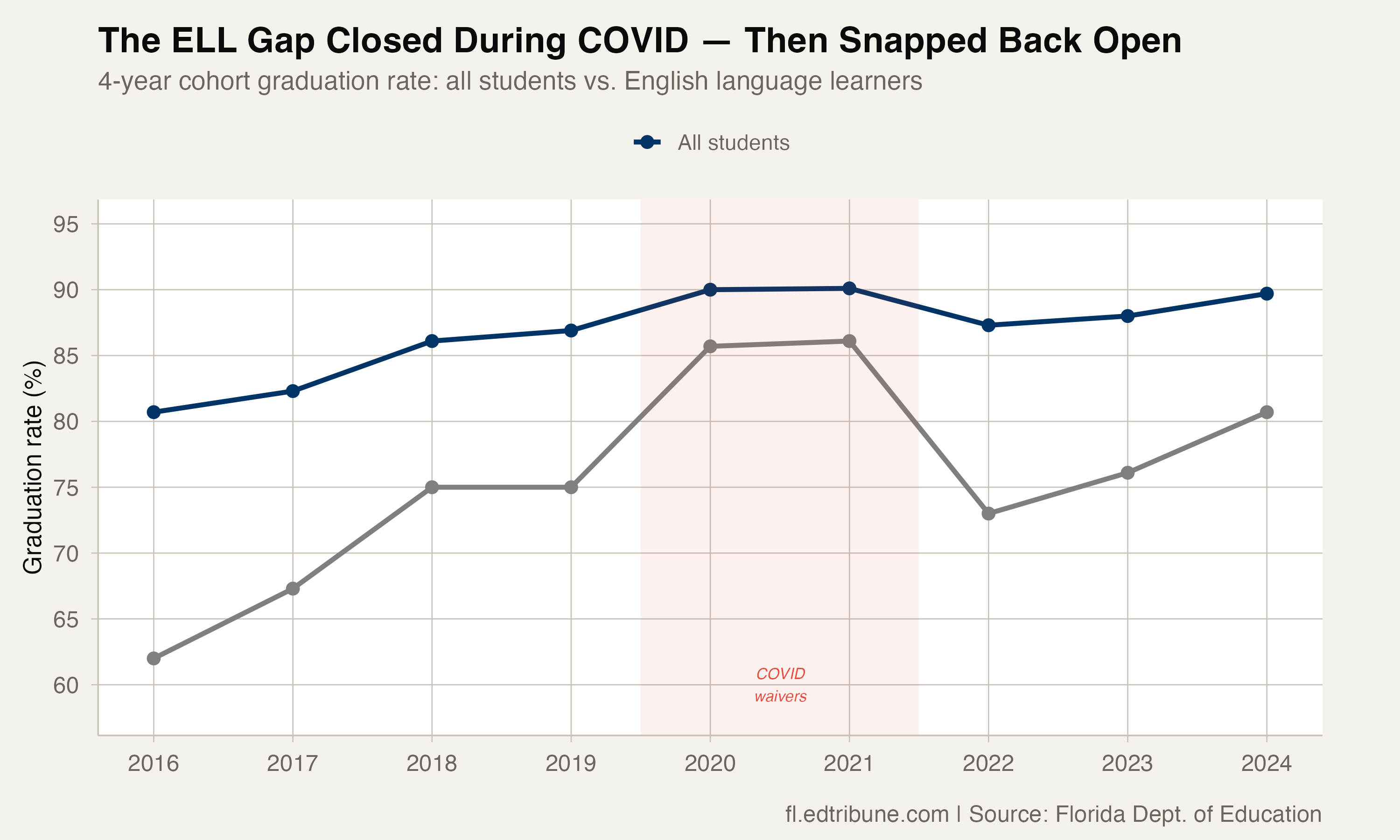
The pattern is unmistakable when charted. The gap narrowed steadily from 18.7 points in 2016 to 11.1 in 2018, then plunged to 4.3 and 4.0 during the waiver years, before rocketing back to 14.3 in 2022.
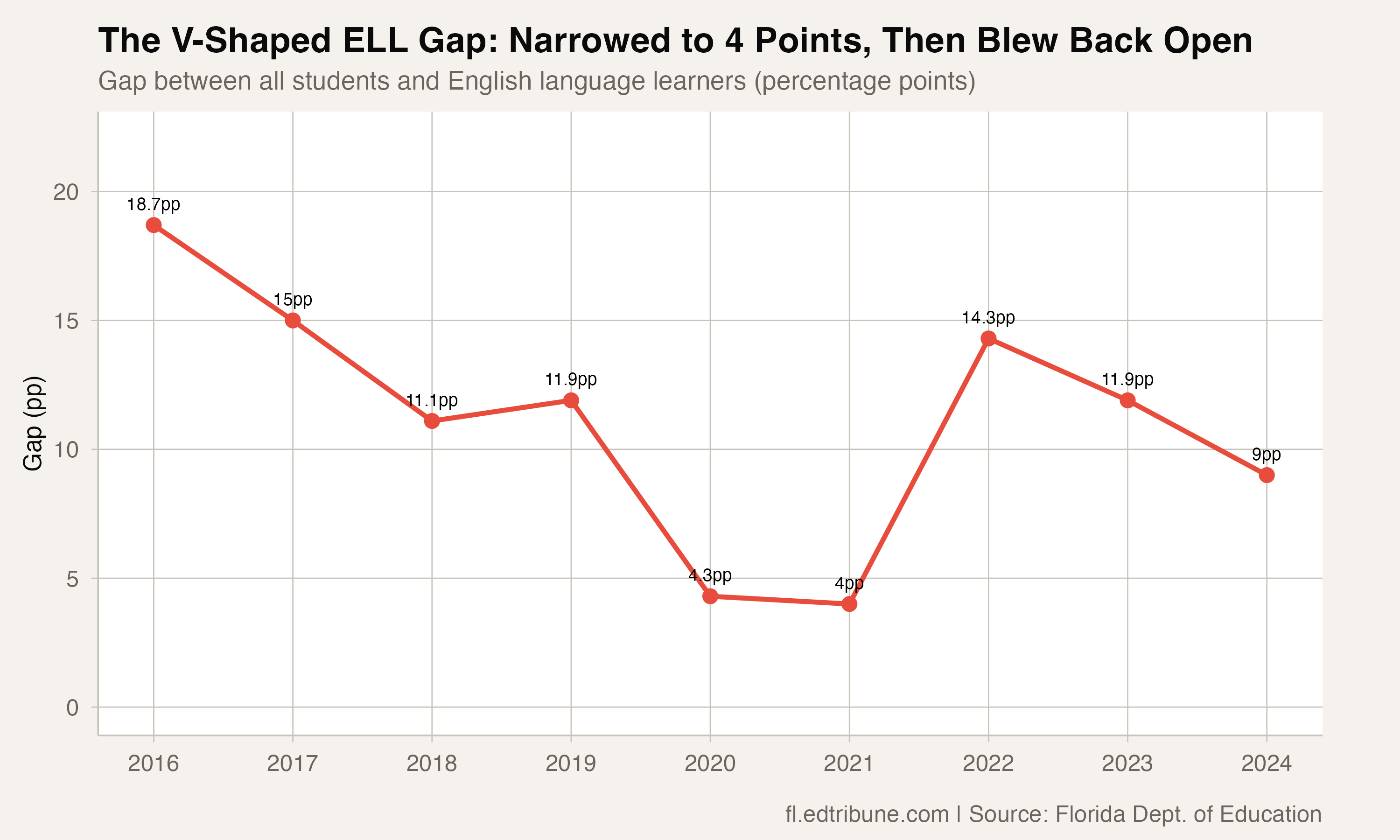
The V-shape tells a specific story about the role of Florida's standardized assessment requirement in determining who graduates. For the statewide student population, the return of testing caused a 2.8-point dip. For English learners, it caused a 13.1-point collapse. The assessment requirement functions as a more binding constraint for ELL students than for any other subgroup.
What the assessment barrier means
Florida requires students to pass the Florida Assessment of Student Thinking in English Language Arts at Level 3 or above to earn a standard diploma. There are concordant scores from the SAT and ACT that can substitute, but the core requirement is an English-language proficiency test.
For students still developing English proficiency, this creates a specific problem: a student may have mastered all academic content but lack the English reading comprehension to pass an ELA assessment designed for native speakers. The COVID waivers temporarily removed this barrier, and ELL graduation rates surged. When it returned, they cratered.
This does not mean the assessment is wrong. It may be measuring exactly what it intends to measure. But the data raises an uncomfortable question: are ELL students who fail the assessment genuinely unprepared for post-secondary life, or are they academically capable students gated by a language proficiency test?
The district picture is more extreme
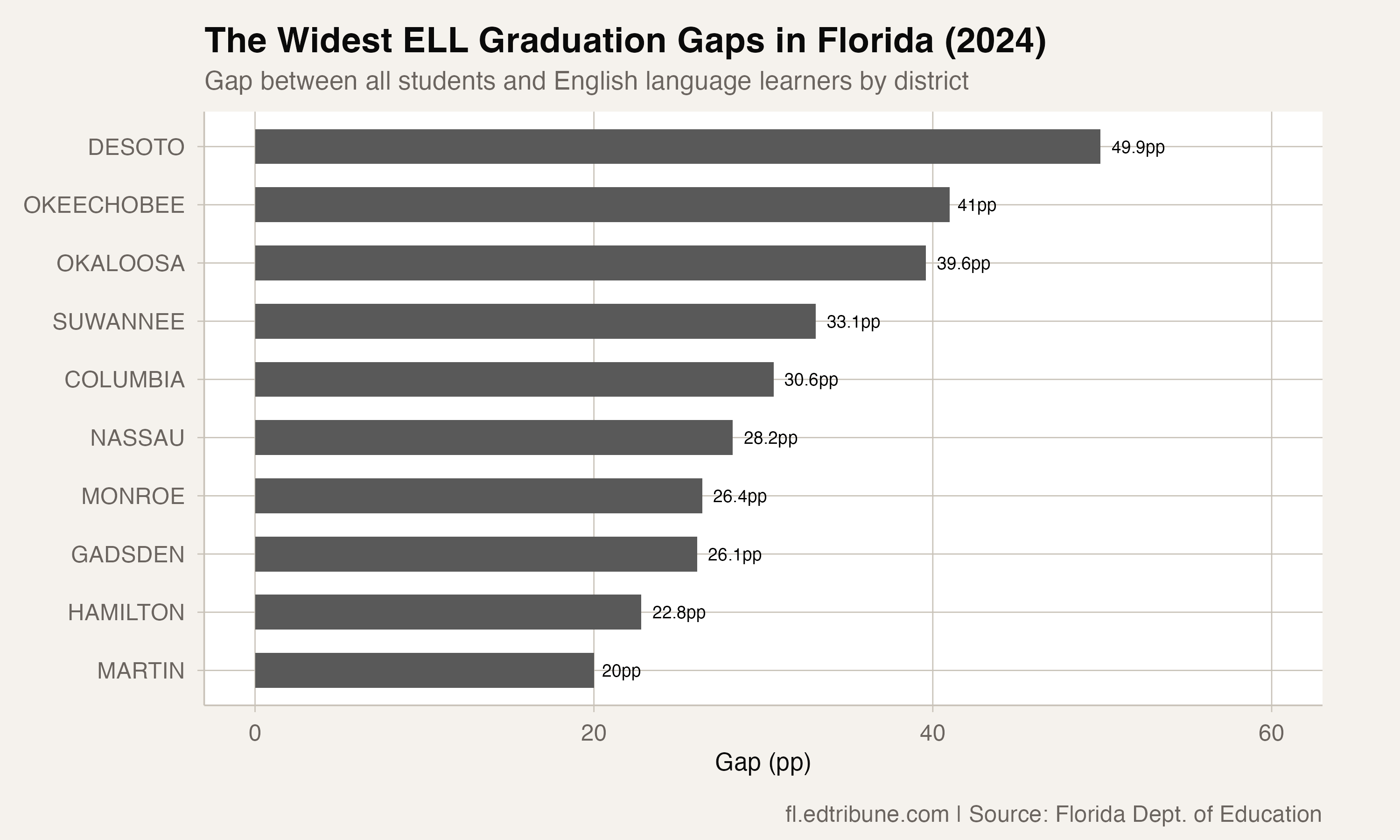
At the district level, the ELL graduation gap widens to staggering proportions. DeSoto County↗ET has a 49.9 percentage-point gap between its overall rate of 77.5 percent and its ELL rate of 27.6 percent. Just one in four English learners in DeSoto earns a diploma.
Okeechobee↗ET follows at 41.0 points, and Okaloosa↗ET at 39.6 points. In all, 17 districts have ELL gaps exceeding 15 percentage points.
The DeSoto figures deserve particular scrutiny. The district's ELL rate has swung wildly, from 6.7 percent in 2016 to 78.3 percent during the COVID waiver year of 2021, back down to 27.6 in 2024. These wild oscillations suggest a very small ELL cohort where individual students dramatically affect the rate. But the persistent pattern of low ELL graduation in an agricultural community with a large migrant worker population points to structural challenges in language access and academic support.
Growing cohorts, stagnant progress
Florida's ELL graduating cohort has grown 39 percent since 2016, from 15,195 to 21,054 students. This reflects the state's growing immigrant and bilingual population. The absolute number of ELL graduates has increased, from 9,419 to 16,982. But the rate of 80.7 percent in 2024 is essentially where the pre-COVID trend was headed, meaning the COVID-era gains were an illusion.
The contrast with Florida's special education subgroup is instructive. ESE students also benefited from COVID waivers, but their gap did not snap back when requirements returned. The ESE gap continued narrowing from 7.8 points in 2021 to 2.9 in 2024. The ELL gap went the other direction, from 4.0 to 9.0.
The difference may lie in the nature of the barrier. Special education accommodations and pathways existed before COVID and were strengthened during the pandemic. For ELL students, the only "accommodation" during COVID was removal of the assessment entirely. When it came back, there was no alternative pathway to replace it.
Detailed code that reproduces the analysis and figures in this article is available exclusively to EdTribune subscribers.
Discussion
Sign in to join the discussion.
Loading comments...