Correction (2026-07-23): An earlier version of this article said Pasco's English learner graduation rate was above the statewide overall average. At 89.6 percent, it sits 0.1 point below the statewide rate of 89.7 percent.
Pasco County↗ET, a growing suburban district north of Tampa with nearly 6,000 students per graduating cohort, posted a 95.5 percent graduation rate in 2024. That is 16.4 percentage points higher than its 2016 rate of 79.1 percent.
The number that stands out most, however, is not the overall rate. It is 96.2 percent, the graduation rate for students with disabilities in Pasco County. ESE students graduated at a higher rate than the general population. In any district, that would be unusual. In a district of nearly 6,000 graduates, it is remarkable.
The steady climb
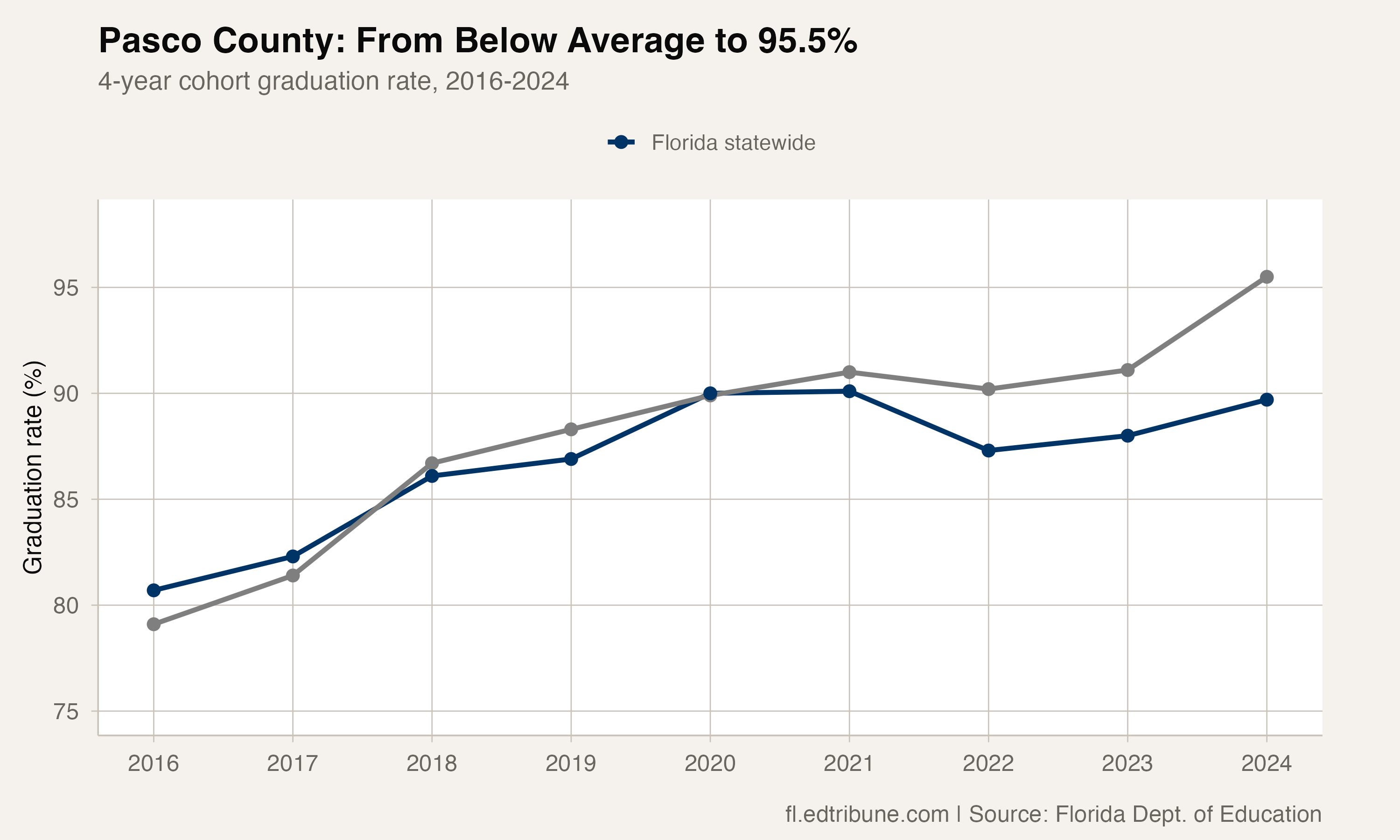
Pasco's improvement has been consistent. The district gained roughly 2 to 5 points per year between 2016 and 2021, moving from below average to above the state mark. When assessment requirements returned in 2022 and most districts dropped, Pasco held steady at 90.2 percent, losing less than a point. It then surged to 91.1 in 2023 and jumped 4.4 points to 95.5 in 2024.
The 2024 leap is striking. A 4.4-point gain for a district this size, in a year when the state gained 1.7 points, suggests something specific happened in Pasco rather than a statewide tide lifting all boats.
Every subgroup above 89 percent
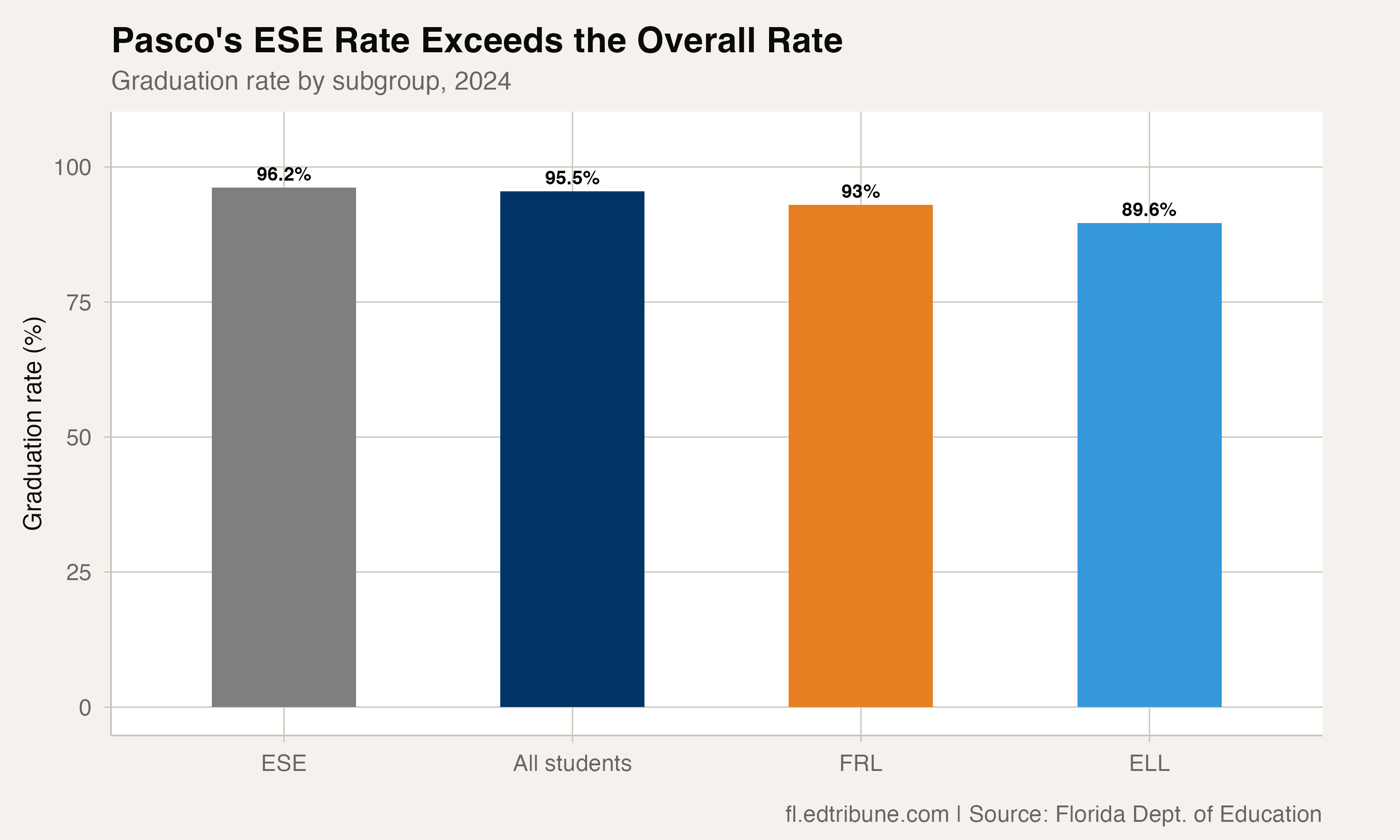
Pasco's 2024 graduation profile is uniformly high across every subgroup in the data. ESE students: 96.2 percent. FRL students: 93.0 percent. ELL students: 89.6 percent. Males: 94.5 percent. Females: 96.5 percent.
The ESE rate exceeding the overall rate is genuinely unusual in national data. Special education students face additional barriers to graduation, including modified curriculum pathways and assessment accommodations. In most states and districts, the special education gap runs 15 to 25 percentage points. Pasco has effectively eliminated it, then pushed past.
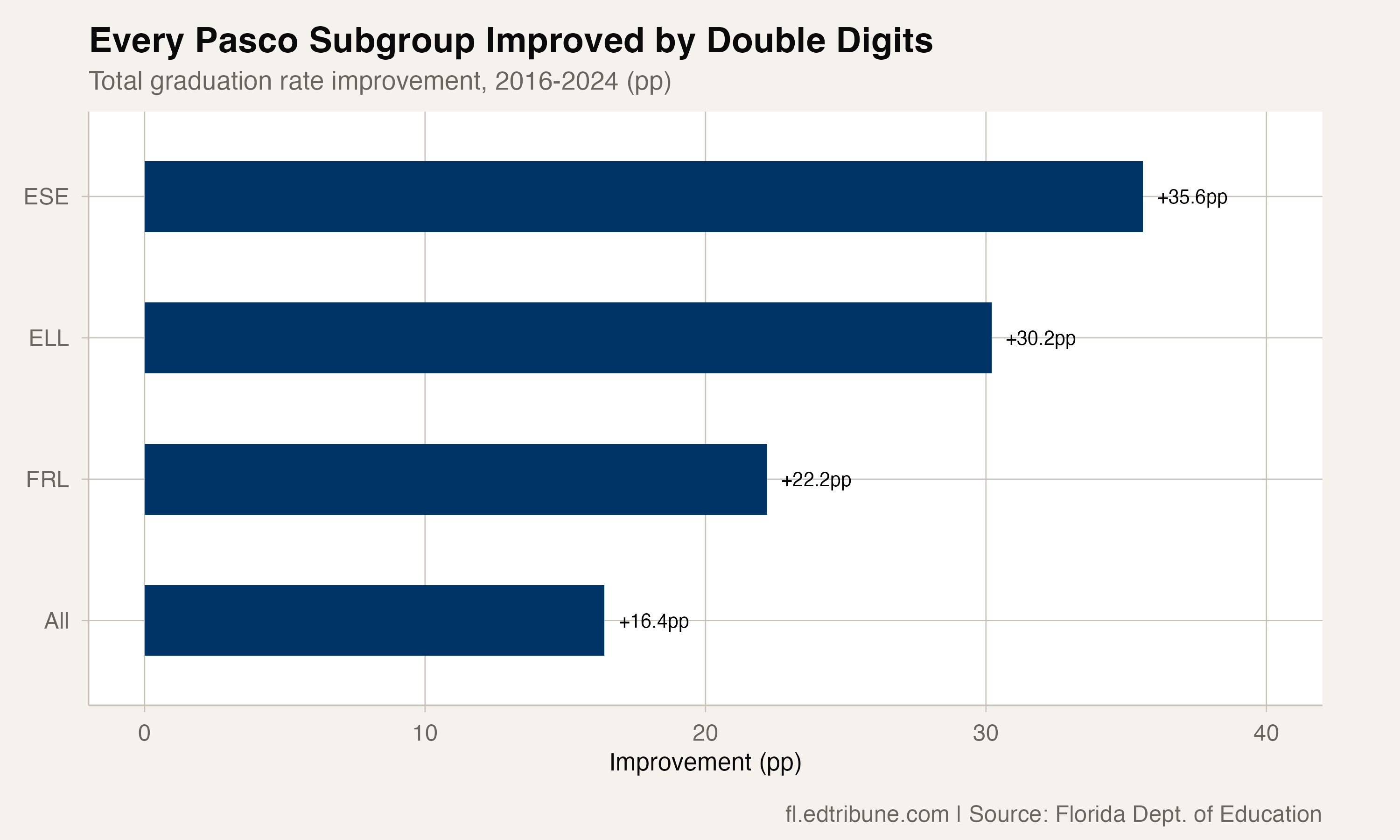
The improvements since 2016 are substantial across the board. ESE students improved by 35.6 points, from 60.6 to 96.2 percent. ELL students gained 30.2 points. FRL students improved 22.2 points. The overall rate gained 16.4.
A growing district
Pasco's cohort has grown from 4,877 in 2016 to 5,953 in 2024, a 22 percent increase. The district graduated 5,683 students in 2024, nearly 1,800 more than in 2016. This is not a case of a shrinking district achieving higher percentages from a smaller denominator.
Pasco County sits in the Tampa-St. Petersburg metropolitan area and has been one of Florida's fastest-growing communities. The combination of rapid population growth and dramatic improvement in graduation outcomes runs counter to what most education research would predict. Growing districts typically face integration challenges that can depress academic metrics.
What the data suggests but cannot prove
A 16.4-point improvement for a large district over eight years, with special education students outperforming the general population, points to systemic practices worth examining. The FRL rate of 93.0 percent suggests that Pasco's success extends to students from lower-income backgrounds. The ELL rate of 89.6 percent, while the lowest subgroup, sits just 0.1 point below the statewide overall average of 89.7 percent.
What specific interventions, tracking systems, or graduation pathways Pasco has implemented is not visible in the state data. But the consistency of improvement across subgroups suggests a district-wide approach rather than targeted programs for individual populations.
Detailed code that reproduces the analysis and figures in this article is available exclusively to EdTribune subscribers.
Discussion
Sign in to join the discussion.
Loading comments...