Florida Virtual School↗ET, the state's original and largest online education program, graduated 96.6 percent of its 2024 cohort, a 30-point improvement from 66.6 percent in 2016. The improvement is the second-largest of any district entity in Florida, behind only the Florida School for the Deaf and the Blind, a specialized residential school that gained 38.4 points over the same period.
In a state where virtual education remains politically contested, FLVS is putting up graduation numbers that most traditional districts cannot match.
From failing to flagship
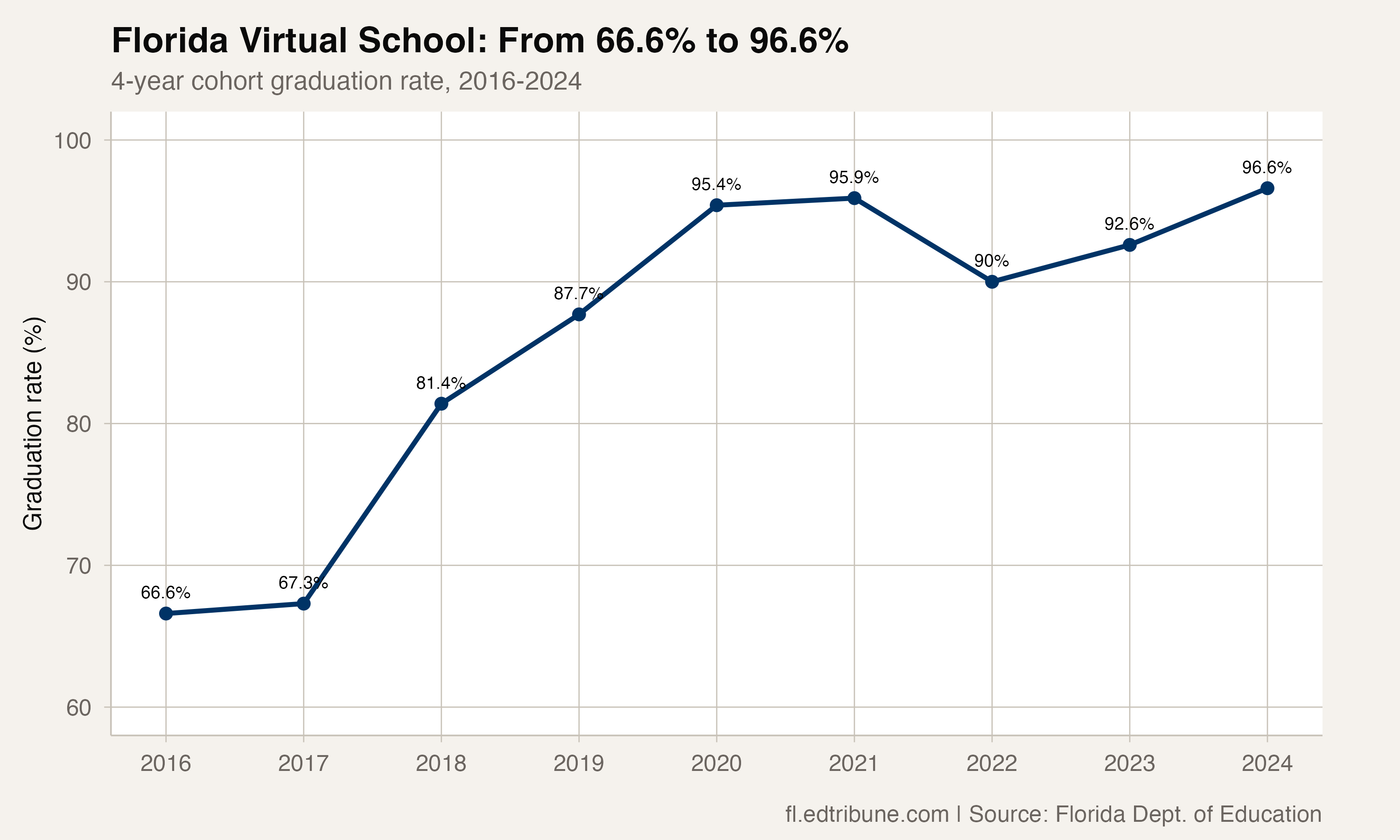
FLVS spent 2016 and 2017 in the mid-60s, rates that would have attracted intervention had they belonged to a traditional district. Then something shifted. The rate jumped nearly 14 points to 81.4 percent in 2018, continued climbing to 87.7 in 2019, and then crossed 95 percent in 2020.
The COVID years that inflated rates for most districts had minimal impact on FLVS's trajectory, which was already ascending. The post-COVID correction was more noticeable: the rate dropped from 95.9 percent in 2021 to 90.0 in 2022, a 5.9-point decline. But FLVS recovered quickly, reaching 92.6 in 2023 and 96.6 in 2024, its all-time high.
A growing program
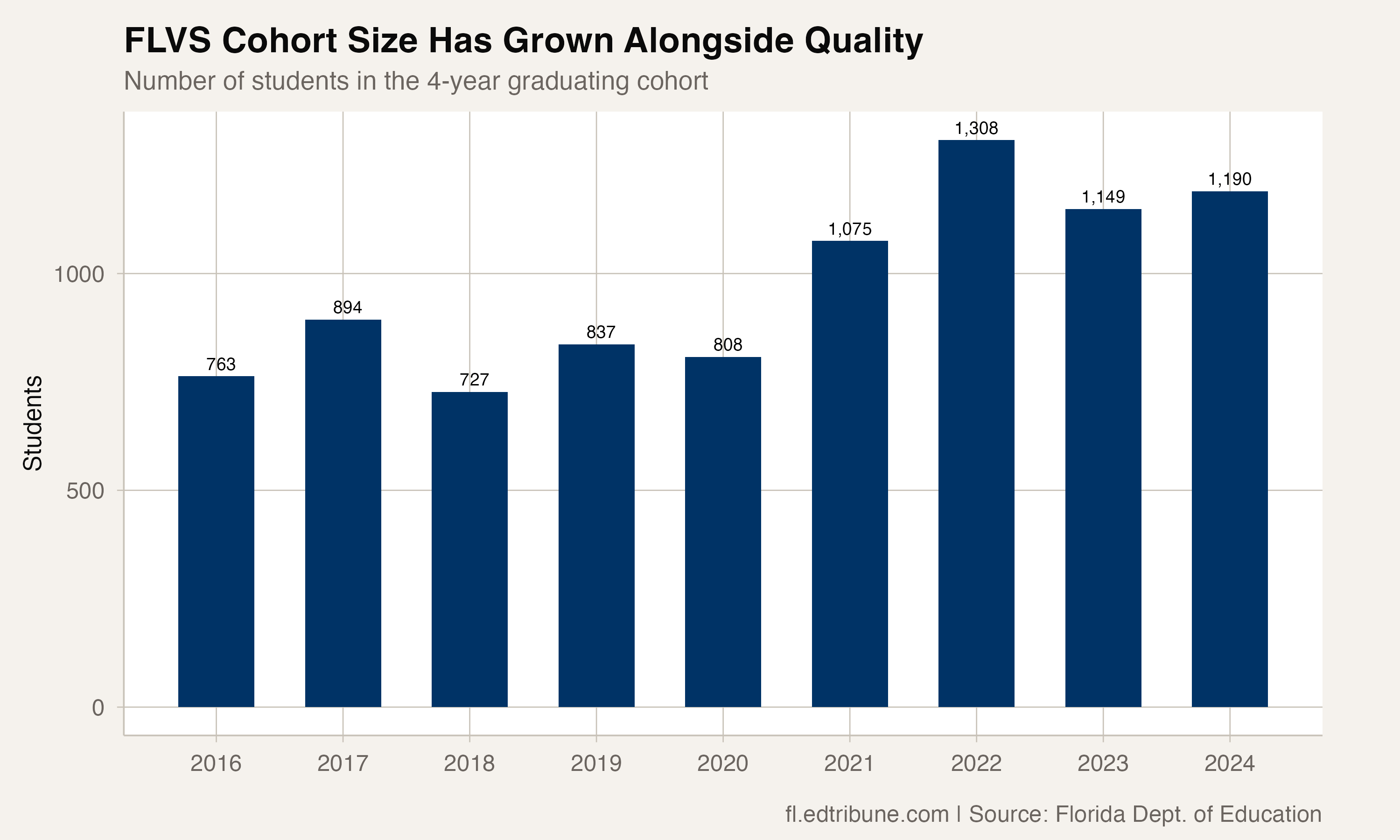
The improvement coincided with growth, not contraction. FLVS's graduating cohort expanded from 763 students in 2016 to 1,190 in 2024, a 56 percent increase. The school graduated 1,150 students in 2024, more than double the 508 who earned diplomas in 2016.
This matters because one explanation for rising virtual school rates is selective attrition: students who are not on track to graduate transfer back to traditional schools, leaving a smaller, higher-performing cohort behind. The growing cohort at FLVS suggests that either the program is retaining students who would have transferred out in earlier years, or it is attracting a broader, more capable student body.
Outperforming traditional districts
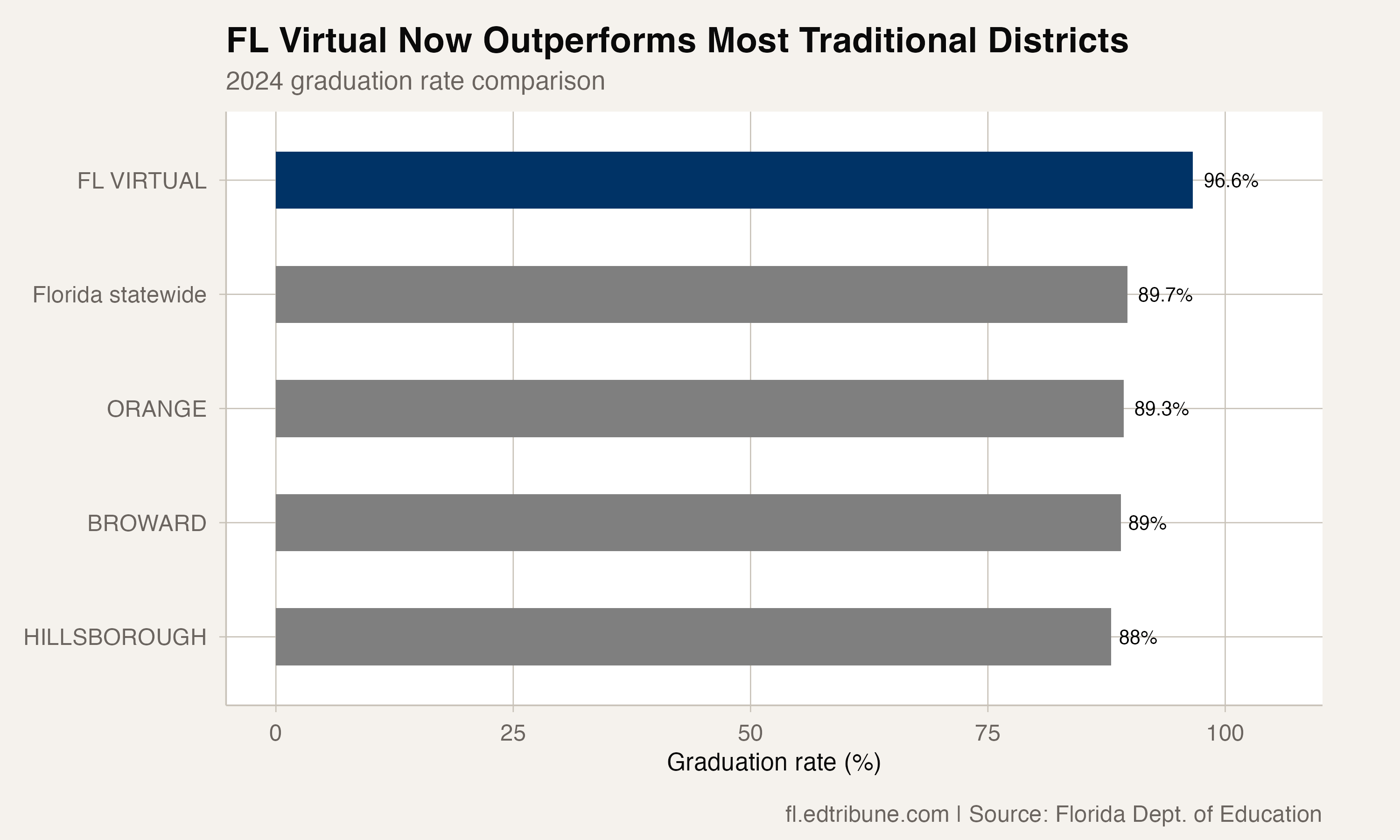
At 96.6 percent, FLVS outperforms every large traditional district in Florida. Broward County, the state's second-largest, graduated 89.0 percent. Hillsborough (Tampa) graduated 88.0 percent. Orange County (Orlando) graduated 89.3 percent. The statewide average is 89.7.
FLVS's 2024 subgroup rates reinforce the comparison. FRL students graduated at 95.5 percent. ESE students reached 98.1 percent. Males and females both exceeded 96 percent. The only volatile subgroup is ELL, which swung from 65.2 percent in 2022 to 100 percent in 2024, though the small number of ELL students at FLVS makes those rates unstable.
What virtual success means
Virtual schooling carries a mixed reputation nationally. Some virtual schools have been plagued by low engagement, poor outcomes, and scandals involving enrollment fraud. Florida's own virtual sector includes programs with varied track records.
FLVS is different in kind from many virtual programs. It is a state-created entity with a longer operational history than most competitors. It offers a full curriculum with certified teachers, not self-paced modules. Its student body of roughly 1,200 per graduating cohort is large enough to be meaningful but small enough to provide more individualized attention than a district of 20,000.
Still, the 30-point improvement in eight years demands scrutiny as well as praise. What changed between 2017 and 2018 that caused the rate to jump 14 points? Are the students who choose FLVS systematically different from those who remain in traditional schools? Does the program's graduation rate reflect genuine academic readiness, or is it measuring something else about the students who self-select into virtual education?
These are questions worth investigating, not to undermine the achievement, but to understand whether it can be replicated.
Detailed code that reproduces the analysis and figures in this article is available exclusively to EdTribune subscribers.
Discussion
Sign in to join the discussion.
Loading comments...