Florida's male graduation rate moved closer to the female rate in each of the eight year-to-year comparisons from 2016 to 2024. In 2016, boys graduated at 77.0 percent compared to 84.5 percent for girls, a 7.5 percentage-point gap. By 2024, boys had reached 87.9 percent and girls 91.6 percent, narrowing the gap to 3.7 points.
The 10.9-point gain for males, compared with 7.1 points for females, is the reason the gender gap narrowed. Boys are still behind girls, but the distance between them has been cut roughly in half.
The steady convergence
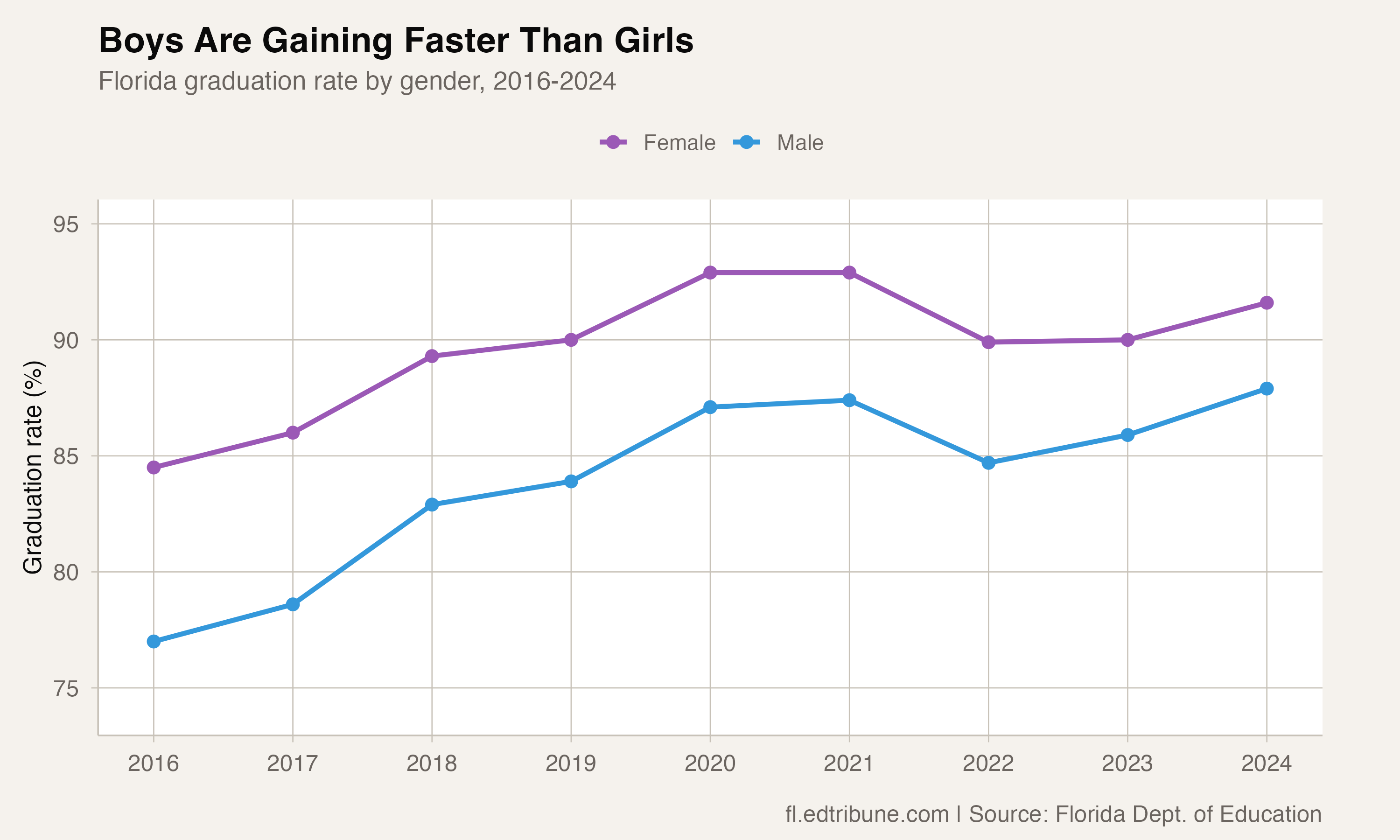
The narrowing has been remarkably consistent. The gap dropped every single year from 2016 to 2024: 7.5, 7.4, 6.4, 6.1, 5.8, 5.5, 5.2, 4.1, 3.7. Both statewide rates dipped in 2022, but the gap still narrowed from 5.5 to 5.2 points.
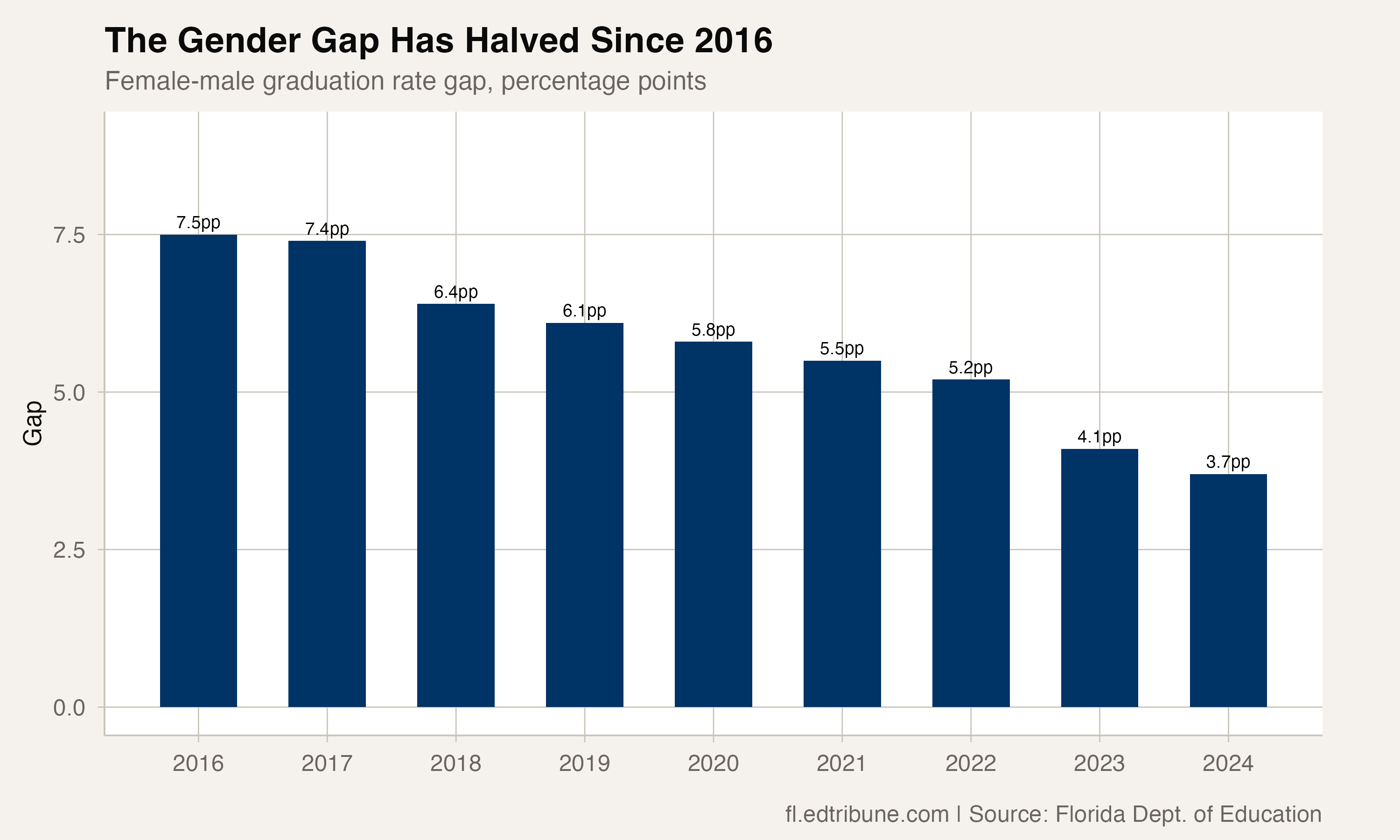
The 2020 and 2021 cohorts did not interrupt the pattern. The female rate held at 92.9 percent across those two years, the male rate edged from 87.1 to 87.4 percent, and the gap narrowed from 5.8 to 5.5 points.
Small-county gaps remain severe
The statewide trend masks severe gender gaps in small districts. Gilchrist County↗ET had the widest 2024 gap: 17.2 points, with girls at 94.2 percent and boys at 77.0. Taylor County↗ET had a 16.0-point gap, Baker County↗ET was at 14.3 points, and Gadsden↗ET was at 12.2.
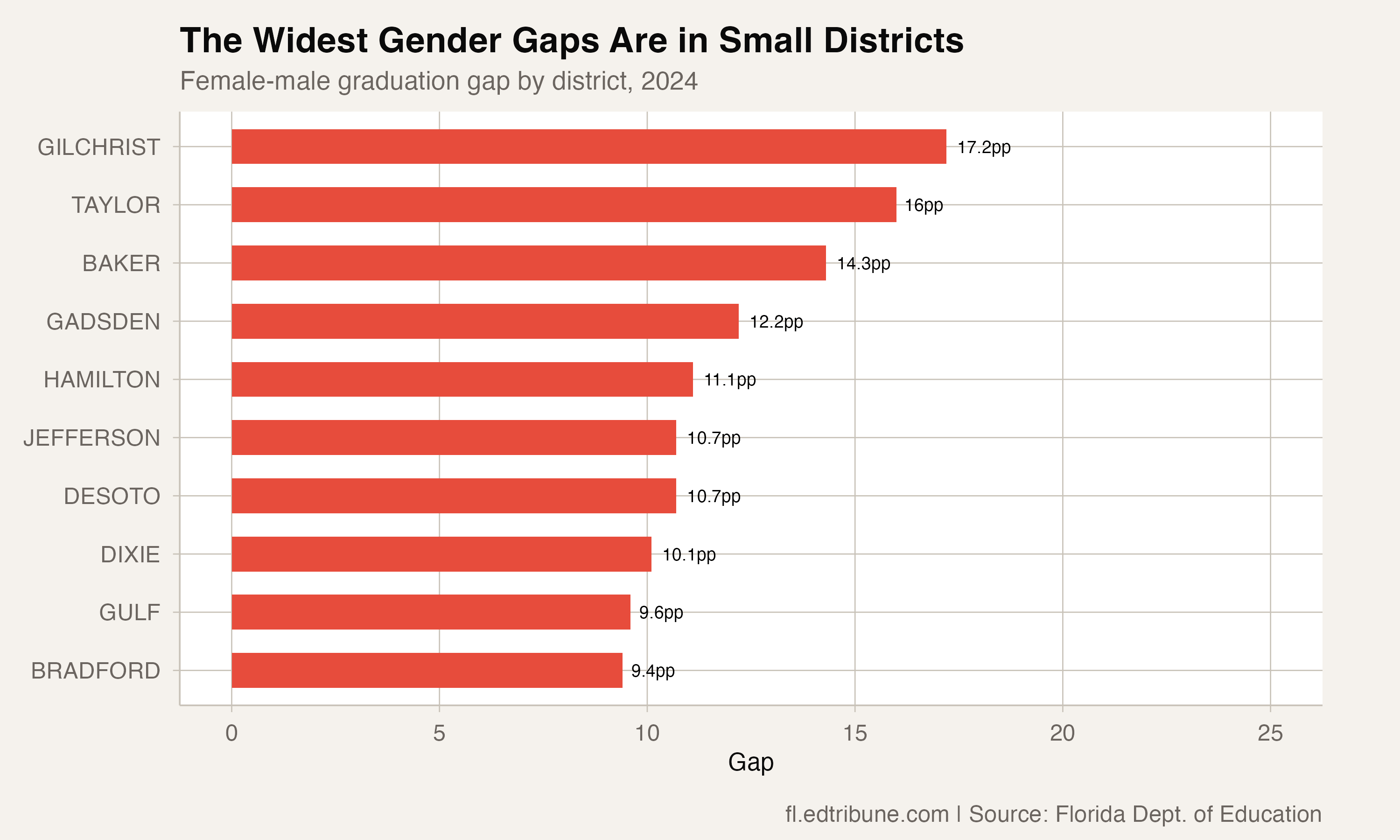
The pattern is concentrated. All eight districts with double-digit gender gaps had 2024 graduation cohorts below 400 students. Seven of the eight had male graduation rates below 78 percent; four had female rates of 88 percent or higher.
Mechanism label: unresourced. The graduation file can show where the gaps are concentrated, but it cannot identify why those gaps exist. Work patterns, course-taking, local labor markets, school climate, and student supports are plausible hypotheses, not verified explanations in this article.
What boys gained
The 10.9-point improvement for boys means 11,913 additional male students graduated in 2024 compared with what Florida would have produced if the 2024 male cohort had graduated at the 2016 male rate. More boys earning diplomas explains a substantial share of the state's overall 9.0-point gain.
The improvement is also durable. After statewide rates dipped in 2022, the male rate recovered from 84.7 percent to 87.9 percent by 2024, while the female rate recovered from 89.9 percent to 91.6 percent. The 2024 gap of 3.7 points is the narrowest in Florida's 2016-2024 graduation file.
Where the gap goes from here
If the 2016-2024 straight-line pace continued, Florida's gender graduation gap would be about 7.8 years from parity. That is simple arithmetic, not a forecast: the state file verifies the narrowing trend, but it does not prove that the trend will continue.
At the statewide level, the gender story in Florida is narrowing but unfinished. Boys are still behind, and the eight double-digit-gap districts had 2024 cohorts ranging from 41 to 350 students.
Detailed code that reproduces the analysis and figures in this article is available exclusively to EdTribune subscribers.
Discussion
Sign in to join the discussion.
Loading comments...