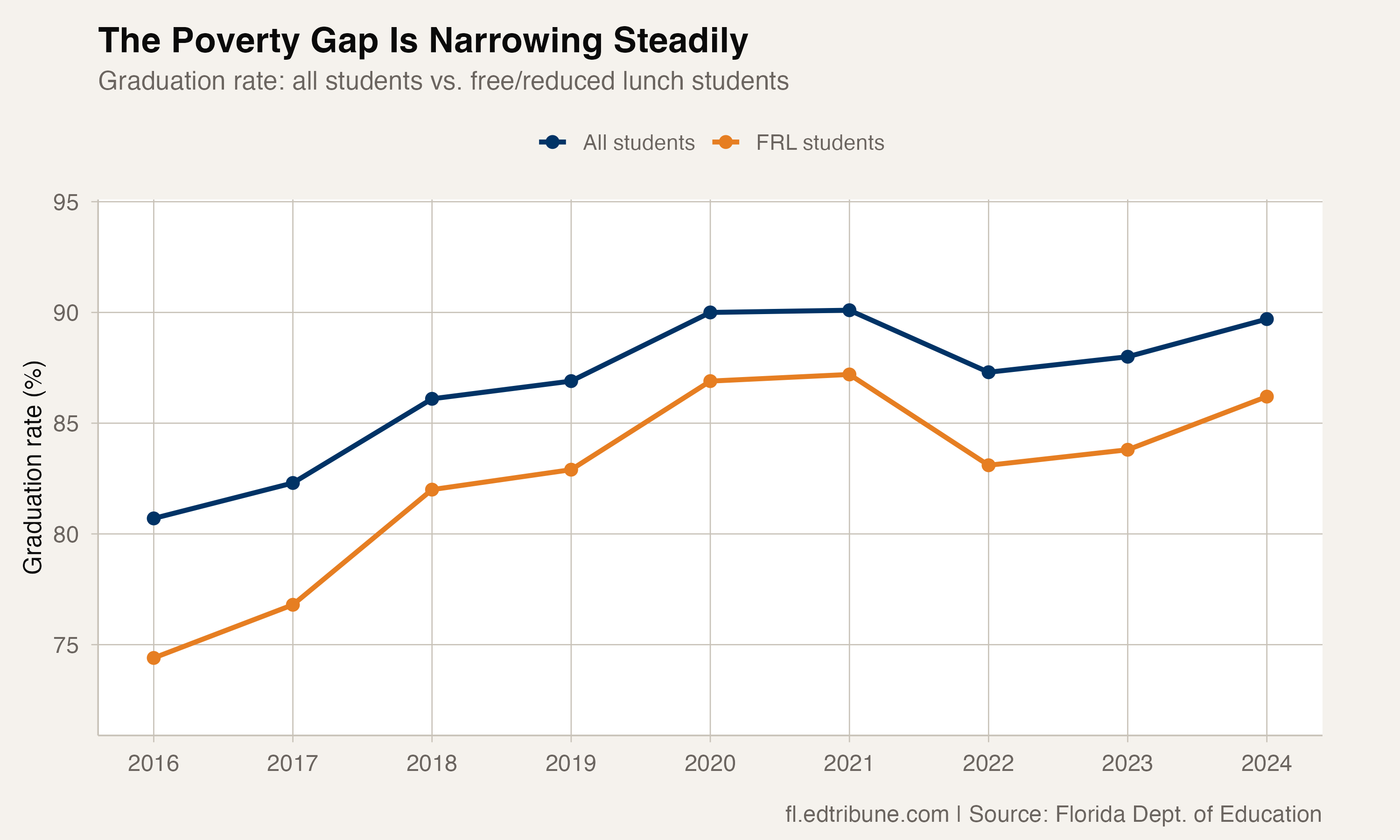
Florida students receiving free or reduced-price lunch graduated at 86.2 percent in 2024, up from 74.4 percent in 2016. The 11.8 percentage-point improvement for FRL students outpaces the 9.0-point gain for all students, steadily closing the poverty-linked graduation gap from 6.3 to 3.5 points.
The poverty penalty for graduation in Florida has nearly halved in eight years.
A durable narrowing
The FRL gap narrowed in almost every year since 2016. It dropped from 6.3 to 5.5 to 4.1 to 4.0 to 3.1 to 2.9 through 2021. The COVID waiver years narrowed it further, hitting 2.9 points in 2021, its all-time low.
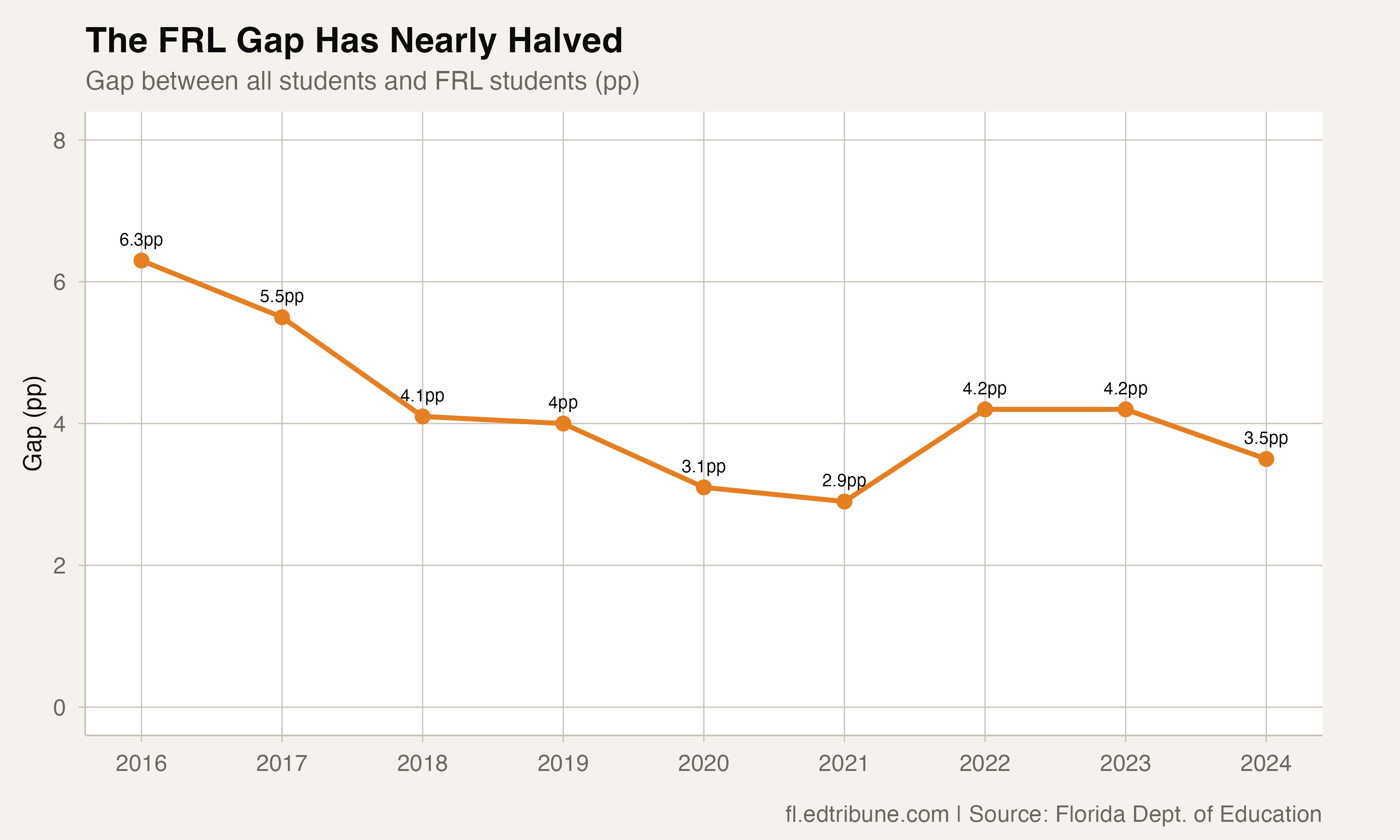
When assessment requirements returned in 2022, the gap widened back to 4.2 points, where it stayed through 2023 before narrowing again to 3.5 in 2024. This represents a partial snapback, but a much milder one than what happened to other subgroups.
The 2024 gap of 3.5 points is the narrowest on record outside the COVID-waiver years of 2020 and 2021, when the gap fell to 3.1 and 2.9. The direction of travel has held.
The contrast with ELL and ESE
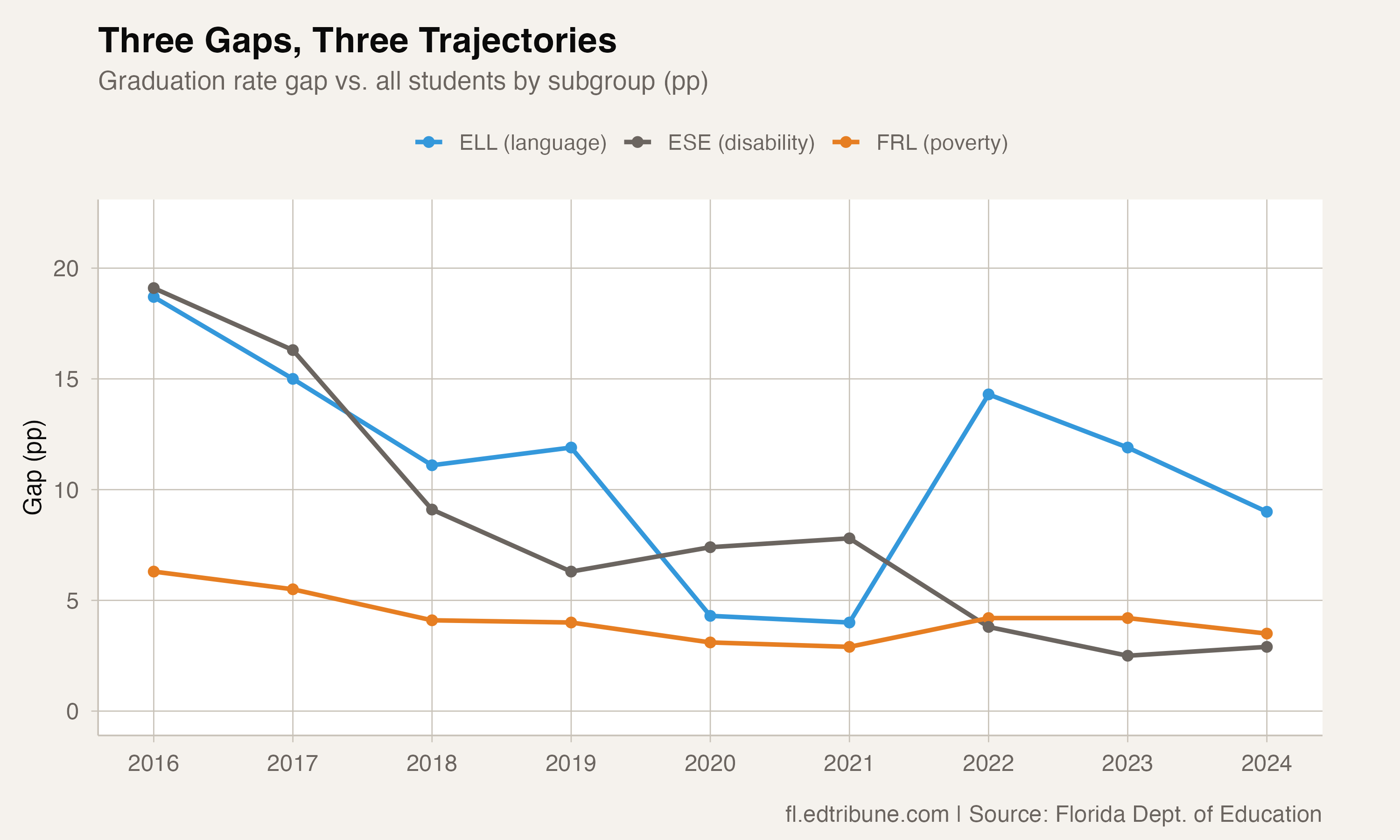
The three major equity gaps in Florida's graduation data have followed strikingly different trajectories since the COVID correction.
The ESE gap continued narrowing after the return of assessment requirements, falling from 7.8 points in 2021 to 2.9 in 2024. The ESE improvement was essentially uninterrupted by COVID policy changes.
The ELL gap snapped back violently, from 4.0 points in 2021 to 14.3 in 2022, and has only partially recovered to 9.0 in 2024. The COVID correction erased most of the ELL progress.
The FRL gap sits between these extremes. It widened from 2.9 to 4.2 points when testing returned, then resumed narrowing. This intermediate trajectory suggests that poverty presents a real but less acute barrier to assessment-based graduation than English language proficiency. Low-income students are disadvantaged on assessments, but not to the same degree as students whose primary barrier is language.
Scale matters
The FRL cohort is enormous. In 2024, 113,844 students classified as FRL were in the graduating cohort, more than half the total. At the 2016 rate of 74.4 percent, about 84,700 of them would have graduated. At the 2024 rate of 86.2 percent, 98,157 did. The improvement produced roughly 13,500 additional graduates from lower-income families in that year alone.
The FRL classification itself carries caveats. Florida participates heavily in the Community Eligibility Provision, which allows schools and districts to designate all students as FRL for meal purposes regardless of individual income. The FRL subgroup in graduation data may therefore include students who are not individually low-income. But the statewide trend in the gap is still informative, even if the subgroup definition has become less precise over time.
What the numbers suggest
A 3.5-point graduation gap between low-income students and the overall rate is a narrow one. Florida has compressed its gap to a level where the remaining difference could plausibly be explained by factors other than poverty itself: special education rates, student mobility, language, family instability.
Whether the gap can be closed entirely depends on whether the improvement for FRL students continues to outpace the overall rate. The trajectory since 2016 says it can. The post-COVID widening says the path is not guaranteed.
Detailed code that reproduces the analysis and figures in this article is available exclusively to EdTribune subscribers.
Discussion
Sign in to join the discussion.
Loading comments...