In 2016, Florida students with disabilities graduated at 61.6 percent, a full 19.1 percentage points below the statewide rate. Eight years later, that gap has all but vanished. Students receiving Exceptional Student Education services graduated at 86.8 percent in 2024, closing the gap to just 2.9 points.
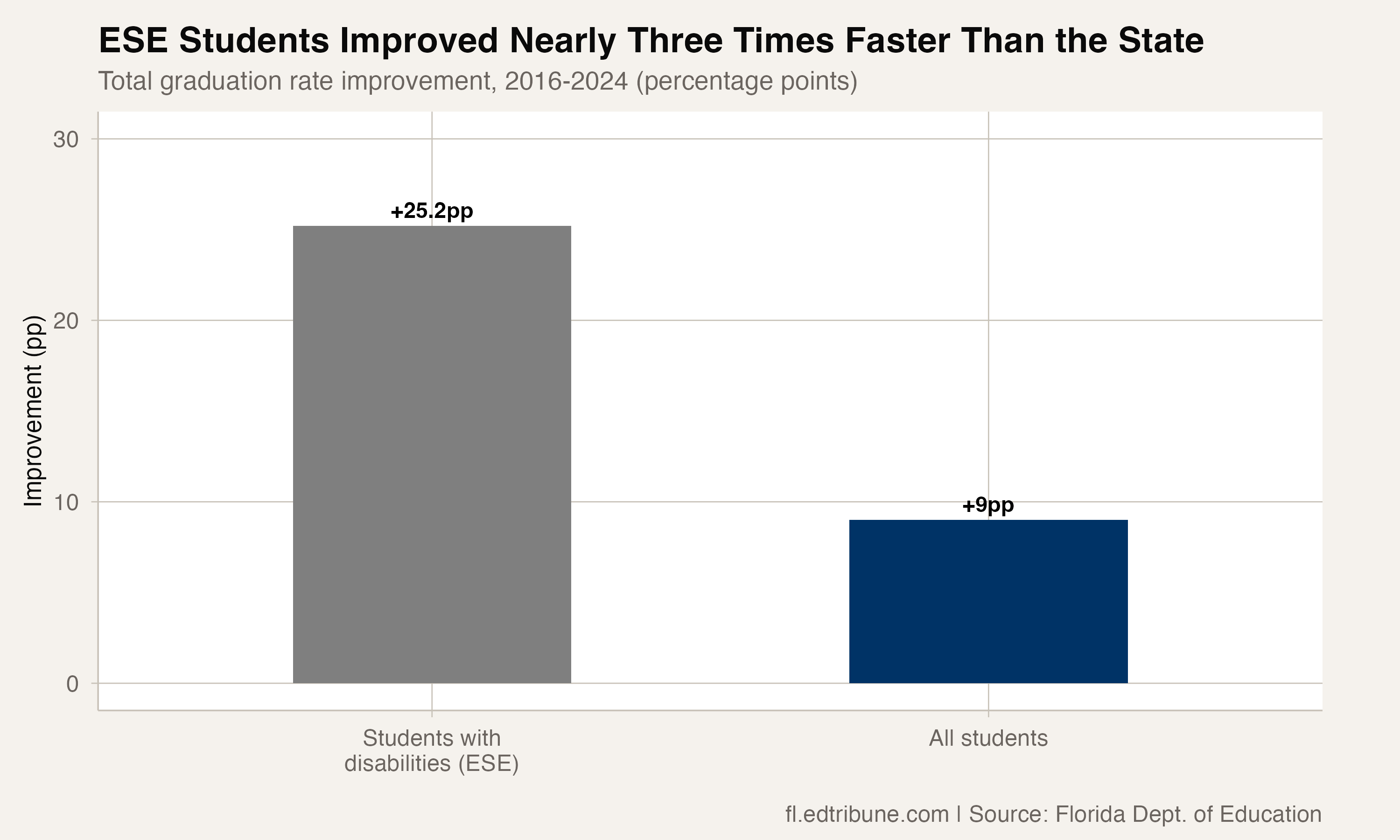
The 25.2 percentage-point improvement for ESE students is nearly three times the statewide gain of 9.0 points over the same period. It is, by a wide margin, the largest subgroup improvement in Florida's graduation data.
The trajectory
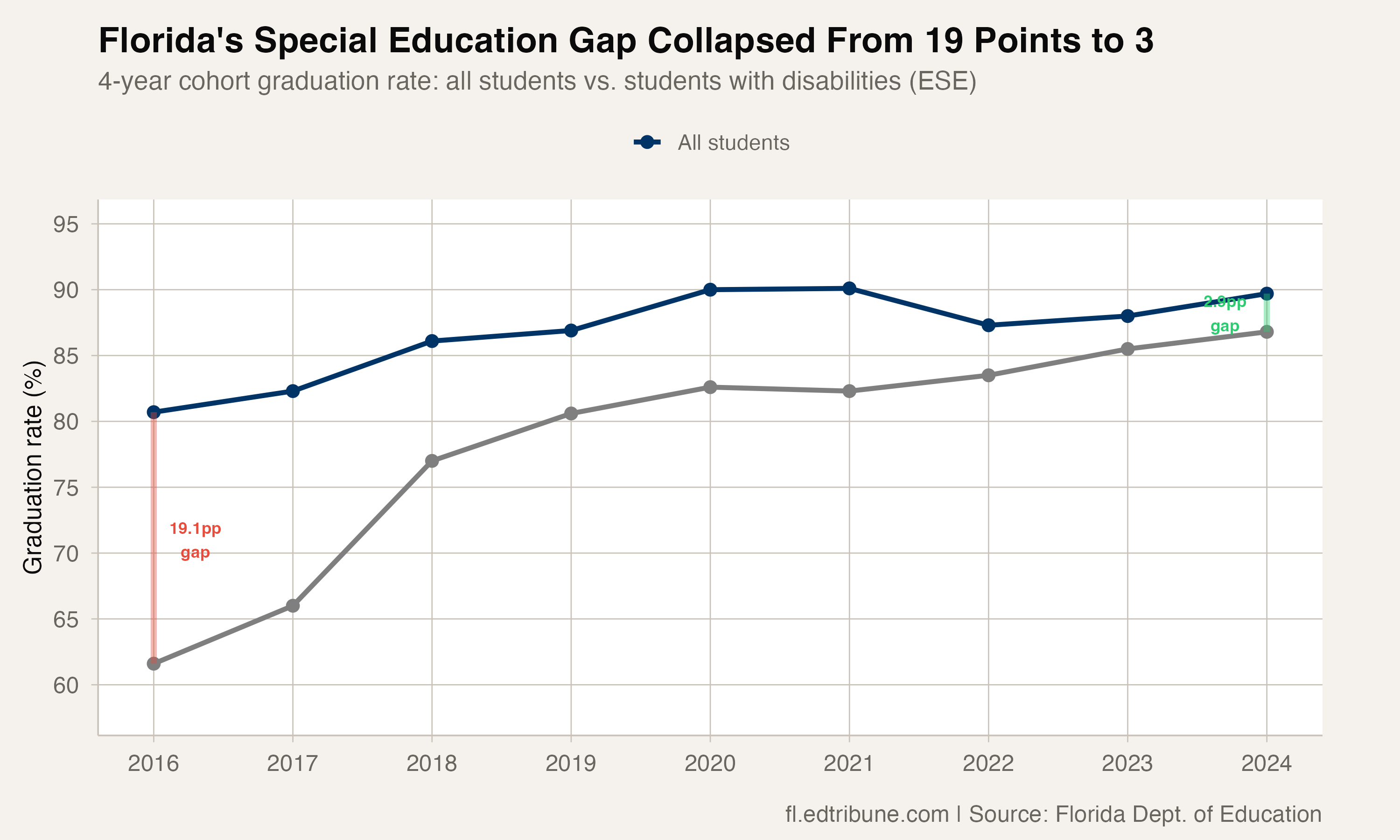
The gap closed in two distinct phases. From 2016 to 2019, ESE rates improved rapidly, from 61.6 to 80.6 percent, cutting the gap from 19.1 to 6.3 points. This four-year stretch accounts for most of the raw improvement.
Then came COVID. The waiver years of 2020 and 2021 actually widened the gap slightly, to 7.4 and 7.8 points respectively, as the overall rate was inflated more than the ESE rate. When assessment requirements returned in 2022, something unexpected happened. The overall rate dropped 2.8 points, but the ESE rate continued climbing, from 82.3 to 83.5 percent. The gap collapsed to 3.8 points.
By 2023, the gap had narrowed to 2.5 points. It widened slightly to 2.9 in 2024 as the overall rate recovered faster, but the ESE rate still reached its all-time high of 86.8 percent.
Growing cohorts, growing success
The improvement is not an artifact of smaller cohorts. Florida's ESE graduating cohort has grown from 22,544 in 2016 to 30,117 in 2024, a 34 percent increase. The state is identifying more students for special education services and graduating a much larger share of them.
In raw numbers, Florida graduated 26,143 ESE students in 2024, compared to 13,876 in 2016. The state nearly doubled the number of students with disabilities earning diplomas.
National context
The national average graduation gap between students with disabilities and all students hovers between 20 and 30 percentage points, according to federal data. Florida's 2.9-point gap in 2024 would place it among the narrowest in the country if the figure holds under federal reporting standards.
What makes Florida's case particularly notable is the scale. This is not a small state achieving low gaps through selective identification. Florida has the third-largest public school enrollment in the country, and its ESE cohort of more than 30,000 students is among the largest anywhere.
What's behind the numbers
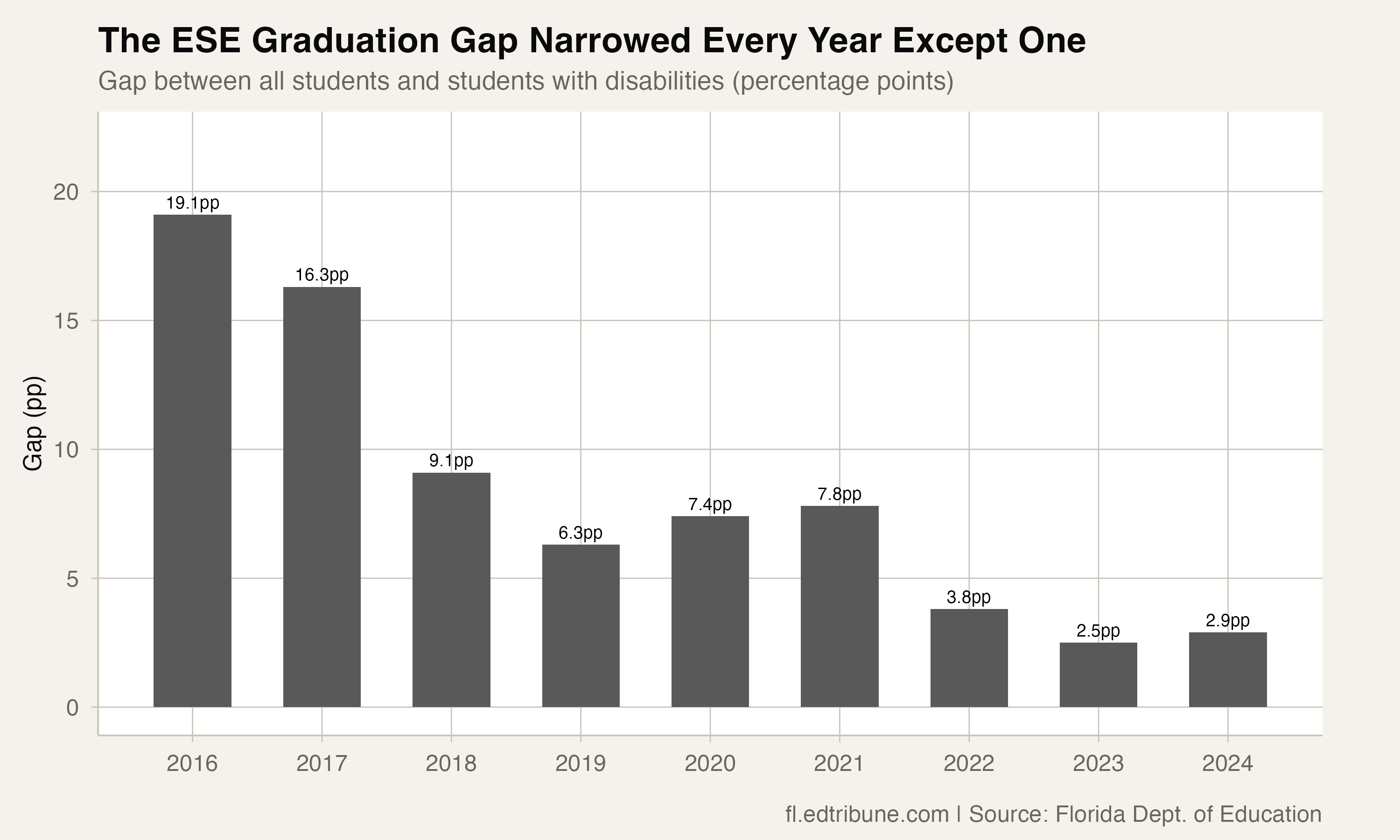
The gap narrowed in almost every single year. The only exceptions were the two COVID-waiver years, when the overall rate was artificially inflated. Once waivers ended, the convergence resumed immediately.
Several policy factors likely contribute to the trend. Florida expanded pathways to graduation through career and technical education credentials, which can substitute for certain academic requirements. The state also invested in transition planning services and required school districts to develop individualized graduation plans for students with disabilities.
But the sheer magnitude of the improvement, from 61.6 to 86.8 percent, suggests something more fundamental changed in how Florida's schools approach special education students as potential graduates rather than as students destined for alternative certificates.
Whether these gains are durable, and whether they reflect genuine readiness for life after high school, are questions that graduation rates alone cannot answer.
Detailed code that reproduces the analysis and figures in this article is available exclusively to EdTribune subscribers.
Discussion
Sign in to join the discussion.
Loading comments...