In a state where the typical school district has roughly a third of its students chronically absent, Palm Beach County↗ET has managed to hold its rate to 23.4%. That number is not good — it means nearly one in four students is missing 10% or more of school — but it is 8 points below the state average, and it is the lowest chronic absenteeism rate among Florida's eight districts with more than 100,000 students.
Part of the Florida Chronic AbsenteeismET series.
Consistently below the line
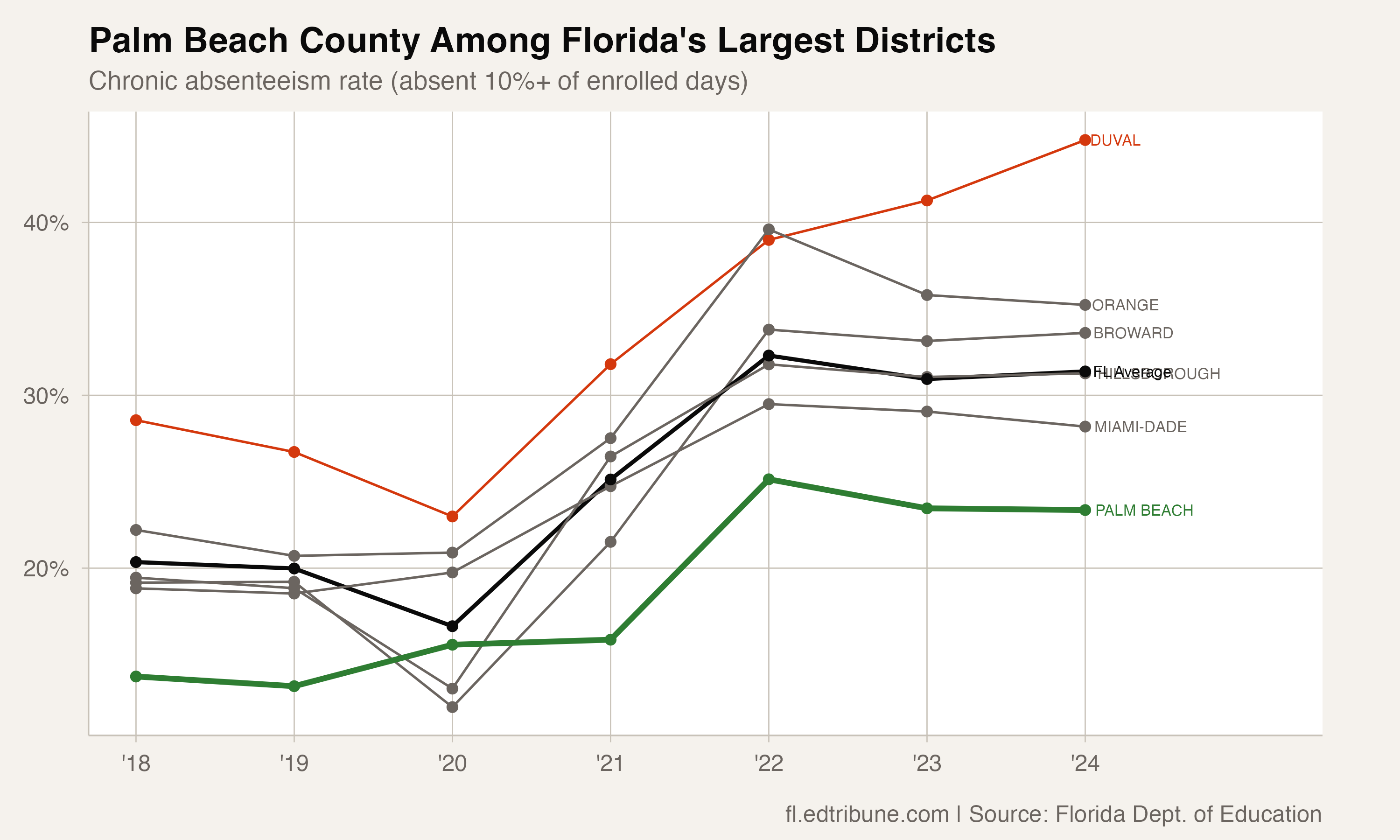
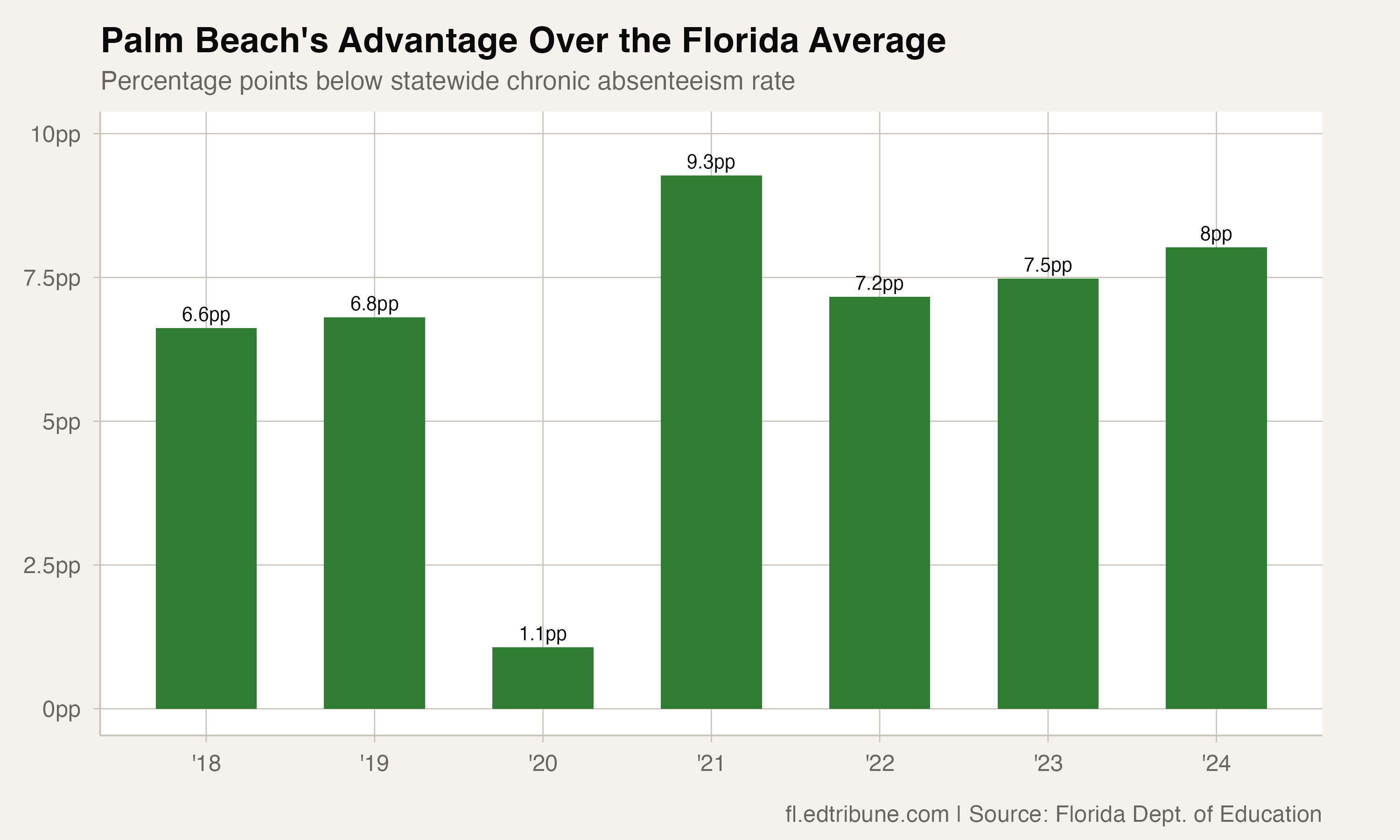
Palm Beach has been below the state average every single year since Florida began tracking the federal chronic absenteeism metric in 2017-18. The gap has ranged from 1.1 points during the pandemic year of 2019-20 — when truncated calendars compressed rates across the board — to 9.3 points in 2020-21, when the state surged and Palm Beach held relatively steady.
The consistency matters more than any single year's number. Many districts dipped below the state average in one year due to an anomalous enrollment change or a particularly disruptive year elsewhere in the state. Palm Beach has been there for seven consecutive years. That suggests something structural about the district's approach to attendance, not a statistical fluke.
The large-district landscape
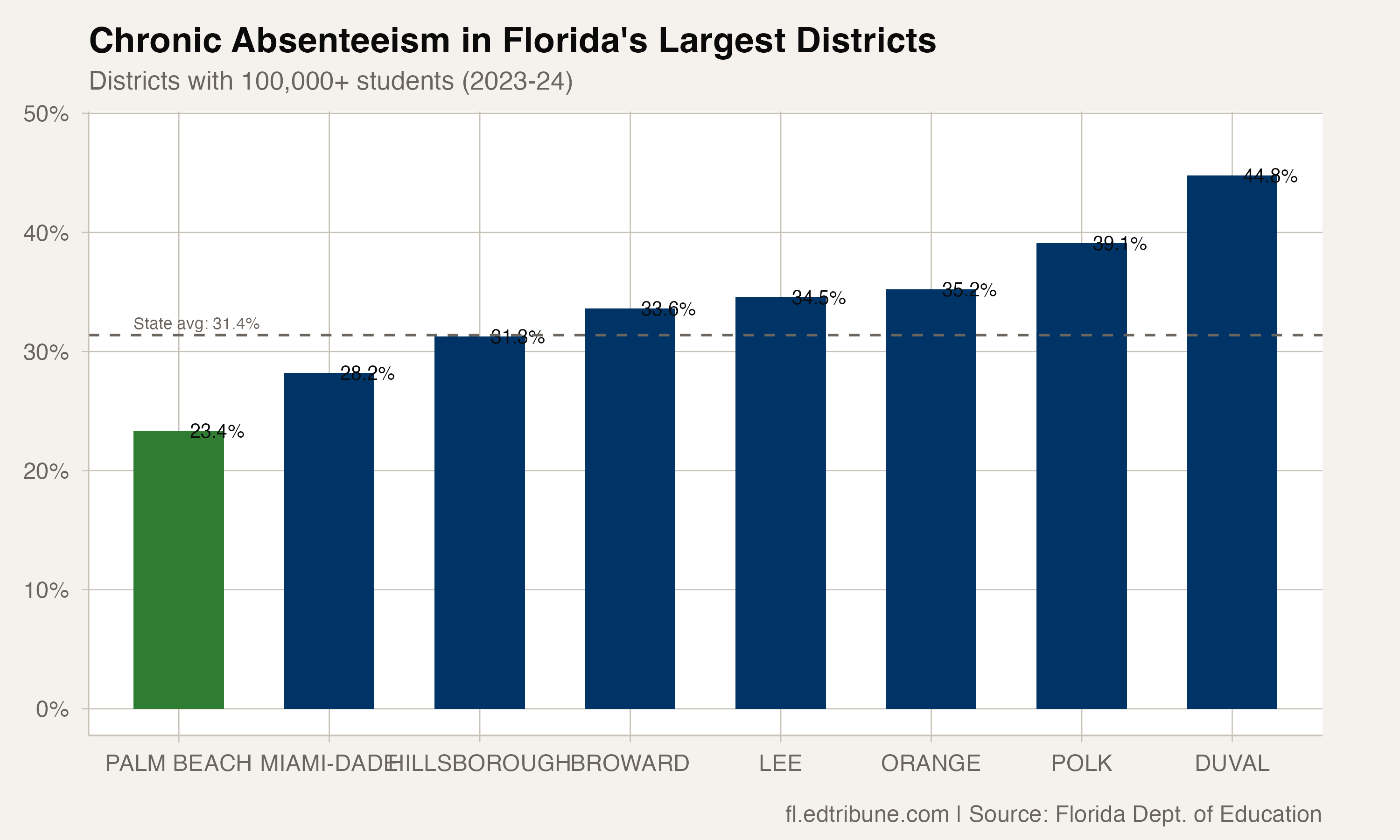
Among the eight Florida districts enrolling 100,000 or more students, the range is striking. Palm Beach sits at the bottom at 23.4%. Duval↗ET sits at the top at 44.8%. The gap between them — 21.4 percentage points — is as wide as the entire pre-COVID chronic rate for many states.
Miami-Dade↗ET, the state's largest district at 361,611 students, comes closest to Palm Beach at 28.2%. Hillsborough↗ET is at 31.3%, right at the state average. Broward↗ET, Palm Beach's immediate neighbor to the south, is at 33.6% — more than 10 points higher despite similar geography and demographics.
The Broward comparison is particularly instructive. The two counties share a border. Their students come from overlapping labor markets and housing markets. Yet Broward's chronic rate is 44% higher than Palm Beach's (33.6% vs. 23.4%). Border effects of this magnitude suggest that district-level policies and culture matter independently of community-level conditions.
Not yet recovered
Palm Beach's relative success should not obscure the fact that it remains far above its own pre-pandemic baseline. In 2018-19, the district's chronic rate was 13.2%. It has risen by 10.2 percentage points since then, a jump that would be alarming in any context other than one where the state average has risen by more.
The district peaked at 25.1% in 2021-22, improved modestly to 23.5% in 2022-23, and essentially held steady at 23.4% in 2023-24. The plateau, while dramatically better than Duval's worsening trend, suggests that Palm Beach faces the same challenge as many other Florida districts: the easiest recoveries have been captured, and the remaining chronically absent students require more intensive interventions.
With 204,048 students, Palm Beach is Florida's fifth-largest district. Its 47,674 chronically absent students represent a community-sized problem even at a relatively low rate. The question is whether whatever Palm Beach is doing differently — its family engagement models, its school culture, its community partnerships — can be understood well enough to export to the districts where the crisis is deepest.
Asked what accounts for the gap, the School District of Palm Beach County pointed to a structure rather than a single program. "Our approach prioritizes early intervention, school-family partnerships, and addressing the barriers to attendance," the district said in a written statement. It described a dedicated central team that trains school staff, tracks attendance through a chronic absenteeism dashboard, and intervenes directly with families. "We learned that attendance is everyone's job, not just one person's, so we train staff to spot problems early and work with families before situations deteriorate."
The statement also described a firmer instrument than the family-engagement language districts usually offer. The district said that since 2023 it has worked with the Children in Need of Services / Families in Need of Services program, a juvenile judge, and other community partners to file truancy petitions. "Through the court process, families are connected to services that help address the underlying issues affecting attendance," the district said, adding that court involvement "has changed the culture on many school campuses." Whether that lever or the softer supports account for more of Palm Beach's margin is not something the state data can separate.
The district did not claim the problem solved. "While we are encouraged by our ranking, we recognize that chronic absenteeism is a national challenge," it said.
Detailed code that reproduces the analysis and figures in this article is available exclusively to EdTribune subscribers.
Discussion
Sign in to join the discussion.
Loading comments...