Correction: An earlier version of this article said Hardee County's most recent graduation rate had fallen below its pre-improvement level of several years earlier, and that Hardee was the only district in this spike-and-crash group to end below its pre-COVID starting point. Hardee's most recent rate sits slightly above that earlier level, and Holmes County also finished modestly below its pre-COVID starting point. This revision restates both points from fresh output.
When Florida waived outstanding assessment graduation requirements for the classes of 2020 and 2021, according to the Florida Department of Education's statewide assessment guidance, the statewide graduation rate rose by about 3 percentage points. In the state's most economically disadvantaged districts, the effect was far larger, and the subsequent correction far more painful.
Gadsden County↗ET provides the starkest example. Its graduation rate jumped from 60.4 percent in 2019 to 82.7 percent in 2021, a 22.3 percentage-point spike over two years. When testing requirements returned, Gadsden's rate dropped to 75.9 in 2022 and settled at 73.9 in 2024. The district retained some of the improvement but lost more than a third of it.
Jefferson County↗ET, with cohorts of just 40 to 54 students, followed an almost identical pattern: 62.7 percent in 2019, up to 81.8 in 2021, down to 73.2 in 2024. Hardee County↗ET went from 81.2 to 88.3 and then crashed to 73.6, ending below its pre-improvement level.
The pattern is unmistakable
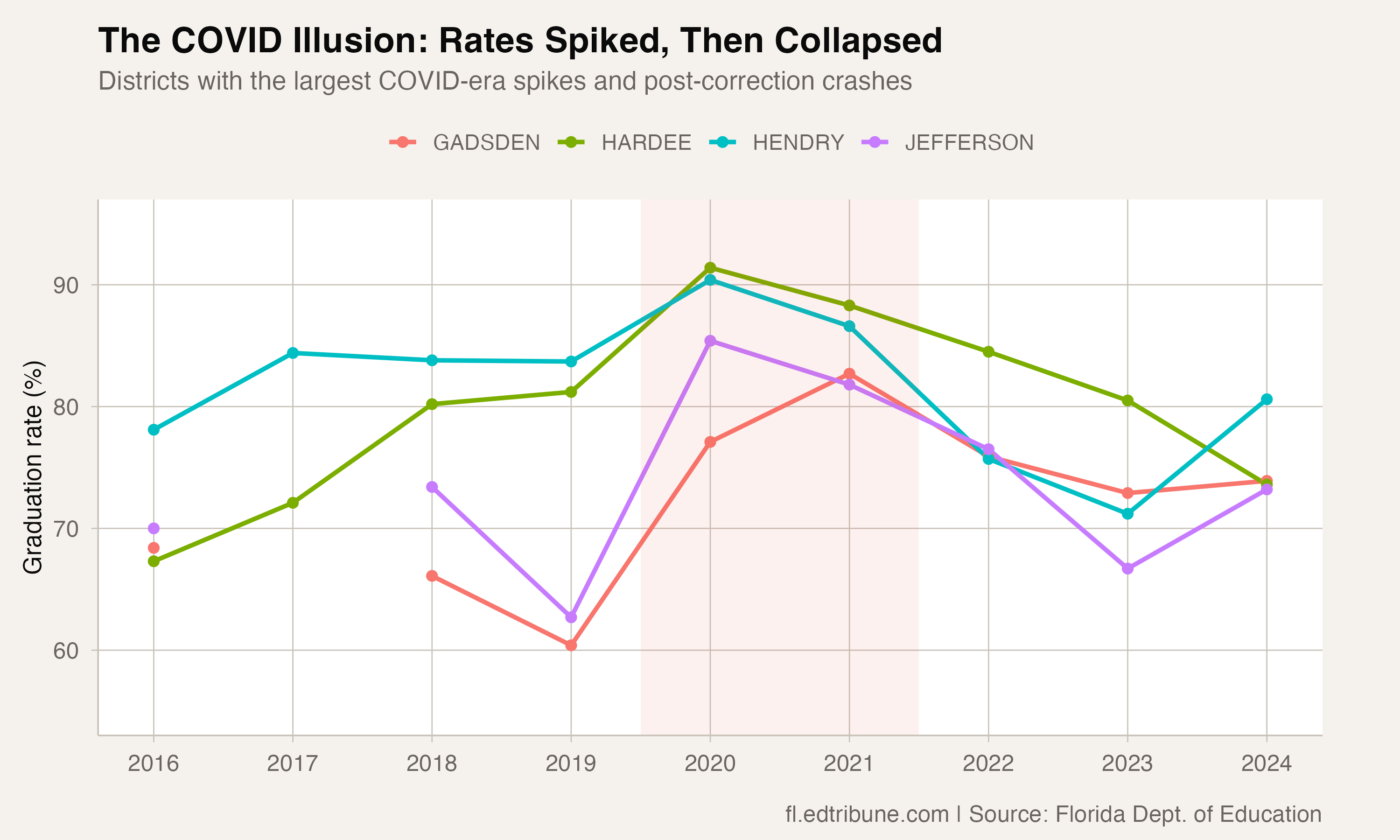
Four Florida districts showed the clear spike-then-crash pattern when measured against a threshold of 5-point spikes followed by 5-point declines. The visual is striking: rates climb sharply during the two waiver years, then plummet when testing returns.
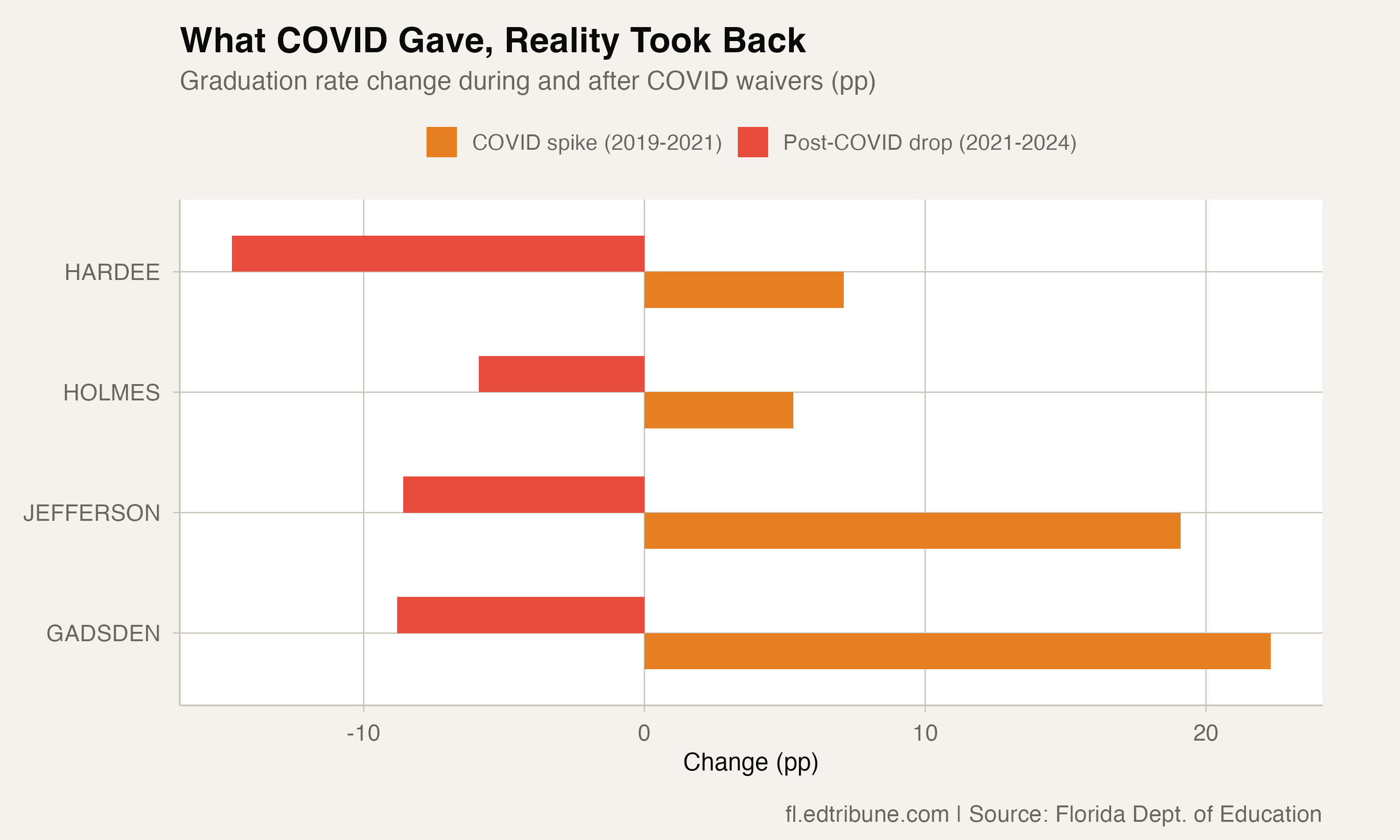
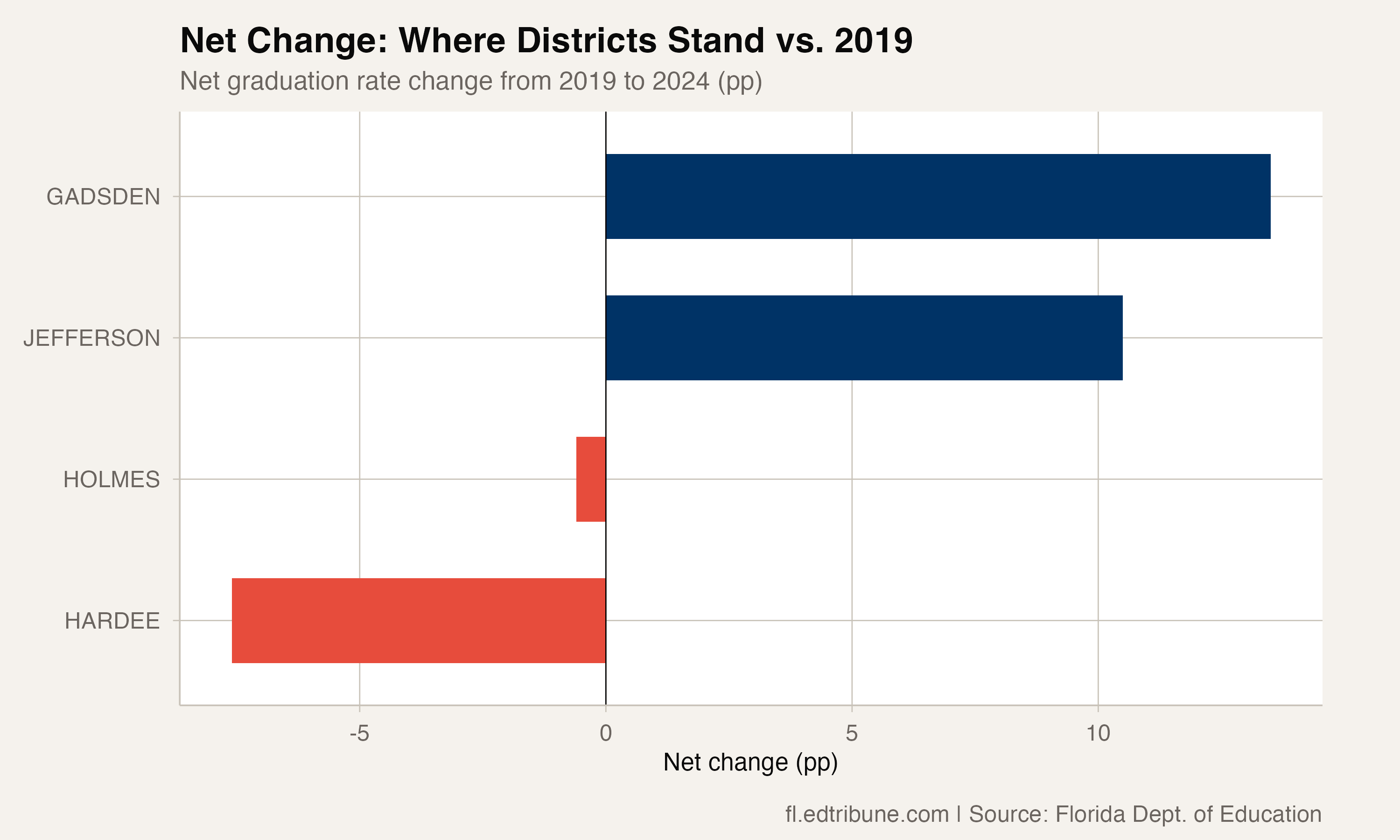
The asymmetry is important. Gadsden gained 22.3 points during the waiver years and lost only 8.8 after. It retained a net gain of 13.5 points compared to 2019. Jefferson retained 10.5 points. The waivers were not pure illusion: some of the improvement has persisted. But the gap between the waiver-era high and the current rate reveals how much of the improvement was specifically tied to the absence of the assessment barrier.
What the assessment does
Florida requires students to pass the Grade 10 English Language Arts assessment or earn a concordant score to meet statewide graduation assessment requirements, according to state graduation guidance. This is a meaningful requirement, not a formality. For students in districts where the requirement binds tightly, the assessment can become a real barrier.
When that barrier was removed during COVID, graduation rates surged. When it was restored, they dropped. The correlation is direct and specific to districts where the assessment requirement binds most tightly.
The equity dimension
The districts most affected by the COVID inflation pattern share a more concrete feature: small cohorts. Gadsden, Jefferson, Hardee, and Holmes are places where a few dozen students can visibly move the rate.
The implication is uncomfortable. The direct evidence here is not that the assessment caused every movement in the rate. It is that the waiver years produced unusually large spikes in a small set of districts, and the post-waiver years took much of that gain back.
This does not necessarily argue for eliminating assessment requirements. The assessments may be measuring real skill gaps. But the COVID experiment provides a useful stress test for how much the graduation gap can move when an assessment gate is temporarily removed.
Hardee's unique case
Hardee County stands out within this group because its post-COVID trajectory has been worse than the others. Gadsden and Jefferson stabilized after their initial drops. Hardee has continued declining every year since 2020, falling from 91.4 to 73.6, a cumulative drop of 17.8 points that has returned it to roughly its 2017 rate of 72.1.
Among these districts, Hardee ended up furthest below its pre-COVID level on a net basis, down 7.6 points from 2019. Holmes also finished slightly below, by 0.6 points. For Hardee, the waivers inflated its rate, and the post-waiver correction erased not just the COVID-era gains but the genuine improvements that preceded them.
Detailed code that reproduces the analysis and figures in this article is available exclusively to EdTribune subscribers.
Discussion
Sign in to join the discussion.
Loading comments...