Putnam County↗ET and Walton County↗ET are both rural Florida districts with enrollment in the 10,000-to-13,000 range. Both sit outside major metro areas. Both have schools named after local landmarks and Friday night football games that draw the whole community.
Their chronic absenteeism rates are far apart. Putnam's is 57.5%. Walton's is 24.3%. The gap between them, 33.2 percentage points, is wider than the entire pre-COVID chronic rate for the state of Florida.
Part of the Florida Chronic AbsenteeismET series.
A gap that doubled
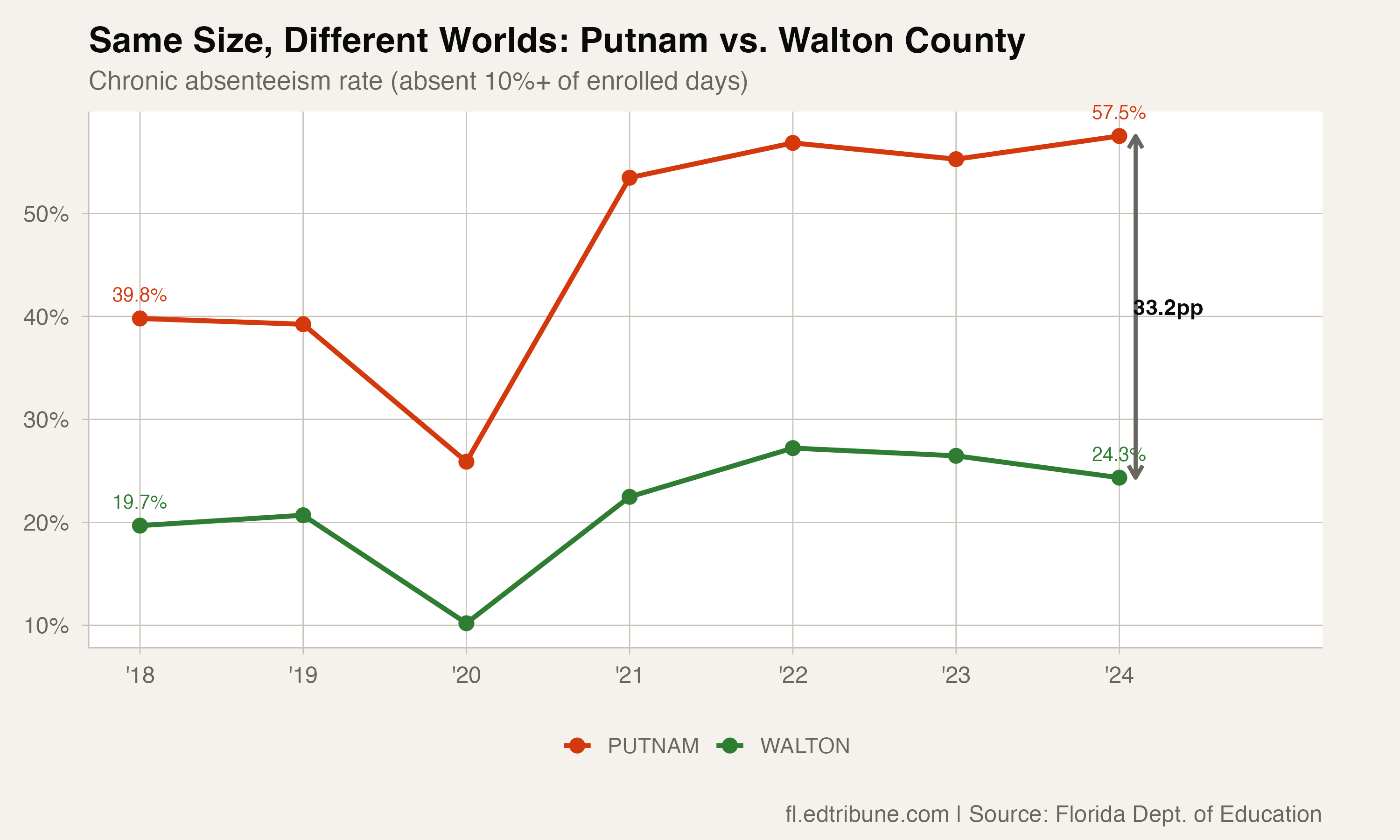
In 2018-19, the gap was already substantial: 18.5 points, with Putnam at 39.2% and Walton at 20.7%. The pandemic blew it wide open. Putnam's rate surged to 53.5% in 2020-21 and kept climbing to 57.5% in 2023-24. Walton's rose more modestly, hitting 27.2% in 2021-22 before pulling back to 24.3%.
The result is a gap that has nearly doubled from 18.5 to 33.2 points. In Putnam, more than half the student body is chronically absent. In Walton, three-quarters of students attend school regularly. Both counties are governed by the same state laws, receive funding through the same FEFP formula, and answer to the same Department of Education.
The obvious explanation is poverty. Putnam County, located in inland North Central Florida, has a poverty rate roughly double the state average. Walton County, anchored by the coastal tourism economy of Destin and 30A, has a more affluent economic base. But poverty alone does not produce a 33-point gap, particularly when both districts had chronic rates in the 20-39% range five years ago. The divergence since COVID suggests that the pandemic hit Putnam's already-fragile support systems in ways that Walton's more robust community infrastructure withstood.
The other pair: Lake and Collier
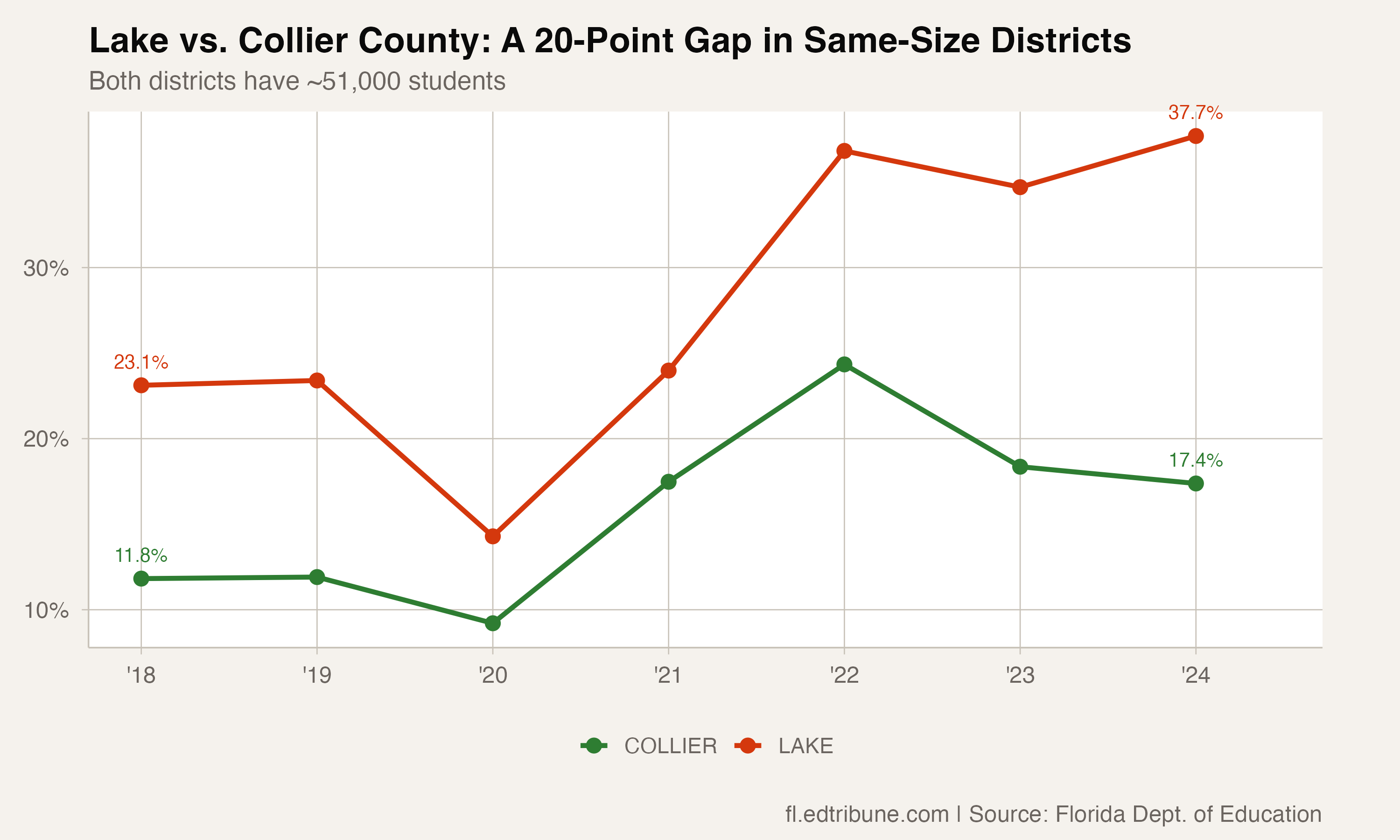
A similar story plays out in larger districts. Lake County↗ET (51,345 students, 37.7% chronic) and Collier County↗ET (51,833 students, 17.4% chronic) have nearly identical enrollment but a 20.3 percentage-point gap in chronic absenteeism.
The gap was 11.3 points in 2018. By 2024 it had nearly doubled. Collier peaked at 24.3% during the COVID surge and recovered to 17.4% — within striking distance of its pre-pandemic 11.9%. Lake peaked at 36.8% and has stayed there, even worsening slightly to 37.7%. Two districts the same size, on opposite attendance trajectories.
Widening, not narrowing
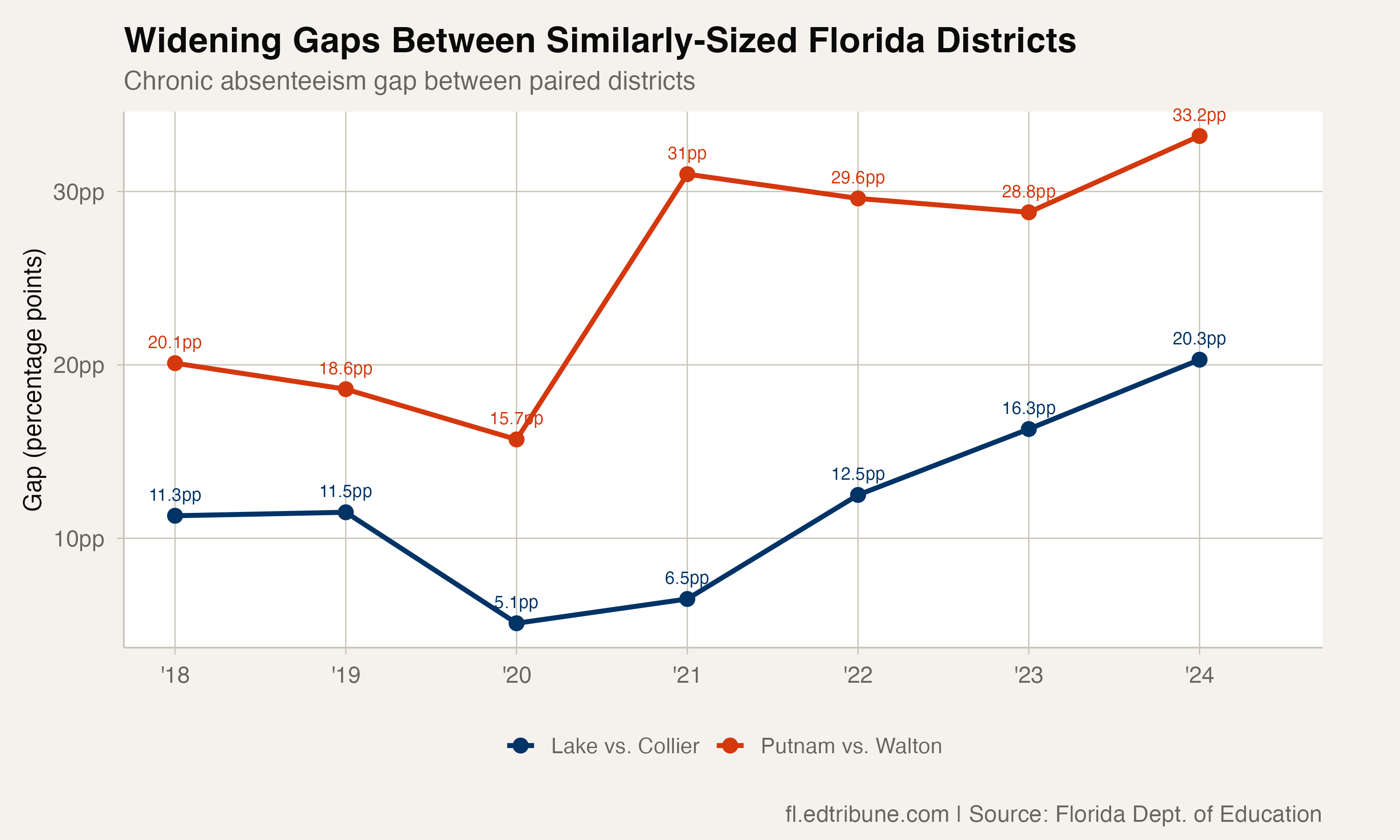
Both paired comparisons show the same pattern: gaps that were already significant before COVID have roughly doubled since. The pandemic did not create Florida's attendance disparities, but it widened them sharply.
The widening raises hard questions about the state's approach to attendance. Florida's school accountability system primarily tracks test scores and school grades. A district like Walton, where students mostly show up, and a district like Putnam, where most do not, receive the same general framework for improvement: attendance letters, truancy referrals, counseling services. That framework was built for a world of modest variation between districts, not for 33-point gaps between neighbors.
What makes Collier and Walton different from Lake and Putnam? The data alone cannot answer that question. Florida's chronic absenteeism reporting includes no demographic subgroups, no attendance band detail, and no breakdown by school type. The patterns suggest that whatever is working in the lower-absence districts, whether community engagement models, family support infrastructure, school culture, or simply a wealthier tax base, is not transferring to the districts where it is most needed.
Detailed code that reproduces the analysis and figures in this article is available exclusively to EdTribune subscribers.
Discussion
Sign in to join the discussion.
Loading comments...