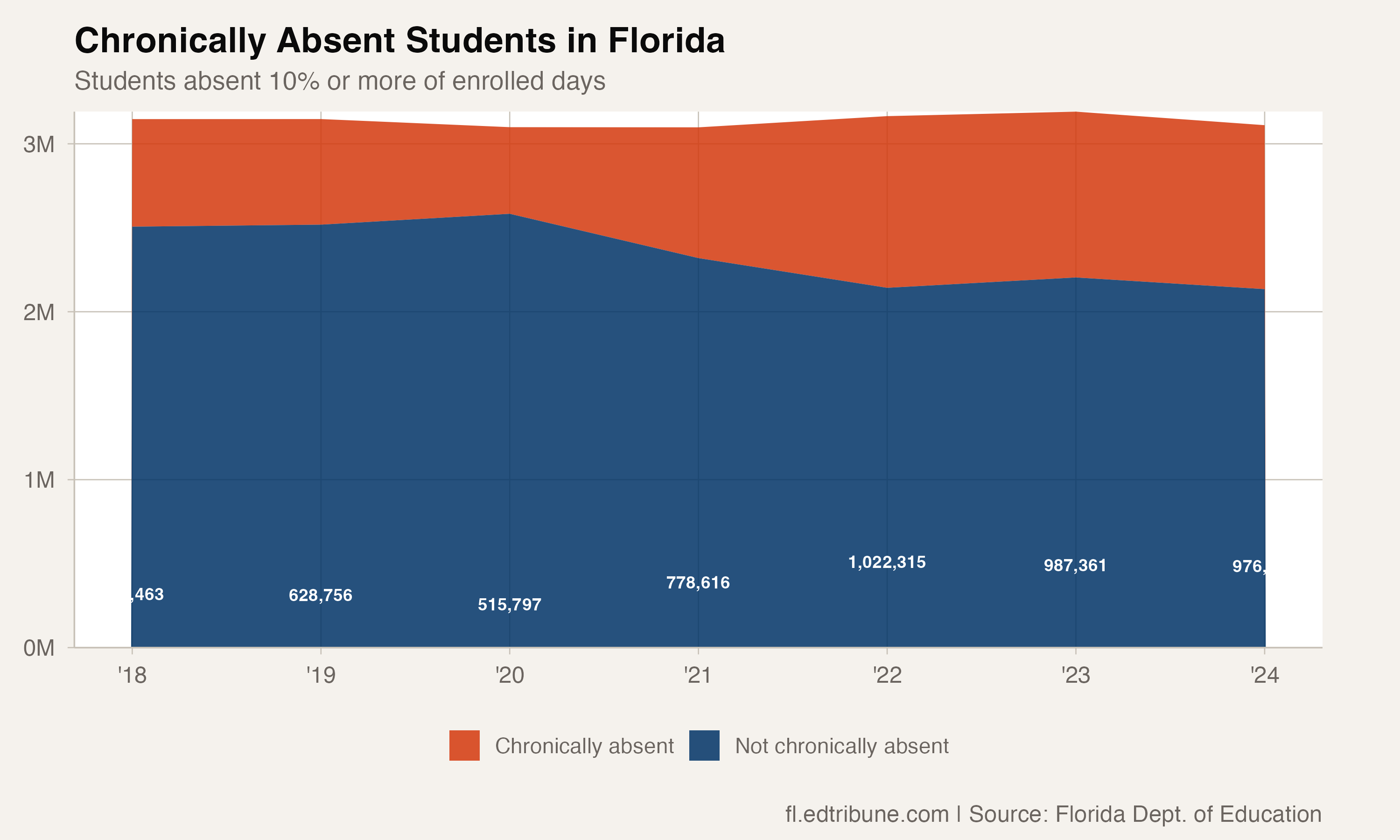
The number is so large it can lose its meaning. In 2023-24, 976,305 Florida public school students were chronically absent — missing at least 10% of their enrolled school days. That is more students than the total public school enrollment of 40 U.S. states. It is roughly the population of Jacksonville.
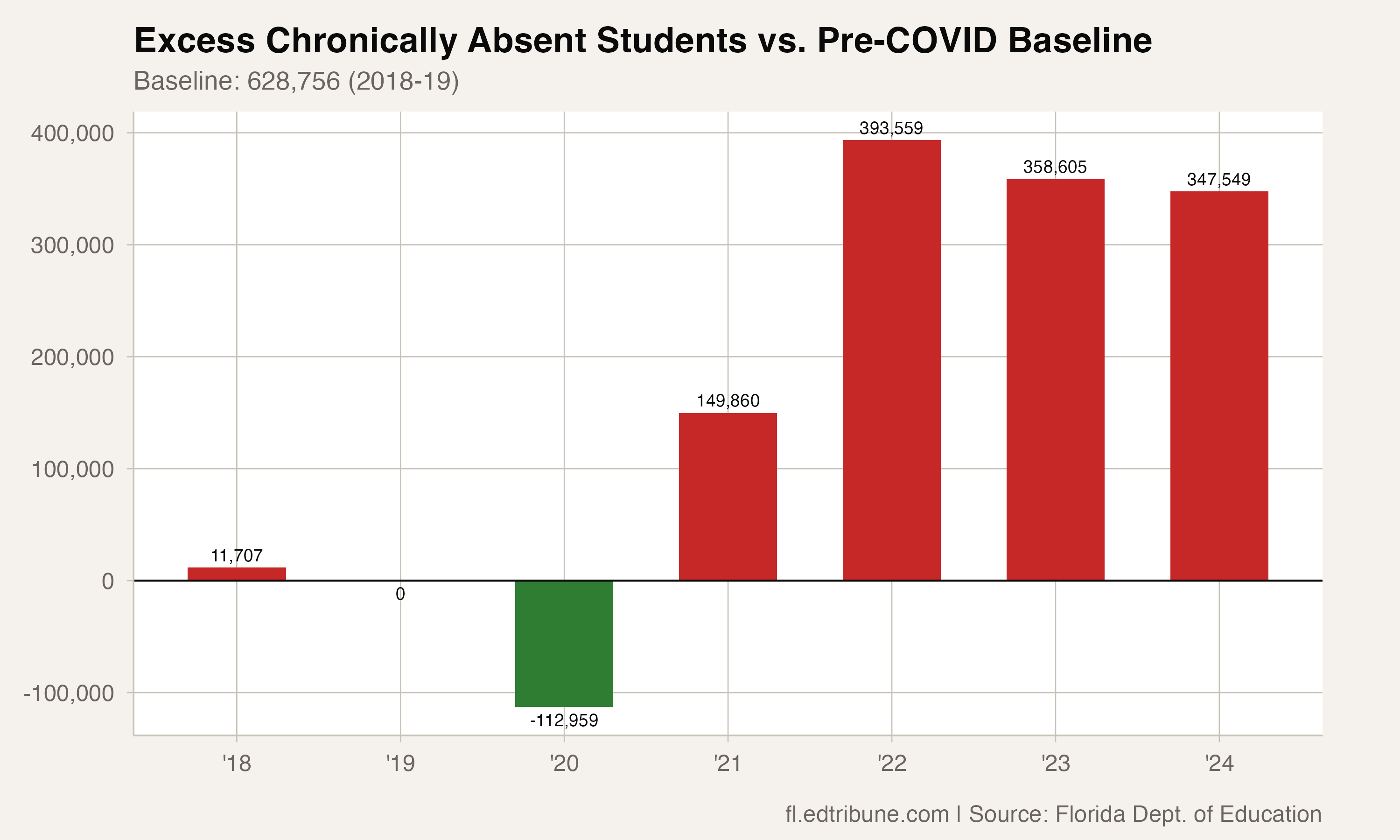
Five years ago, before the pandemic, the number was 628,756. The increase of 347,549 students — a 55.3% jump — has happened entirely since COVID, and it has not reversed.
Part of the Florida Chronic AbsenteeismET series.
What a million looks like
In concrete terms: if every chronically absent student in Florida attended the same school district, it would be the largest in America — larger than New York City's public schools, larger than Los Angeles Unified. Every one of these students is losing roughly 18 or more days of instruction per year, the equivalent of nearly a full month of school.
The pandemic year of 2019-20 actually saw fewer chronically absent students than the year before — 515,797 compared to 628,756 — because schools closed in March 2020 and many districts relaxed absence accounting. The real surge came in 2020-21, when 778,616 students were chronically absent despite fully reopened campuses in most Florida districts. The peak arrived in 2021-22: 1,022,315, the only year to cross the million-student threshold.
The subsequent decline to 976,305 has been slow, halting, and — as of 2024 — possibly stalling. The 2023-24 count is 11,056 fewer than the prior year, a 1.1% decrease that barely registers against the scale of the problem.
The cumulative toll
Chronic absenteeism is not a condition that resets each September. Every year a student misses a month of instruction compounds the academic damage from the year before. A third-grader who was chronically absent in first and second grade enters the school year already behind in reading. A tenth-grader with three years of chronic absence has missed nearly a full semester of high school.
Since the 2019-20 school year, Florida has accumulated 1,136,614 excess chronically absent student-years above the pre-COVID baseline. That is the sum of every additional student in every additional year who crossed the chronic threshold. Even in years when the count was declining, it remained hundreds of thousands above pre-pandemic levels.
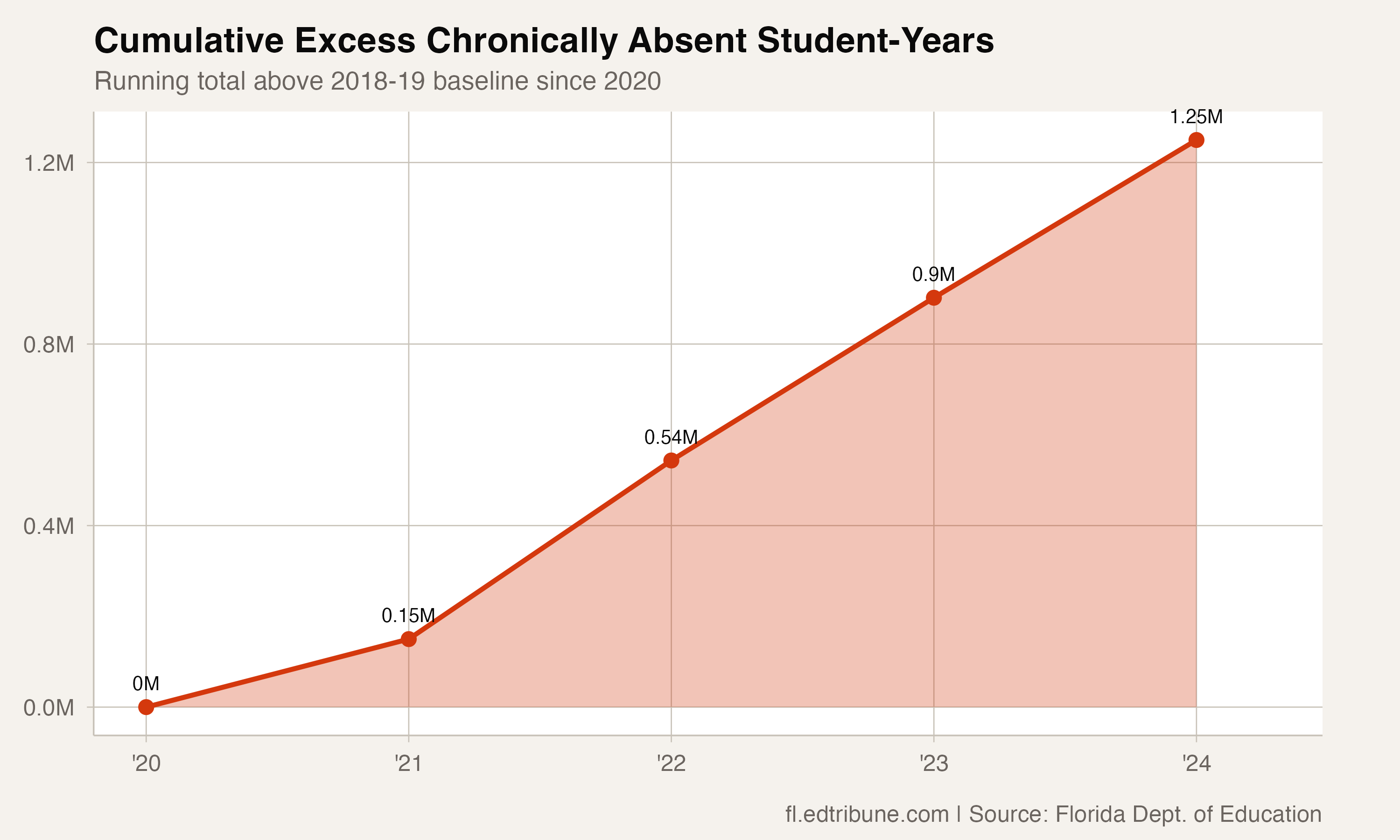
The academic research on chronic absenteeism is unambiguous about the stakes. A Johns Hopkins study found that chronic absence in sixth grade was a stronger predictor of dropping out than test scores or suspensions. Florida's 1.1 million excess student-years represent a debt against future graduation rates, college enrollment, and workforce readiness that the state is still accumulating, not yet repaying.
The rate in context
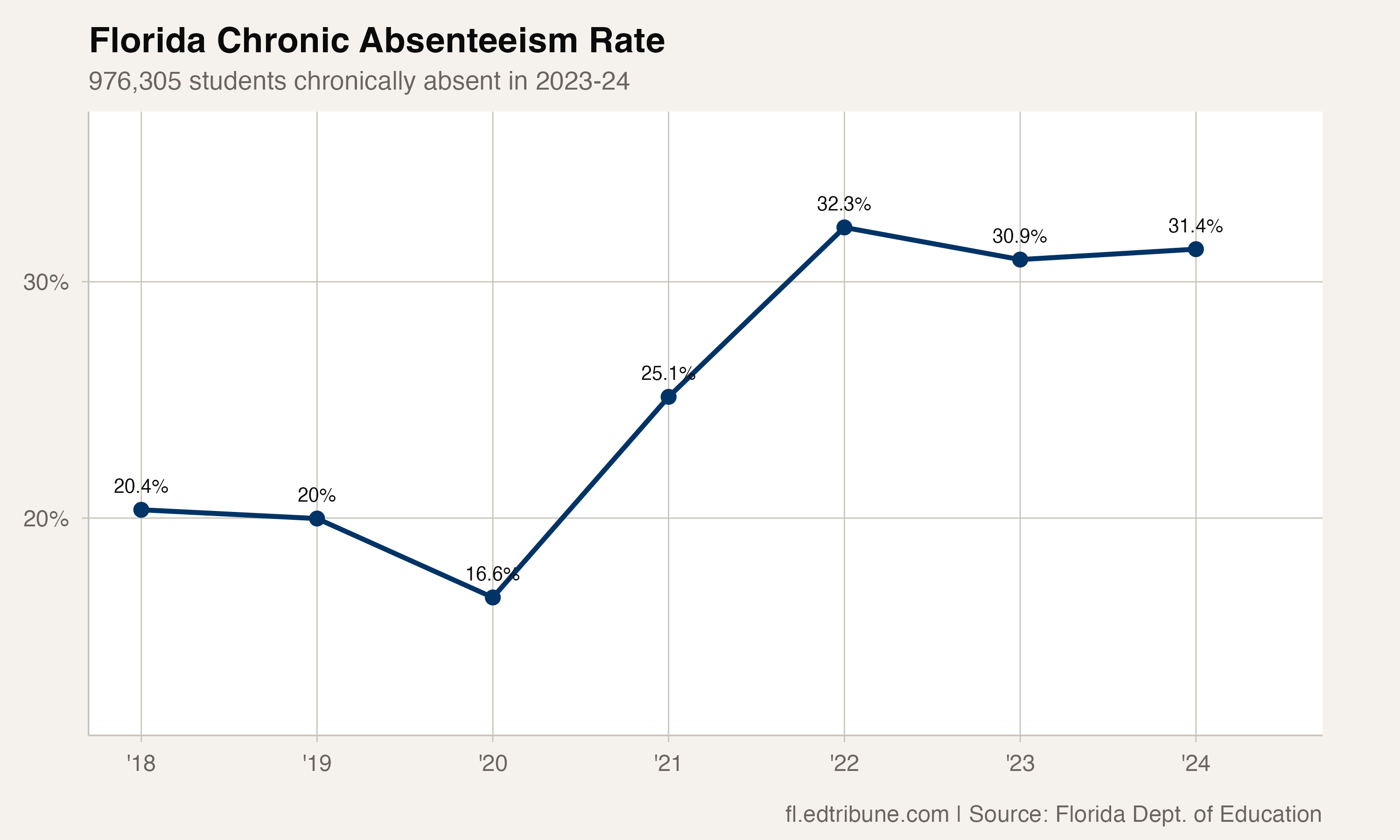
The chronic absenteeism rate — 31.4% in 2023-24 — can sound abstract until you translate it to a classroom. In an average Florida class of 25 students, roughly eight are chronically absent. Teachers plan lessons knowing that on any given day, several seats will be empty, and the students in those seats will need to catch up on material they missed, if they return at all.
Florida's FEFP (Florida Education Finance Program) funding formula incorporates average daily attendance, turning chronic absenteeism into a budget problem on top of an academic one. Every empty seat costs money, and the districts with the highest absence rates tend to be the ones that can least afford the revenue loss. At nearly a million students, the fiscal exposure is statewide.
Detailed code that reproduces the analysis and figures in this article is available exclusively to EdTribune subscribers.
Discussion
Sign in to join the discussion.
Loading comments...