Correction (September 30, 2026): An earlier version of this article, headlined "Only 1 of 73 Florida Districts Has Recovered to Pre-COVID Attendance Levels," reported that Hendry County's chronic absenteeism rate fell below its pre-pandemic level, to 20.1% in 2023-24 from 28.6% in 2018-19. Hendry's district total includes Digital Academy of Florida, an online school that enrolled 6,838 of the district's 14,885 students that year and recorded none of them as chronically absent. Across Hendry's schools that do record attendance, the 2023-24 rate was 37.1%, higher than before the pandemic. No Florida district in the comparison has recovered. We retitled the article, rewrote the Hendry section and replaced the charts. The earlier version also gave Okaloosa's increase as 2.2 points; it is 2.3.
Of the 73 Florida school districts with chronic absenteeism data spanning both sides of the pandemic, none has returned to where it was before COVID shut everything down.
Every large urban system, every suburban ring and every rural county in the Panhandle and inland Florida had a higher share of students missing a tenth or more of the school year in 2023-24 than in 2018-19.
Part of the Florida Chronic AbsenteeismET series.
The district that only looked recovered
On paper, one district did recover. Hendry County↗ET, a small agricultural district in southwest Florida, reported a chronic absenteeism rate of 20.1% in 2023-24, down from 28.6% in 2018-19.
That drop comes from how one school counts attendance. Hendry's enrollment nearly doubled between 2019 and 2021, from 8,082 to 16,181 students, and in 2023-24 it stood at 14,885. Most of that growth is Digital Academy of Florida, an online school counted in Hendry's total. In 2023-24 it enrolled 6,838 students, 46% of the district, and the state's data records none of them as chronically absent. The rest of the district enrolled 8,047 students, about the size of the whole district before the pandemic. Those students count in the district's denominator while adding nothing to its count of chronically absent students.
Across Hendry's schools that do record attendance, the rate in 2023-24 was 37.1%, well above the district's pre-pandemic 28.6% and above the state average of 31.4%. Hendry is not an exception to Florida's non-recovery. It is part of it.
A wall of non-recovery
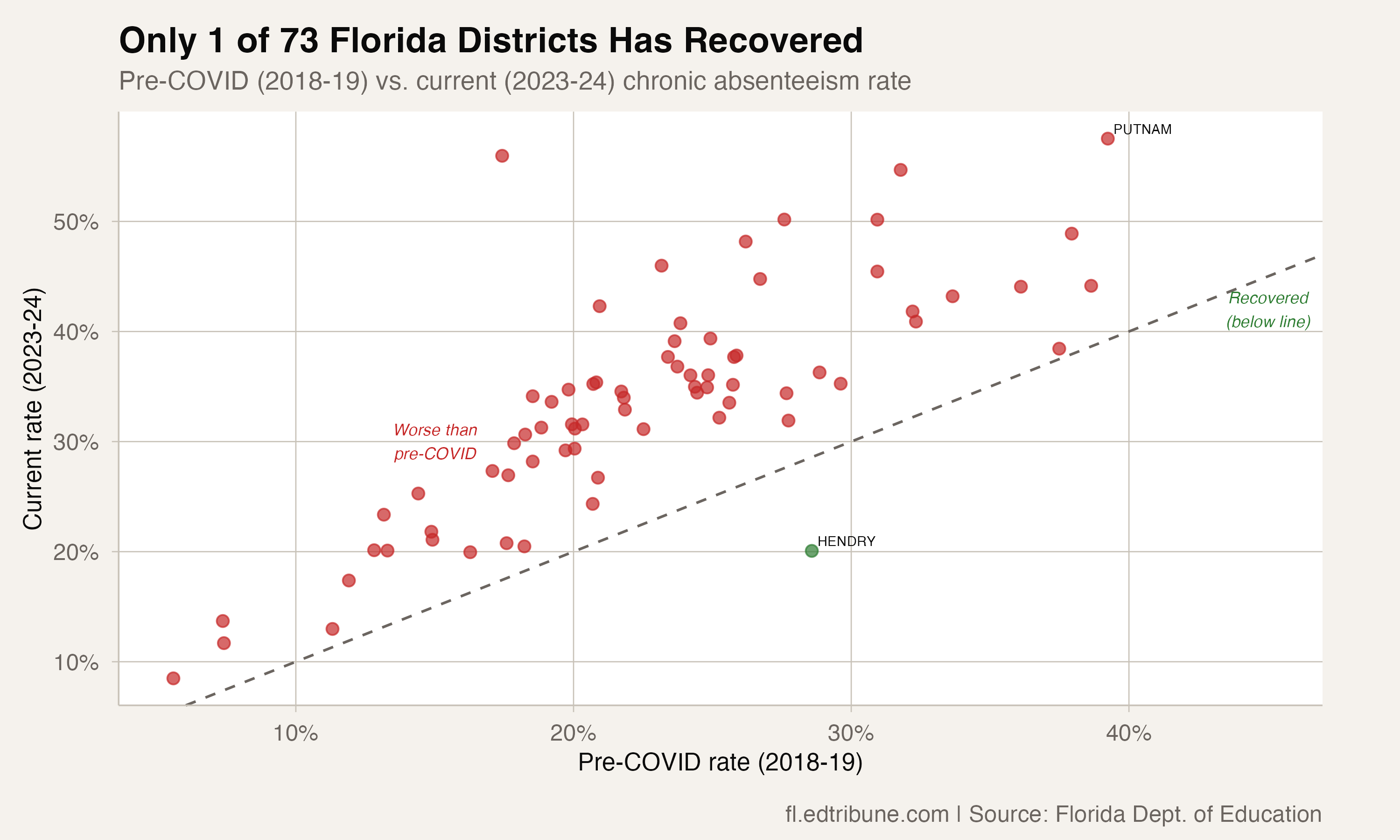
The scatter plot tells the story at a glance: every dot sits above the diagonal line that represents recovery. Most sit well above it. Gadsden County↗ET worsened by 38.5 percentage points, from 17.4% to 56.0%. Taylor County↗ET worsened by 22.9 points. Duval County↗ET, with 142,504 students, worsened by 18.1 points.
The districts closest to recovery are Liberty↗ET (+0.9 points), FL Virtual↗ET (+1.7), and Okaloosa↗ET (+2.3). But "close to recovery" still means worse than before, and for the vast majority of districts, the gap is measured in double digits.
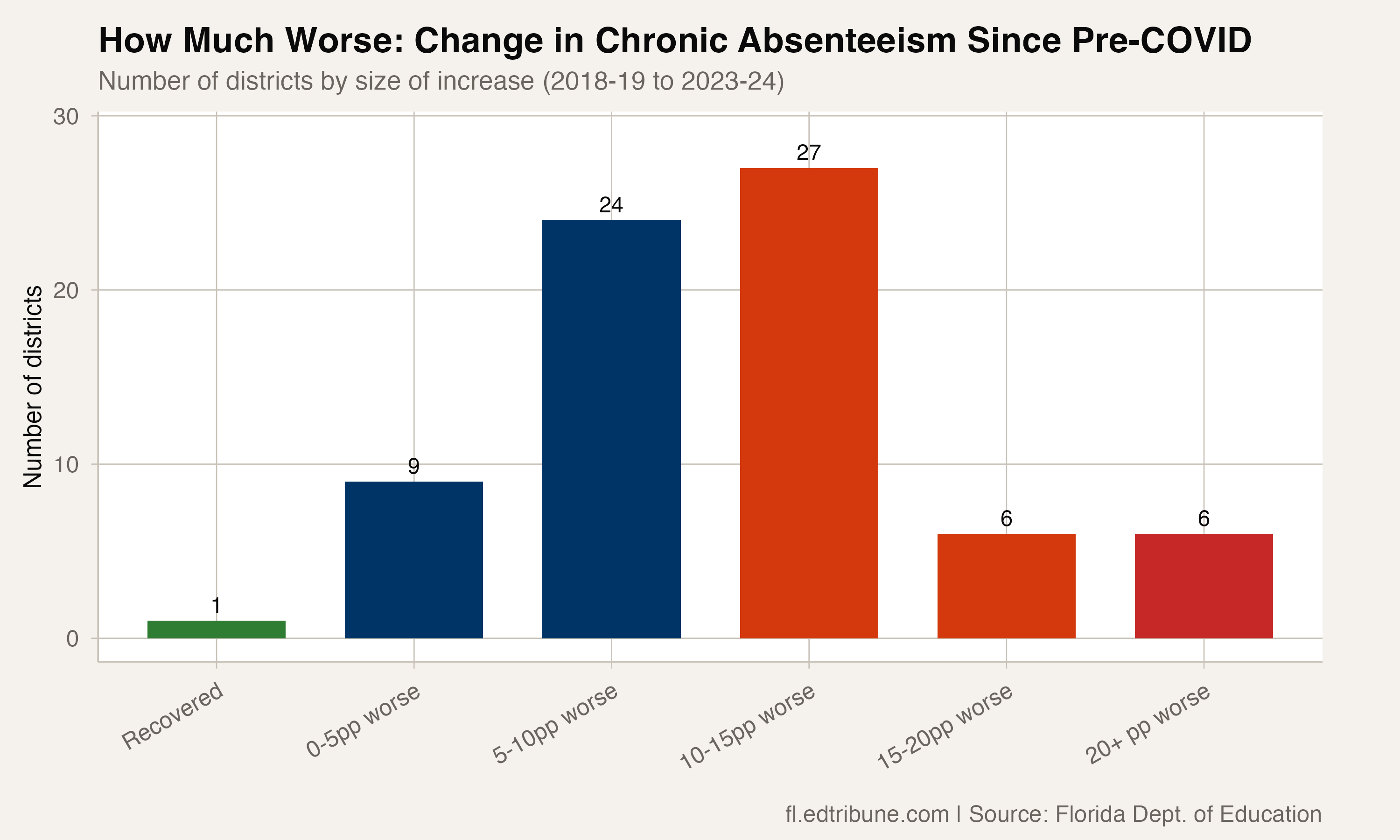
The distribution is unforgiving. A plurality of districts, 27 of 73, worsened by an amount in the 10-to-15 range of percentage points, which in a large district means thousands of additional children crossing the chronic threshold every year. The far end of the distribution, where rates rose the most, includes not just small rural counties but Duval, one of the state's largest.
Large districts: zero recoveries
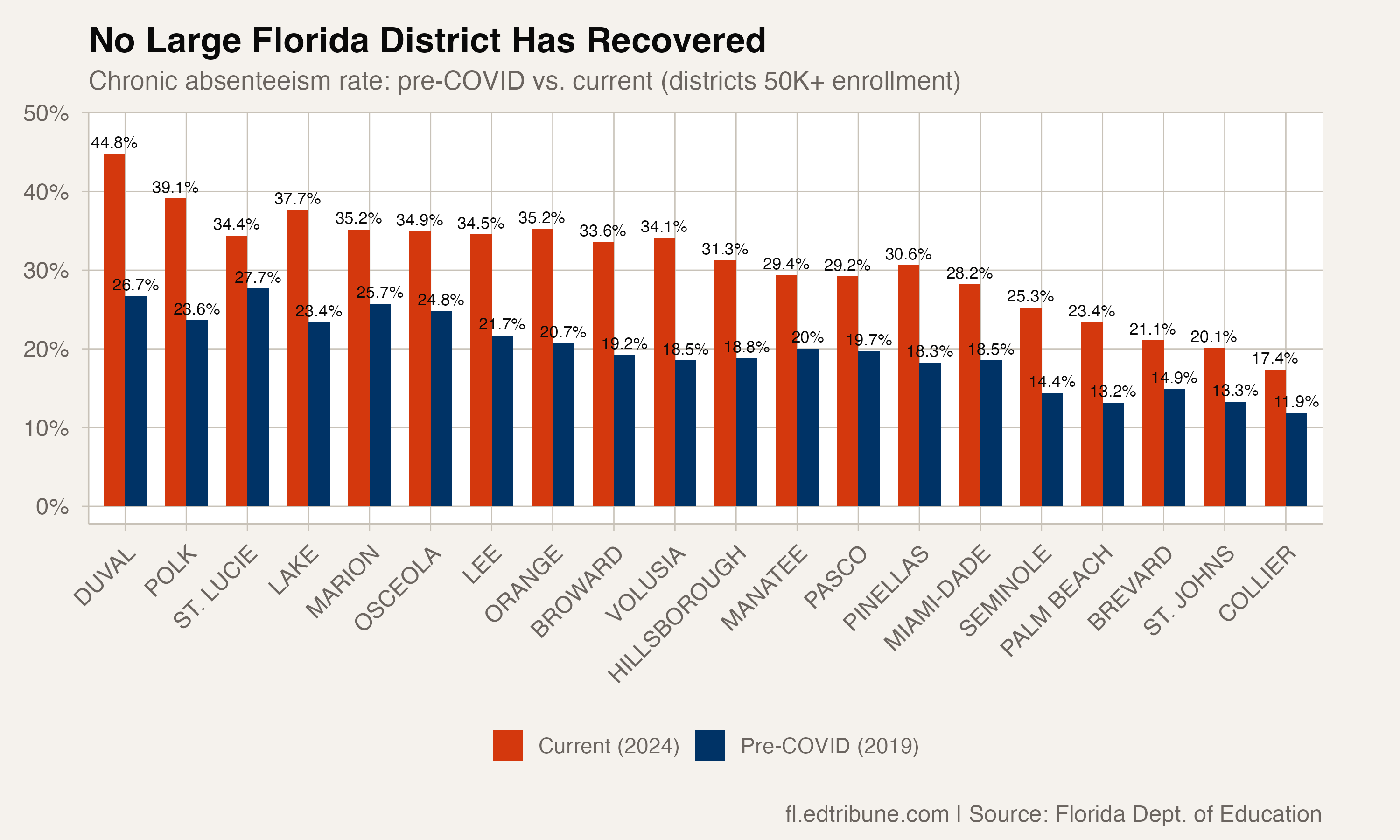
Among Florida's districts with 50,000 or more students, the picture is uniformly bleak. Every one has a higher chronic rate than before the pandemic. Palm Beach↗ET came closest, rising from 13.2% to 23.4%, still 10.2 points above baseline. Broward↗ET went from 19.2% to 33.6%. Miami-Dade↗ET rose from 18.5% to 28.2%. Polk↗ET climbed from 23.6% to 39.1%, a 15.5-point swing.
These are districts that collectively enroll more than a million students. Their inability to return to pre-pandemic attendance levels is not a statistical footnote. It is a structural failure that touches the daily lives of hundreds of thousands of families.
What recovery would actually require
Returning to a statewide rate of 20.0% from 31.4% means moving roughly 350,000 students from "chronically absent" to "regularly attending." That is not a problem that resolves through awareness campaigns or automated phone calls. The students still chronically absent in 2023-24 are disproportionately those with barriers that compound over time: housing instability, mental health crises, transportation gaps, and fractured relationships with school that neither side has figured out how to repair.
Not one district out of 73 is back where it started.
Detailed code that reproduces the analysis and figures in this article is available exclusively to EdTribune subscribers.
Discussion
Sign in to join the discussion.
Loading comments...