Correction (2026-07-23): An earlier version of this article said Florida had run four consecutive school years with chronic absenteeism above 30%. It has run three (2021-22 through 2023-24). The 2020-21 rate was 25.1%.
Before the pandemic, one in five Florida public school students was chronically absent. Now it is nearly one in three, and the distance between those two numbers has barely budged in two years.
Florida's chronic absenteeism rate — the share of students missing 10% or more of enrolled school days — peaked at 32.3% during the 2021-22 school year. Two full school years later, it stands at 31.4%. That 0.9 percentage-point improvement represents just 7.5% of the gap between the pre-COVID baseline and the pandemic peak, a recovery so minimal it rounds to nothing at the scale of a state with 3.1 million public school students.
Part of the Florida Chronic AbsenteeismET series.
A year of backsliding
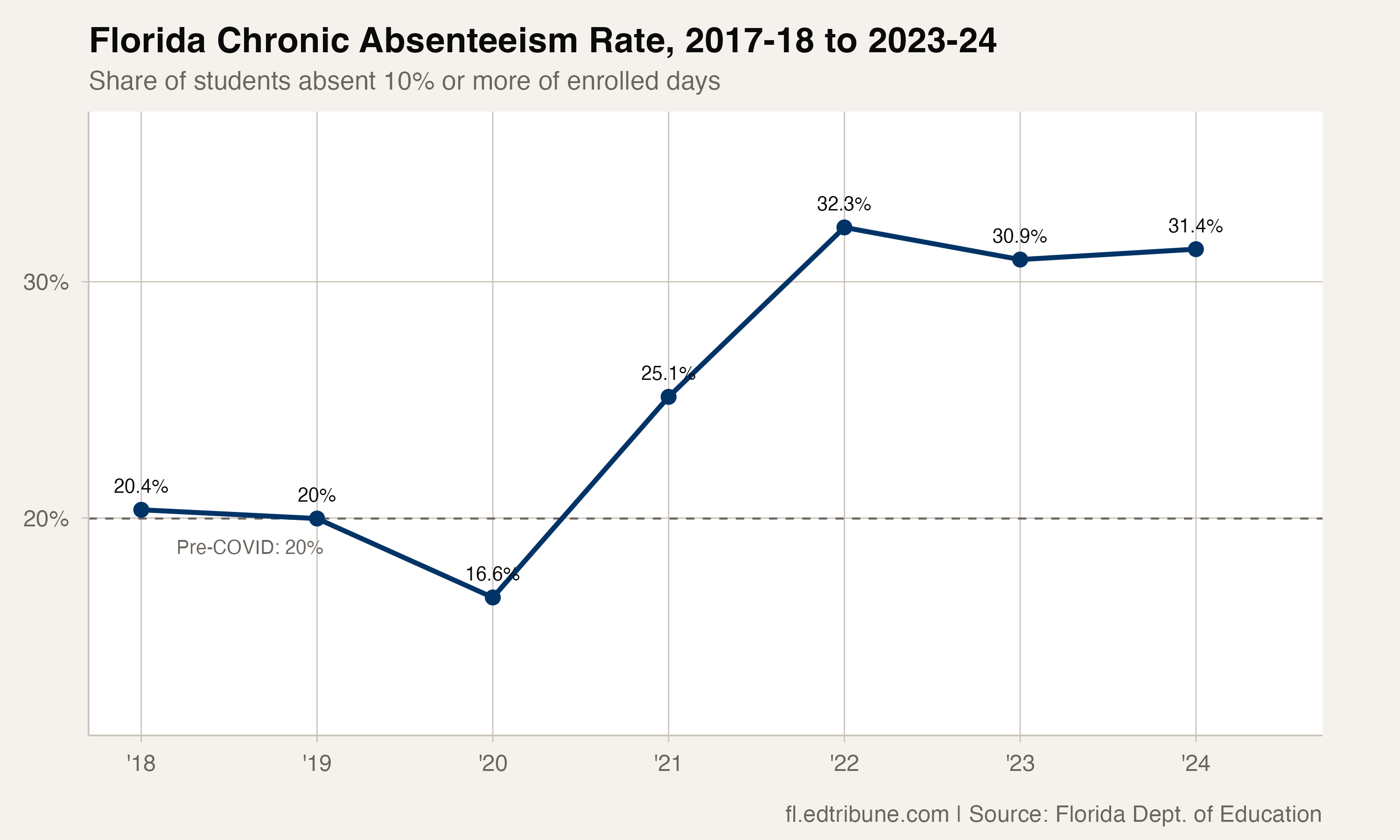
The 2022-23 school year offered a flicker of hope. The chronic rate dropped 1.4 percentage points, from 32.3% to 30.9%, the first meaningful improvement since the pandemic began. Counselors reconnected with families. Schools deployed attendance specialists. The assumption, reasonable at the time, was that the worst had passed and the recovery would continue.
It did not. In 2023-24, the rate climbed back to 31.4%, erasing nearly a third of the prior year's progress. The reversal came during a year of normal school operations — no quarantines, no hybrid schedules, no pandemic disruptions of any kind.
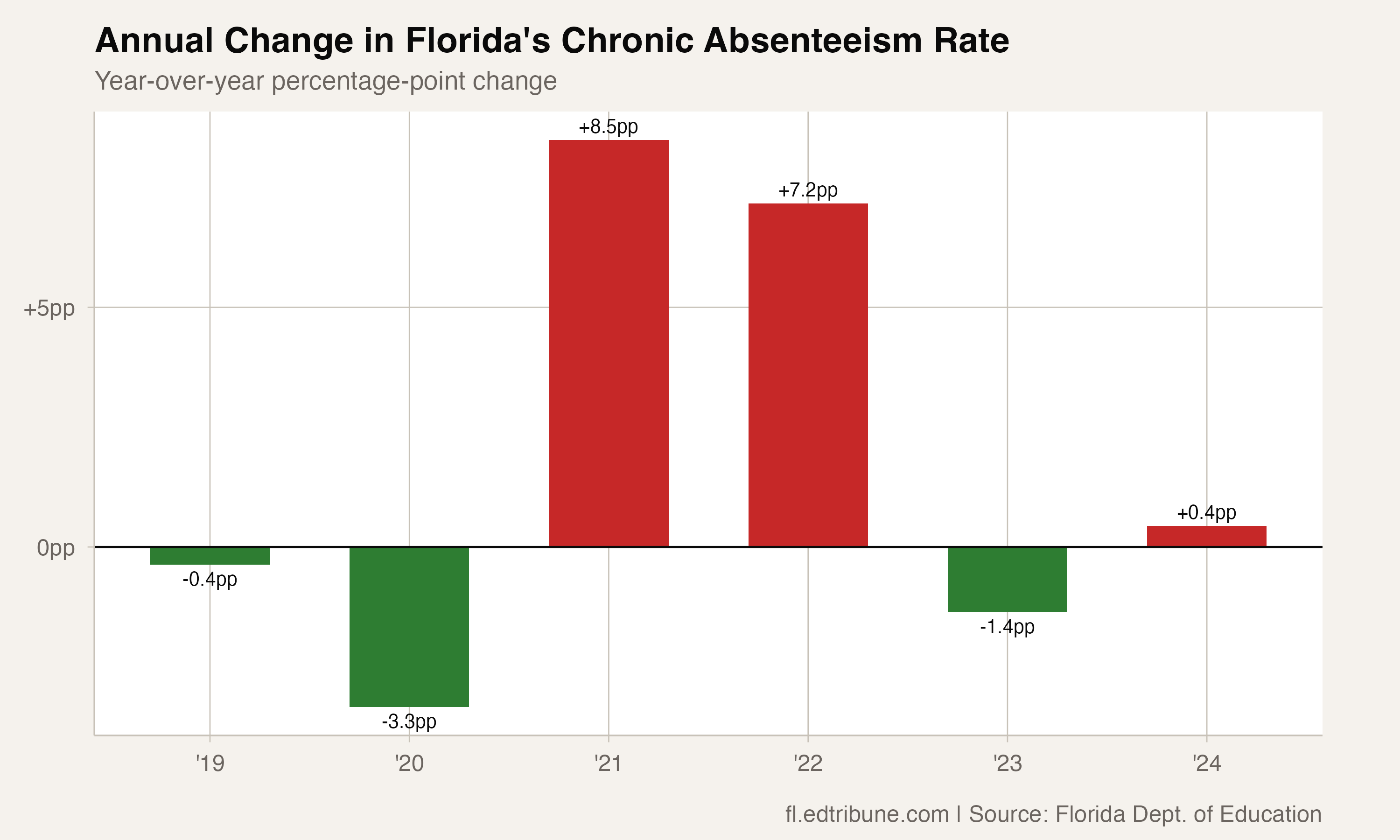
That pattern, a modest dip followed by a re-acceleration, is more troubling than a steady plateau. It suggests the 2022-23 improvement may have captured the easiest recoveries: students whose pandemic-era habits simply needed a push back toward normalcy. What remains are students with entrenched barriers — housing instability, unmet mental health needs, transportation gaps, fractured relationships with schools — that a single attendance letter cannot solve.
The arithmetic of a generation
The math is bleak. From the 2022 peak of 32.3% to the current 31.4%, Florida has recovered 0.9 percentage points. The gap back to the pre-COVID rate of 20.0% is 11.4 points. A simple linear projection from the three post-peak years — the only trajectory the data supports — puts the return to pre-COVID levels at roughly 2048, a quarter-century from now.
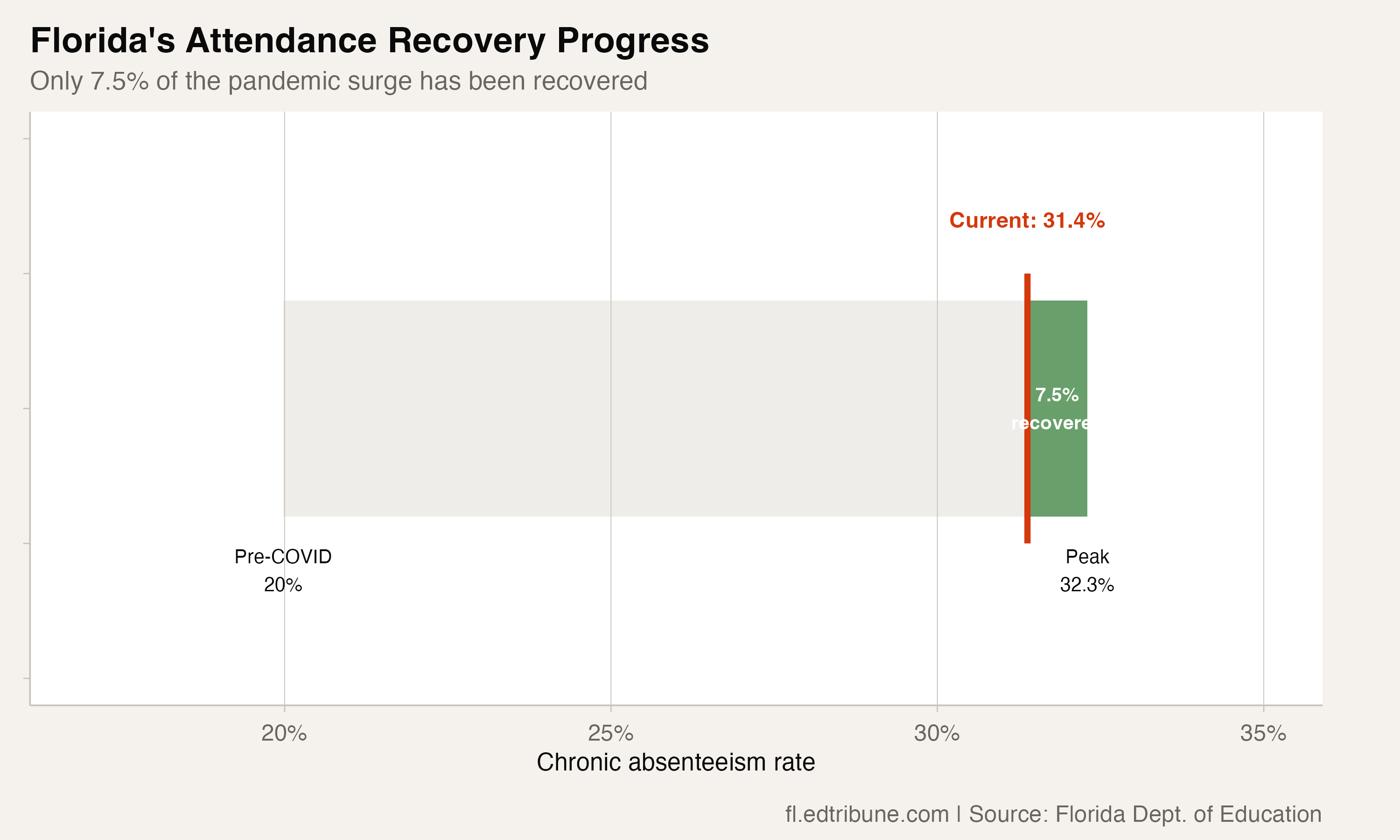
That projection is deliberately crude, and the state's leaders would rightly object that it assumes nothing changes. But the point is not the exact year. The point is the scale of the problem: Florida is so far from its pre-pandemic attendance baseline that even sustained, annual improvement would take many years to close the gap.
Florida ranks third nationally in chronic absenteeism, trailing only Alaska and New Mexico. The state legislature has taken notice: SB 938, filed by Senator Stan McClain, would require teachers to flag students absent 10% or more within the first nine weeks of school, shifting identification from an end-of-year report card to an early warning signal.
976,305 students
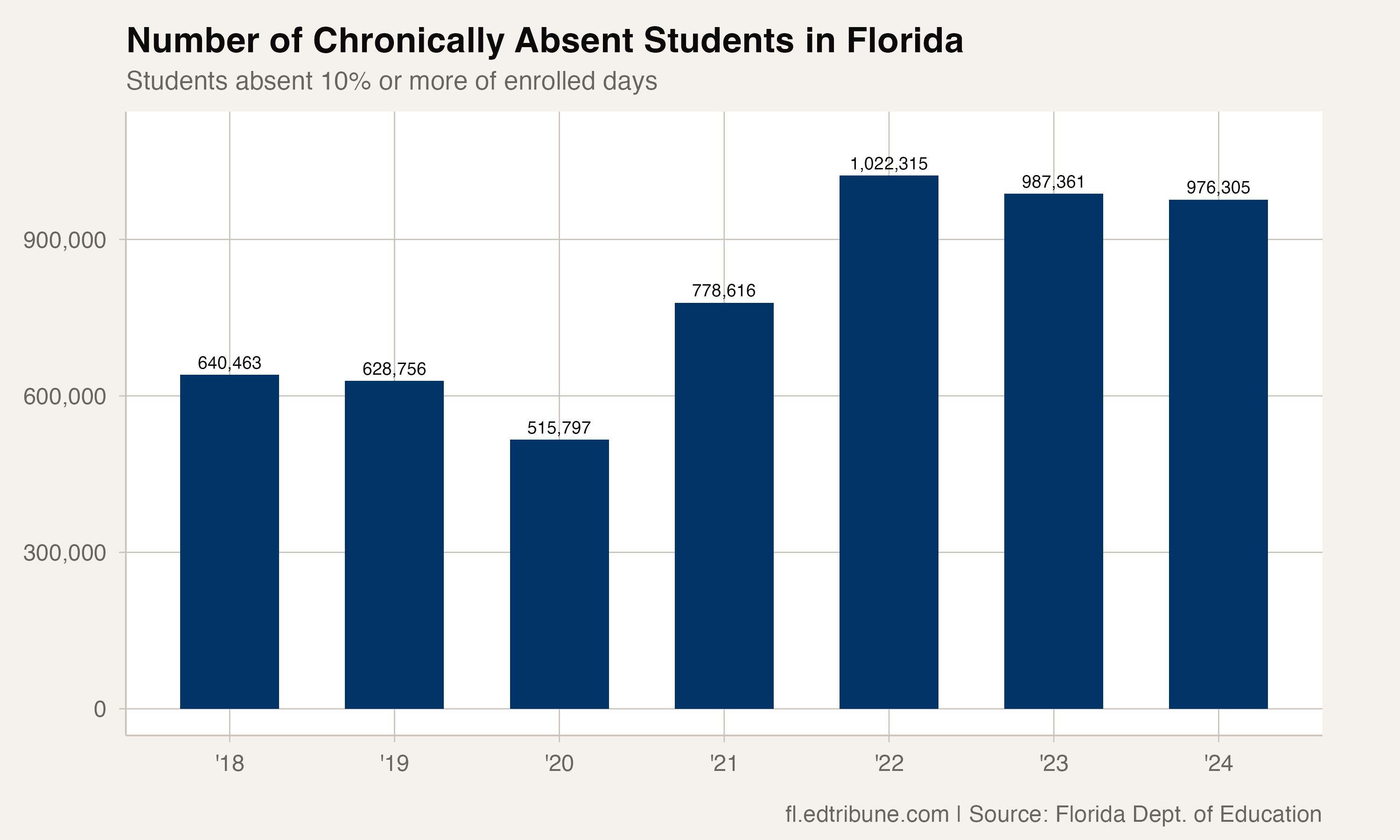
Raw numbers convey what percentages can obscure. In 2023-24, 976,305 Florida students were chronically absent, up from 628,756 in 2018-19. That is 347,549 additional students missing critical instructional time.
Research from Johns Hopkins found that chronic absence in sixth grade predicts dropping out more reliably than test scores. Florida has now run three consecutive school years with chronic rates above 30%. The students who entered sixth grade during the pandemic peak are finishing middle school, carrying cumulative absences that no single intervention year can undo.
The state has one school counselor for every 459 students, nearly double the recommended ratio. SB 938's early-warning mandate could help identify students sooner, but identification was never the bottleneck. Schools know who is missing. The question is what they can do about it with the staff they have.
Detailed code that reproduces the analysis and figures in this article is available exclusively to EdTribune subscribers.
Discussion
Sign in to join the discussion.
Loading comments...